Tripura High Court Disposes of PIL on Illegal Immigration
Source:Indian Express ↗
Why It Matters
The article is highly relevant for GS3 (Border Security) and GS2 (Polity/Judiciary). It provides a concrete example of the limits of PILs in matters of national security and border management, illustrating the practical application of the separation of powers. It also serves as a contemporary reference point for questions on illegal transborder migration in North-East India.
Summary
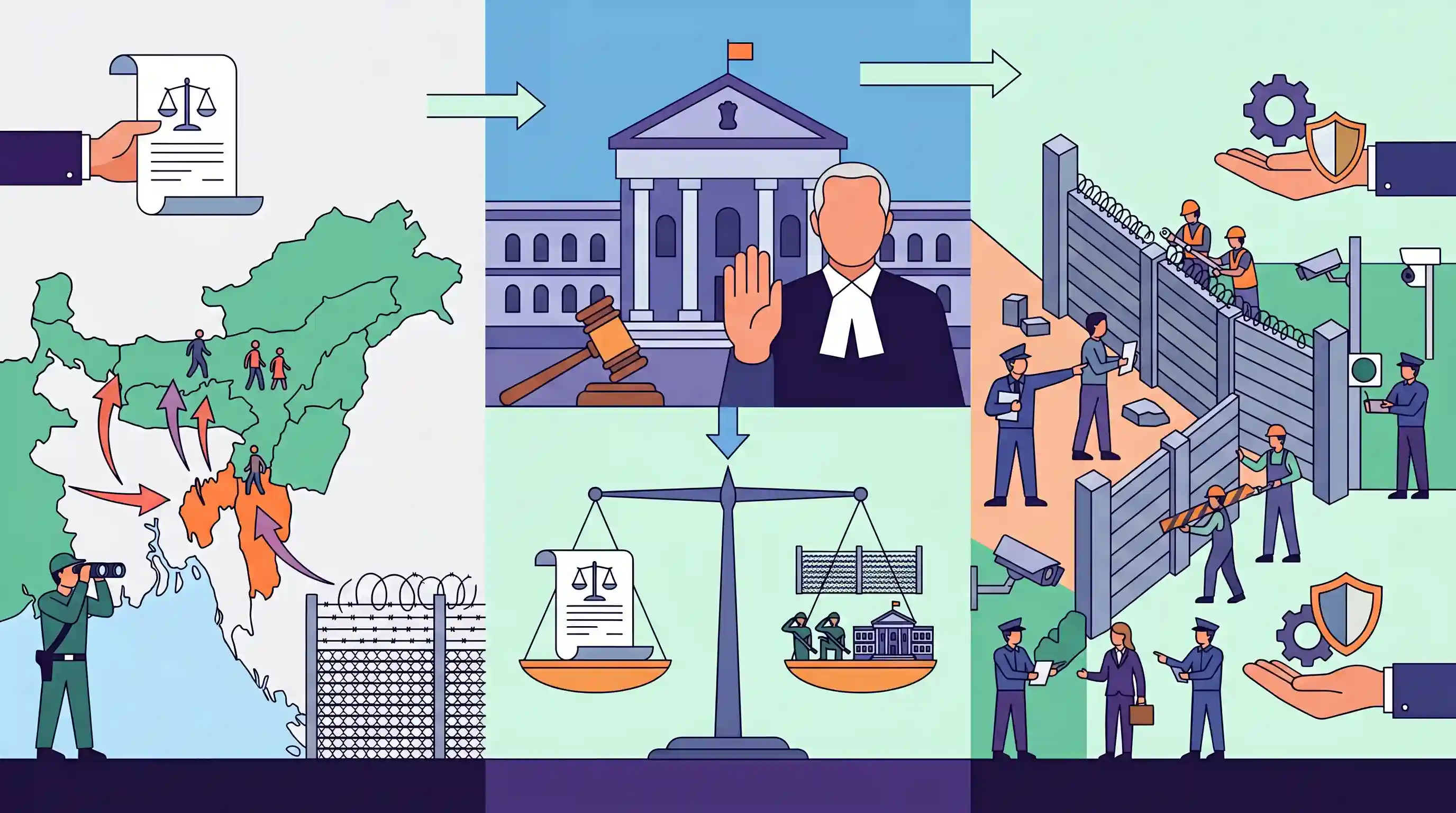
The Tripura High Court recently disposed of a Public Interest Litigation (PIL) that sought judicial directions on the state government's actions to curb illegal immigration. The Court instructed the petitioners to wait, suggesting a deference to the ongoing administrative and executive measures being taken by the government. This highlights both the persistent internal security challenge of trans-border migration in North-East India and the boundaries of judicial intervention in executive policy domains like border management.
Key Points
- The Tripura High Court disposed of a Public Interest Litigation (PIL) concerning the state government's measures to address illegal immigration.
- By advising the petitioners to wait, the Court exercised judicial restraint, implicitly acknowledging that border security and immigration control are primarily executive functions.
- The case underscores the chronic internal security challenges faced by border states like Tripura, which shares a long international boundary with Bangladesh.
- This development highlights the intersection of judicial activism (through PILs) and the doctrine of separation of powers in matters of national security policy.
Important Terms
Tripura High Court

A constitutional court established in 2013 under the North-Eastern Areas (Reorganisation) Act, 1971, exercising jurisdiction over Tripura and protecting fundamental rights through writs under Article 226.
UPSC context
GS Paper 2: Judiciary; specifically relevant for regional judicial administration and legal issues in North-East India.
Public Interest Litigation (PIL)
A legal mechanism allowing any public-spirited individual to approach the court for the protection of public interests, characterized by the relaxation of the traditional 'locus standi' rule.
UPSC context
GS Paper 2: Judiciary/Governance; tests understanding of judicial activism and access to justice for marginalized groups.
Illegal Immigration
The movement of persons across international borders in violation of the immigration laws of the destination country, often involving undocumented entry or overstaying.
UPSC context
GS Paper 3: Internal Security; focuses on demographic challenges, ethnic tensions, and border management in sensitive regions like the North-East.
Border Management
A comprehensive approach to securing national borders, involving the regulation of immigration, prevention of smuggling, and infrastructure development like fencing and sensor-based monitoring.
UPSC context
GS Paper 3: Internal Security; essential for topics on cross-border challenges and national sovereignty.
Separation of Powers
A constitutional doctrine (Article 50) dividing government functions into legislative, executive, and judicial branches to prevent arbitrary power, though in India it follows a system of checks and balances.
UPSC context
GS Paper 2: Constitution/Polity; evaluates the boundaries between judicial oversight and executive policy-making.
Foreigners Tribunal
Quasi-judicial bodies established under the Foreigners (Tribunals) Order, 1964, primarily in Assam, to determine whether a person is a 'foreigner' under the Foreigners Act, 1946.
UPSC context
GS Paper 2: Governance/Judiciary; relevant for administrative laws concerning citizenship and deportation processes.
Prelims Trap
Assam Rifles guards the India-Bangladesh border, and Tripura shares an international boundary with Myanmar.
The Border Security Force (BSF) guards the India-Bangladesh border, not Assam Rifles (Indo-Myanmar). Additionally, Tripura is surrounded by Bangladesh on three sides and does not touch Myanmar.
Static Concepts Connected
Which Central Armed Police Forces (CAPFs) guard India's respective international borders?
- BSF: Guards the India-Pakistan and India-Bangladesh borders, handling challenges like smuggling and illegal immigration.
- ITBP and SSB: ITBP secures the high-altitude Indo-China border, while SSB is deployed along the open Indo-Nepal and Indo-Bhutan borders.
- Assam Rifles: Guards the highly porous Indo-Myanmar border. It uniquely operates under MHA administrative control but Indian Army operational control.
What are the limits of judicial intervention via Public Interest Litigation (PIL)?
- Executive Policy Deference: Courts traditionally exercise restraint and defer to the executive on core policy domains like national security, foreign relations, and border management.
- Separation of Powers: The judiciary cannot usurp legislative or administrative functions. It intervenes in policy primarily if it violates fundamental rights or constitutional mandates, maintaining the separation of powers.
Cross-Topic Patterns
CIBMS & Riverine Border Management
The Comprehensive Integrated Border Management System (CIBMS) addresses gaps in physical fencing across difficult terrains, such as riverine stretches in Assam and Tripura, by utilizing thermal imagers, sensors, and radar.
Demographic shifts and Insurgency
Unchecked cross-border migration alters regional demography and strains local resources, historically acting as a major catalyst for socio-political unrest, ethnic friction, and insurgent recruitment across Northeast India.

Expect a 2026 prelims question pairing border geography (states touching Bangladesh) with specific guarding CAPFs and CIBMS deployment.
Linked PYQs · 4
Linked PYQs · 4
- 2014MainsGS3
How does illegal transborder migration pose a threat to India's security? Discuss the strategies to curb this, bringing out the factors which give impetus to such migration.
- 2019MainsGS3
Cross-border movement of insurgents is only one of the several security challenges facing the policing of the border in North-East India. Examine the various challenges currently emanating across the India-Myanmar border. Also, discuss the steps to counter the challenges.
- 2020MainsGS2
Judicial Legislation is antithetical to the doctrine of separation of powers as envisaged in the Indian Constitution. In this context justify the filing of large number of public interest petitions praying for issuing guidelines to executive authorities.
- 2024MainsGS2
Explain the reasons for the growth of public interest litigation in India. As a result of it, has the Indian Supreme Court emerged as the world's most powerful judiciary ?
