Tripura healthcare infrastructure and private hospital land lease
Source:Indian Express ↗
Why It Matters
The article serves as a strong case study for GS2 (Issues relating to Health) and GS3 (Infrastructure, PPP). It highlights the practical dilemmas states face in balancing the need for rapid healthcare infrastructure development through private capital against the risks of healthcare marketisation and ensuring affordable access.
Summary
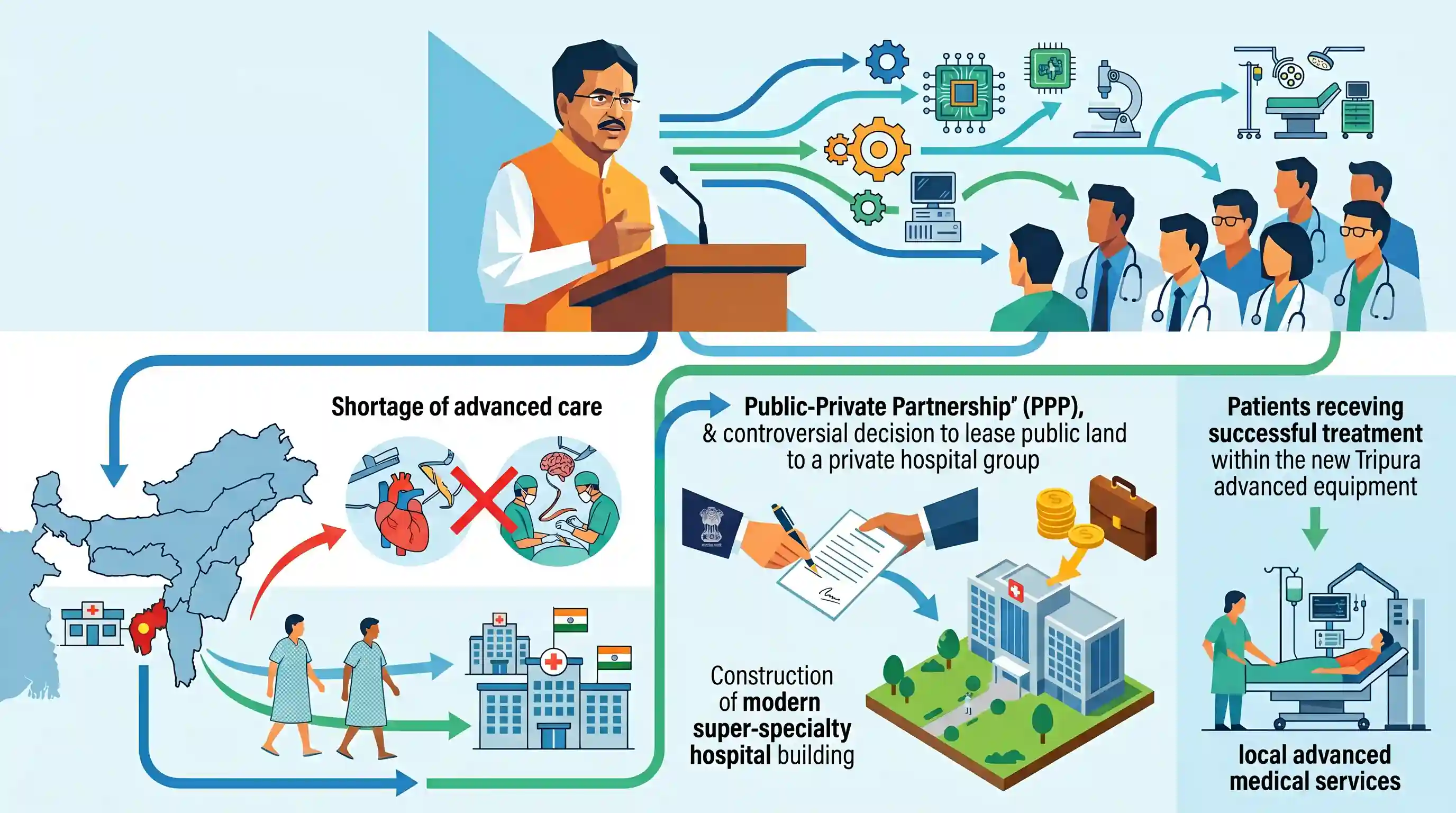
Tripura Chief Minister Manik Saha has urged doctors to engage in continuous medical education to keep pace with evolving medical technologies. In the same address, he defended the state government's controversial decision to lease out public land to a private hospital group. Highlighting the severe deficit of super-specialty healthcare facilities in Tripura, the CM argued that leveraging private investment is essential to provide advanced medical services locally and prevent patients from having to travel to other states for complex treatments. This development underscores the ongoing debate over the marketisation of healthcare and the use of Public-Private Partnerships (PPP) to bridge public infrastructure gaps.
Key Points
- Tripura CM Manik Saha underscored the necessity for medical professionals to continuously upgrade their skills and stay updated with modern technological advancements.
- He strongly defended the state government's decision to lease out land to a private hospital group, framing it as a necessary step to develop super-specialty healthcare infrastructure.
- The initiative aims to curb the outflow of patients who currently have to travel to other states to access advanced medical treatments.
- The development highlights the growing reliance on Public-Private Partnerships (PPP) to address healthcare infrastructure deficits in tier-2 states and the Northeast region.
Prelims Trap
Public Health and hospitals fall under the Concurrent List, requiring Union approval for PPPs.
Public health, sanitation, and hospitals fall squarely under the State List (Entry 6) of the 7th Schedule, giving states autonomy over local PPPs.
Static Concepts Connected
What are the common PPP models applicable to social infrastructure like healthcare?
- Build-Operate-Transfer (BOT): The private partner builds and operates the facility to recover costs before transferring ownership back to the government.
- Design-Build-Finance-Operate (DBFO): The private sector takes on the entire lifecycle under a long-term lease, often used when government provides land.
- Viability Gap Funding (VGF): The government provides a one-time capital grant to make economically essential but financially unviable projects attractive to private players.
What is Out-of-Pocket Expenditure (OOPE) in healthcare?
- Definition: Direct payments made by individuals to healthcare providers at the time of service, outside of any insurance or pre-payment scheme.
- Current Status: India's OOPE remains disproportionately high (approx. 47% of total health expenditure), which frequently drives vulnerable households into poverty.
- Impact of PPPs: Increased privatization without robust fee regulation can exacerbate OOPE, making public health insurance schemes like Ayushman Bharat (PM-JAY) critical.
Cross-Topic Patterns
Northeast Healthcare & Act East Policy
Upgrading medical infrastructure in Tripura not only curtails outbound distress migration but positions the state as a potential medical tourism destination for neighboring Bangladesh under the Act East framework.
Land Monetization for Social Infrastructure
State governments are increasingly using public land leasing as a proxy for capital subsidy (VGF alternative) to attract private healthcare investors into underserved Tier-2 and Tier-3 geographies.

Mains GS-2 will likely feature a question evaluating the socio-economic risks of PPPs in super-specialty healthcare vs primary care.
Linked PYQs · 4
Linked PYQs · 4
- 2015MainsGS2
Public health system has limitations in providing universal health coverage. Do you think that the private sector could help in bridging the gap? What other viable alternatives would you suggest?
- 2024MainsGS2
In a crucial domain like the public healthcare system the Indian State should play a vital role to contain the adverse impact of marketisation of the system. Suggest some measures through which the State can enhance the reach of public healthcare at the grassroots level.
- 2013MainsGS3
Adoption of PPP model for infrastructure development of the country has not been free of criticism. Critically discuss pros and cons of the model.
- 2021MainsGS2
“Besides being a moral imperative of a Welfare State, primary health structure is a necessary precondition for sustainable development.” Analyze.
