Implementation of New Criminal Laws in India
Source:Indian Express ↗
Why It Matters
Provides concrete administrative examples of how the new criminal codes (BNS, BNSS, BSA) operationalize e-governance, transparency, and victim rights. It is crucial for GS-2 answers evaluating recent institutional reforms, the application of technology in justice delivery, and measures for gender justice.
Summary
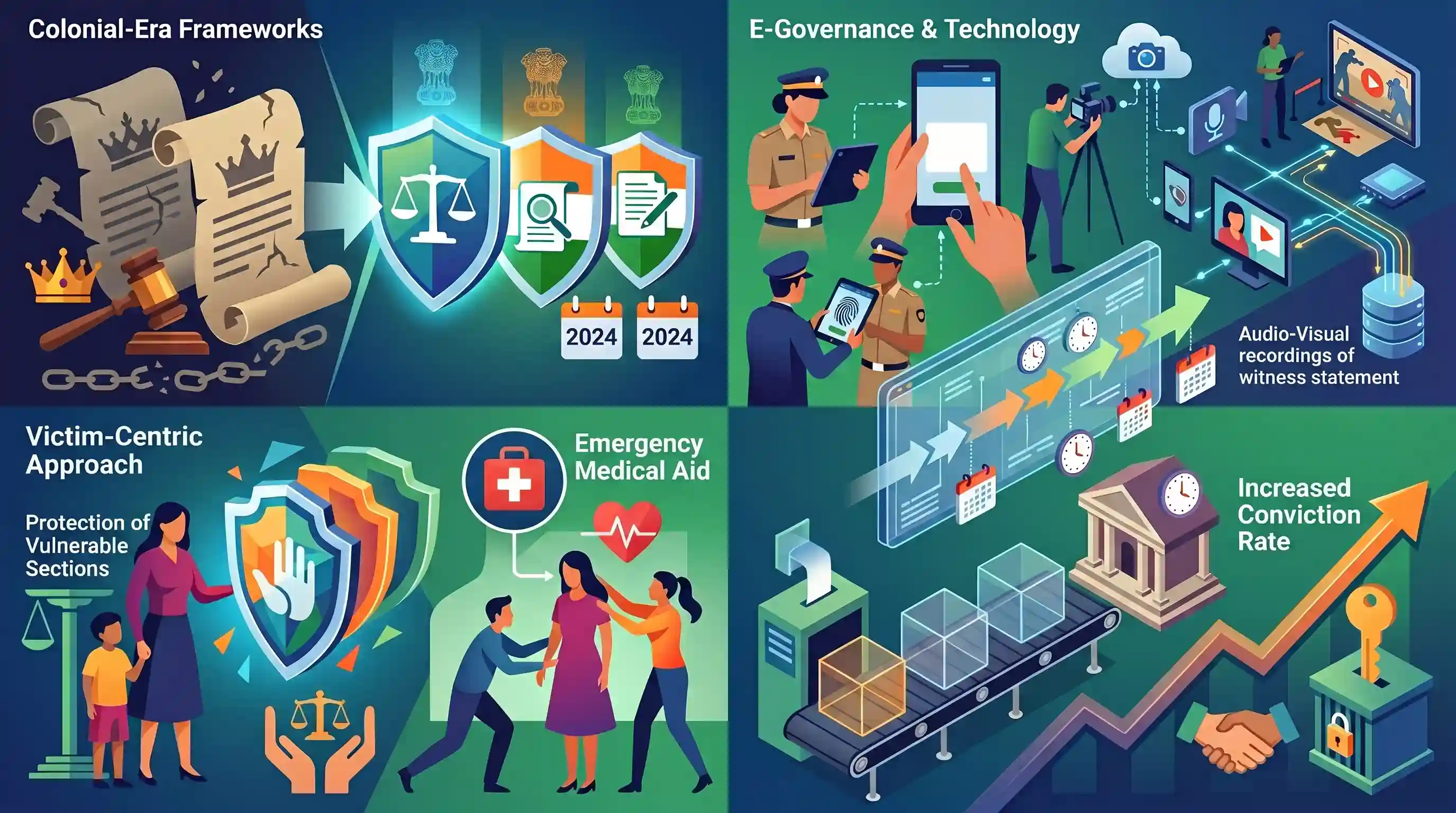
Tripura Chief Minister Manik Saha highlighted the transformative impact of India's three new criminal laws—Bharatiya Nyaya Sanhita (BNS), Bharatiya Nagarik Suraksha Sanhita (BNSS), and Bharatiya Sakshya Adhiniyam (BSA). He emphasized that the laws replace colonial-era frameworks with a modernized, victim-centric approach. Significant technological interventions, such as e-FIRs and mandatory audio-visual recording of crime scenes and statements, aim to enhance transparency and accountability. The new legislation also incorporates strict procedural timelines to reduce delays and mandates enhanced protections for women and children, including guaranteed free emergency medical aid. These reforms collectively intend to improve the conviction rate and streamline the criminal justice system.
Key Points
- The new criminal laws (BNS, BNSS, BSA) mark a paradigm shift towards a victim-friendly, technology-driven, and time-bound justice delivery system in India.
- Technological integration is prioritized through features like e-FIRs (enabling crime reporting from anywhere), audio-video recordings of search/seizure, and digital evidence collection by forensic experts.
- Women and child protection is strengthened by mandating free emergency medical treatment for victims across all hospitals and ensuring female magistrates record statements in sexual assault cases.
- Strict procedural timelines are enforced, including updating victims on investigations every 90 days, providing case documents within 14 days, and mandating medical/forensic reports within 7 days.
- Restorative justice elements, such as community service for minor offences, have been introduced to reduce judicial burden and focus on improving conviction rates for serious crimes.
Important Terms
Bharatiya Nyaya Sanhita (BNS)

The official criminal code of India, replacing the 1860 Indian Penal Code. It defines offenses and prescribes punishments, prioritizing justice and victim protection over colonial-era punitive deterrence.
UPSC context
GS Paper II: Governance/Criminal Justice. Tests understanding of substantive legal reforms, new offenses like terrorism, and shift toward corrective justice.
Bharatiya Nagarik Suraksha Sanhita (BNSS)
The procedural law governing criminal investigation, arrest, and trial in India, replacing the 1973 CrPC. It introduces mandatory forensics and strict timelines for legal proceedings.
UPSC context
GS Paper II: Governance/Judiciary. Tests knowledge of procedural efficiency, rights of the accused versus state power, and technology-driven administration.
Bharatiya Sakshya Adhiniyam (BSA)
India's new law governing the admissibility of evidence, replacing the 1872 Indian Evidence Act. It modernizes the legal framework by equating digital/electronic records with primary physical evidence.
UPSC context
GS Paper II & III: Technology/Law. Tests understanding of digital evidence admissibility and the impact of technology on judicial transparency.
Zero FIR
A First Information Report registered at any police station regardless of jurisdiction. It is then transferred to the relevant station for investigation, preventing delays in urgent cases.
UPSC context
GS Paper II: Citizen-centric governance. Tests knowledge of procedural mechanisms that enhance accessibility to justice and reduce police apathy.
e-FIR
A First Information Report filed electronically via digital communication. Under BNSS Section 173, it must be signed by the complainant within three days to be officially recorded.
UPSC context
GS Paper II: E-Governance. Tests understanding of how digitalization simplifies crime reporting and increases police accountability through electronic trails.
Community Service
A non-custodial punishment introduced for petty crimes in the BNS. It requires offenders to perform unpaid work for the benefit of the community, emphasizing reformative justice.
UPSC context
GS Paper II: Social Justice/Governance. Tests knowledge of shifts from punitive to reformative justice models in India's penal system.
Prelims Trap
"The BNSS introduces community service as a new punishment."
Community service is a substantive punishment added to the Bharatiya Nyaya Sanhita (BNS), replacing the IPC. The BNSS handles procedure, not penalties.
Static Concepts Connected
How does the Right to Speedy Trial fit into the Constitution?
- Fundamental Right: Implicitly guaranteed under Article 21 (Right to Life and Personal Liberty), as established by the Supreme Court in the landmark Hussainara Khatoon case.
- Statutory Execution: The new BNSS operationalizes this fundamental right by legally enforcing strict procedural timelines for investigations, forensics, document supply, and judgments.
What is Restorative vs. Retributive Justice?
- Retributive Justice: Focuses strictly on punishing the offender in proportion to the crime committed, which was the typical approach of traditional colonial penal codes.
- Restorative Justice: Prioritizes repairing the harm caused to victims and society. The new BNS incorporates this philosophy by formally introducing community service for minor offences.
Cross-Topic Patterns
E-FIRs and ICJS Integration
The mandate for e-FIRs and digital evidence under BSA and BNSS heavily relies on the Inter-operable Criminal Justice System (ICJS) and CCTNS digital infrastructure to function effectively nationwide.
Emergency Aid and Article 21
Mandating free emergency medical aid for victims across all hospitals formally codifies the SC’s Parmanand Katara ruling that immediate medical assistance is an absolute obligation under Article 21.

Expect a multi-statement Prelims question testing the precise statutory timelines (e.g., 90-day victim updates) and new digital mandates.
Linked PYQs · 3
Linked PYQs · 3
- 2023MainsGS2
e-governance, as a critical tool of governance, has ushered in effectiveness, transparency and accountability in governments. What inadequacies hamper the enhancement of these features ?
- 2024MainsGS2
e-governance is not just about the routine application of digital technology in service delivery process. It is as much about multifarious interactions for ensuring transparency and accountability. In this context evaluate the role of the 'Interactive Service Model' of e-governance.
- 2023MainsGS2
Explain the constitutional perspectives of Gender Justice with the help of relevant Constitutional Provisions and case laws.
