West Bengal Assembly Elections: Governance and Electoral Shift
Source:The Hindu ↗
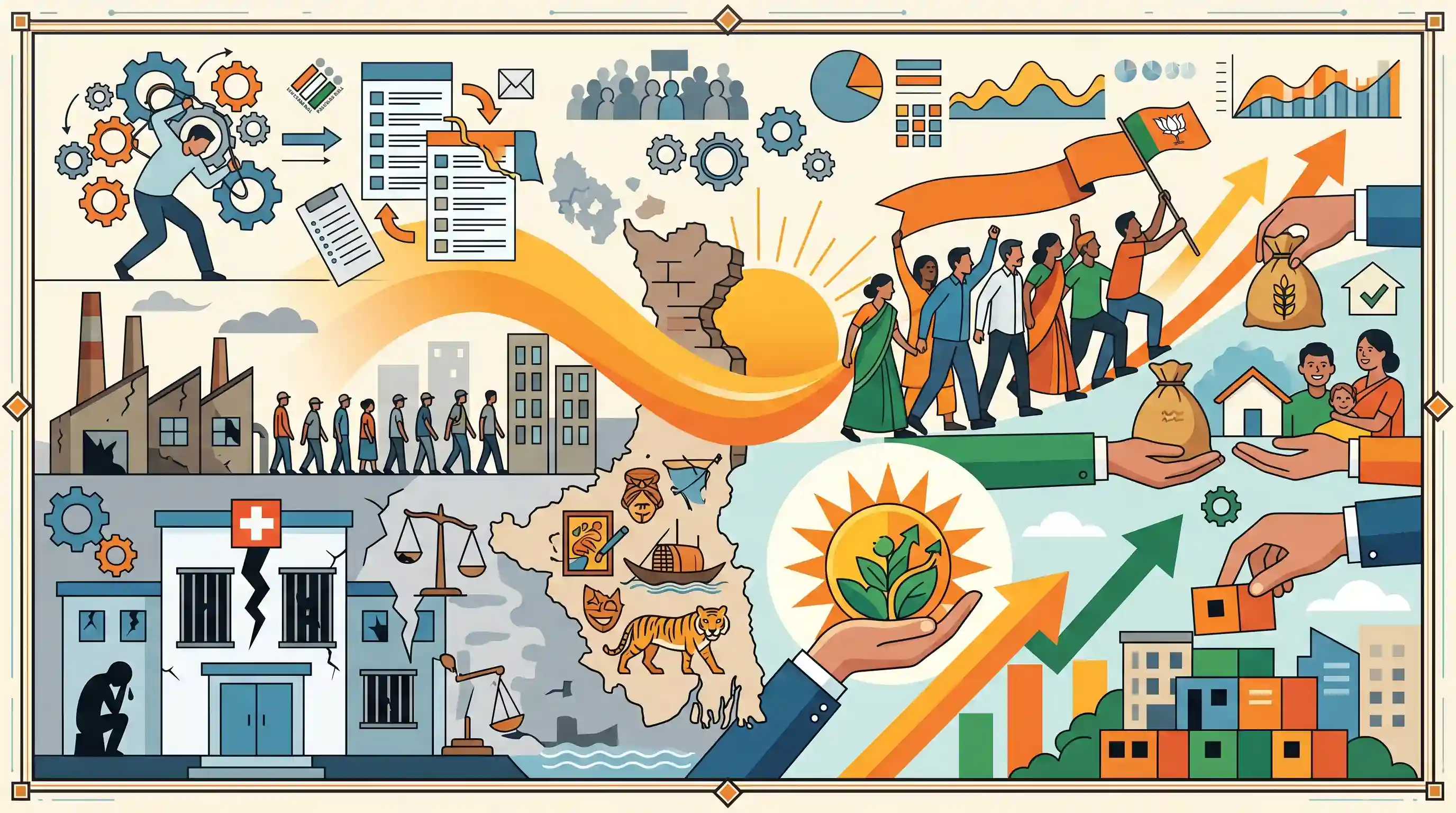
Why It Matters
The article provides critical insights into the real-world impact of the Election Commission's administrative actions (like electoral roll revisions) on democratic processes. It also highlights the growing influence of socio-economic factors—such as women's safety, employment, and industrial development—over identity politics and regional sub-nationalism in shaping electoral outcomes.
Summary
The article analyzes the political transformation in West Bengal following the BJP's decisive victory over the incumbent Trinamool Congress (TMC) in the 2026 Assembly elections. The TMC's defeat is attributed to a multifaceted crisis: mismanagement of its response to the Election Commission's special intensive revision (SIR) of electoral rolls, failure to address deep-seated economic issues like unemployment and industrial flight, and widespread public outrage over crimes against women, notably the R.G. Kar Hospital incident. Furthermore, the TMC's strategy of leveraging Bengali sub-nationalism proved ineffective against the BJP's cohesive campaign and promises of expanded welfare, marking a significant shift in regional electoral dynamics.
Key Points
- The BJP secured a landslide victory in the 2026 West Bengal Assembly elections, winning or leading in 208 out of 294 seats and defeating the incumbent TMC.
- The TMC's campaign suffered by overly focusing on protests against the Election Commission's special intensive revision (SIR) of electoral rolls, which had deleted 12% of voter names.
- Public anger over crimes against women, particularly the 2024 rape and murder at R.G. Kar Hospital, heavily influenced voter sentiment against the ruling party.
- Economic stagnation, unemployment, corruption (such as the teachers' recruitment scam), and industrial flight eclipsed the appeal of the TMC's welfare schemes.
- The TMC's reliance on Bengali sub-nationalism to portray the BJP as an 'outsider party' failed to resonate with the electorate.
Important Terms
Special Intensive Revision (SIR) of electoral rolls

A comprehensive house-to-house voter verification exercise by the Election Commission to correct systemic roll anomalies, remove ineligible entries, and add new voters ahead of major elections.
UPSC context
GS II: Electoral Reforms. Tests knowledge of ECI’s administrative tools for maintaining electoral rolls and ensuring free and fair elections.
Election Commission of India (ECI)
An autonomous constitutional body established under Article 324 to superintend, direct, and control the entire process for conducting elections to Parliament and State Legislatures.
UPSC context
GS II: Constitutional Bodies. Fundamental for understanding the institutional framework of Indian democracy and its role in managing electoral integrity.
Sub-nationalism
The assertion of regional, linguistic, or cultural identity as a primary political interest, often used by regional parties to mobilize support against perceived national imposition.
UPSC context
GS I: Regionalism. Relevant for analyzing identity politics, federalism, and the tension between regional aspirations and national integration.
Representation of the People Act (RPA), 1950
A statutory framework providing for the allocation of seats, delimitation of constituencies, and the registration of electors for the preparation and revision of electoral rolls.
UPSC context
GS II: Salient features of the RPA. Essential for understanding the legal basis of voter registration and electoral roll management.
Electoral Integrity
The adherence to democratic principles and legal standards throughout the election cycle, ensuring that voter lists are accurate and the voting process is transparent.
UPSC context
GS II: Governance/Electoral Reforms. Tests ability to evaluate the quality of democratic processes and effectiveness of institutional interventions.
Prelims Trap
Special Intensive Revision (SIR) of electoral rolls is conducted by the ECI under the Representation of the People Act, 1951.
Preparation and revision of electoral rolls, including Special Intensive Revisions, are governed by the Representation of the People Act, 1950, not 1951.
Static Concepts Connected
What distinguishes Special Intensive Revision (SIR) from routine electoral roll revisions?
- Legal Backing: Ordered by ECI under Article 324 and Section 21(3) of RPA 1950 when existing rolls are severely flawed.
- Process Difference: Involves comprehensive, house-to-house enumeration to verify voters, unlike summary revisions that rely primarily on voluntary claims and objections.
- Primary Objective: Aims to aggressively purge deceased, duplicate, or ineligible voters (as seen with the 12% deletion in WB) to purify the mandate.
How does Regionalism manifest in state-level electoral politics?
- Sons of the Soil: Mobilizing voters using sub-national linguistic or cultural pride to frame national parties as 'outsiders'.
- Economic Triggers: Often triggered by real or perceived grievances regarding unemployment, industrial flight, and uneven development.
- Limits of Identity: Regional identity mobilization frequently fails if systemic governance failures (corruption, crime) eclipse cultural sentiments.
Cross-Topic Patterns
Electoral Rolls & Right to Vote
Mass voter deletions via SIR intersect with constitutional debates on the Right to Vote (Article 326) and ECI's administrative overreach during elections.
Gender Violence & Law and Order
The R.G. Kar incident links state police accountability (State List) with broader civil society movements demanding institutional gender justice and safe workplaces.

Expect a 2026 Prelims trap swapping RPA 1950 (electoral rolls) with RPA 1951 (conduct of elections) in the context of ECI's SIR powers.
Linked PYQs · 5
Linked PYQs · 5
- 2022MainsGS2
Discuss the role of the Election Commission of India in the light of the evolution of the Model Code of Conduct.
- 2017MainsGS2
To enhance the quality of democracy in India the Election Commission of India has proposed electoral reforms in 2016. What are the suggested reforms and how far are they significant to make democracy successful?
- 2016MainsGS1
What is the basis of regionalism? Is it that unequal distribution of benefits of development on regional basis eventually promotes regionalism? Substantiate your answer.
- 2022MainsGS3
Economic growth in the recent past has been led by increase in labour productivity." Explain this statement. Suggest the growth pattern that will lead to creation of more jobs without compromising labour productivity.
- 2023MainsGS2
Explain the constitutional perspectives of Gender Justice with the help of relevant Constitutional Provisions and case laws.
