Evolution of National Flag Flying Rights as Fundamental Liberty
Source:Indian Express ↗
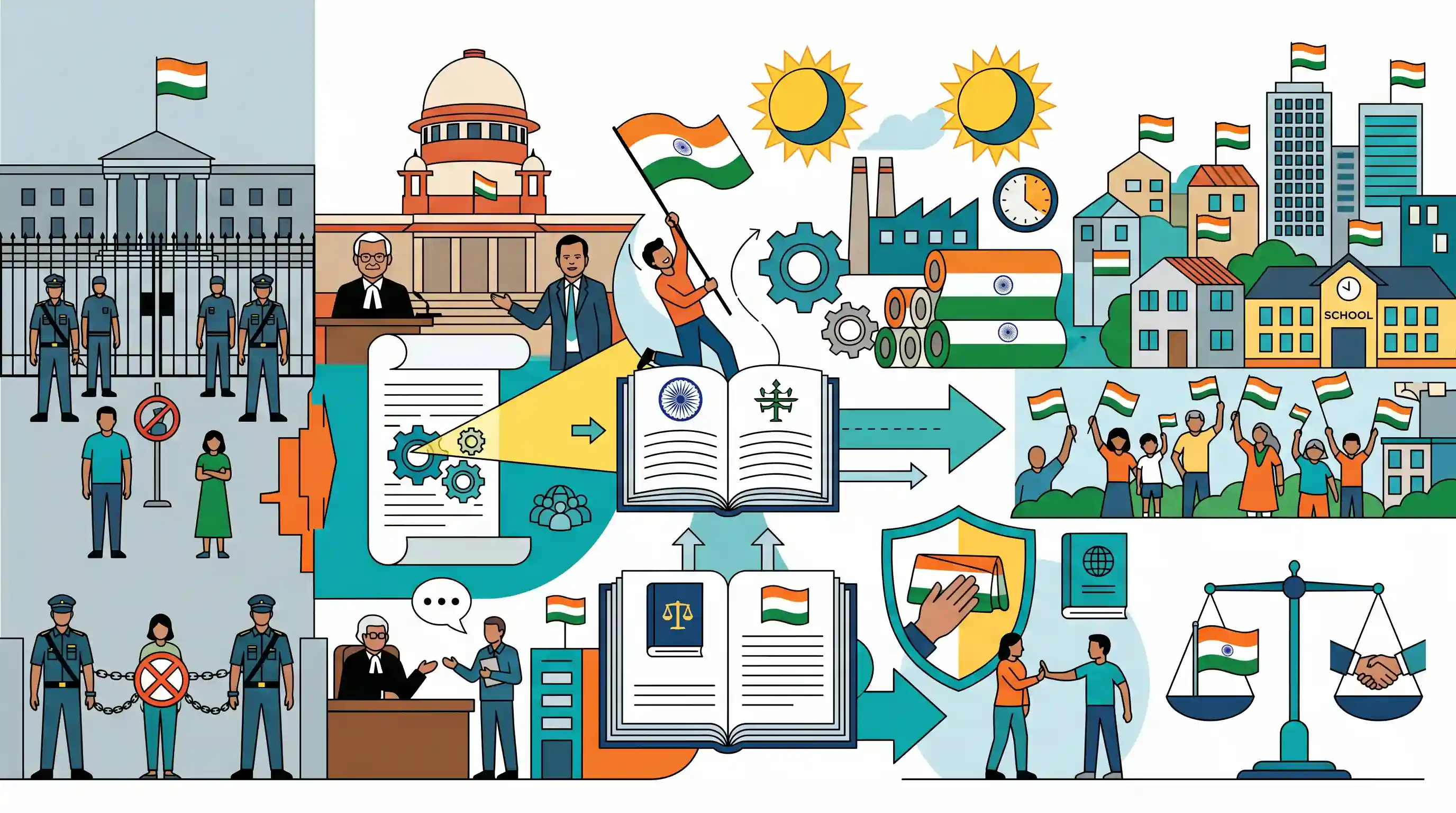
Why It Matters
The evolution of the Flag Code is highly relevant to UPSC Polity, specifically touching on the interpretation of Fundamental Rights (Article 19) and Fundamental Duties (Article 51A). The Supreme Court's role in expanding freedom of speech and expression to include non-verbal symbols like the national flag showcases judicial activism in securing democratic participation. The topic bridges historical rights discourse with contemporary mass campaigns ('Har Ghar Tiranga'), serving as a potent example of how statutory guidelines shape civic identity.
Summary
The article outlines the evolution of citizens' rights to hoist the Indian National Flag, highlighting its journey from a heavily restricted symbol to a widely accessible emblem of democracy. Central to this shift was Naveen Jindal's legal battle, leading to the 2004 Supreme Court ruling that recognized flying the Tricolour as a fundamental right under Article 19(1)(a). Subsequent revisions to the Flag Code of India, 2002, particularly the recent amendments allowing machine-made flags and round-the-clock hoisting, laid the groundwork for the 'Har Ghar Tiranga' campaign. This trajectory illustrates the democratization of national symbols, bridging the gap between state protocol and citizens' patriotic expression, while maintaining the flag's dignity through constitutional duties and the Prevention of Insults to National Honour Act.
Key Points
- The article traces the democratization of flying the Indian Tricolour, evolving from strict restrictions to an accessible fundamental right.
- Naveen Jindal\'s 1990s legal battle culminated in the landmark 2004 Supreme Court ruling (Union of India v. Naveen Jindal), which declared flying the National Flag freely with respect and dignity a fundamental right under Article 19(1)(a) (freedom of speech and expression).
- The Flag Code of India, 2002 relaxed restrictions, and subsequent amendments (2021-2022) allowed for polyester/machine-made flags and round-the-clock hoisting.
- This legal evolution paved the way for mass participatory campaigns like \'Har Ghar Tiranga\', strengthening the connection between citizens and democratic symbols while ensuring adherence to the Prevention of Insults to National Honour Act, 1971.
Important Terms
Flag Code of India, 2002

A consolidated set of guidelines and laws governing the use, display, and hoisting of the Indian National Flag. Recent amendments (2021-22) allowed machine-made polyester flags and 24/7 display.
UPSC context
GS Paper 2: Governance/Constitutional Provisions. Tests knowledge of the legal-executive framework regulating national symbols and recent patriotic campaigns.
Article 19(1)(a)
Constitutional provision guaranteeing freedom of speech and expression. The Supreme Court interpreted this to include flying the National Flag as a non-verbal symbolic expression of one's patriotism and allegiance.
UPSC context
GS Paper 2: Fundamental Rights. Tests the ability to link constitutional clauses with evolving judicial interpretations and civil liberties.
Prevention of Insults to National Honour Act, 1971
A penal statute prohibiting the desecration of national symbols. It criminalizes burning, mutilating, or showing disrespect to the National Flag, the Constitution, or the National Anthem in public view.
UPSC context
GS Paper 2: Important Acts. Tests understanding of legal safeguards intended to protect the sanctity and dignity of India's sovereign symbols.
Union of India v. Naveen Jindal (2004)
A landmark Supreme Court judgment that declared the right of every citizen to fly the National Flag with dignity as a fundamental right under Article 19(1)(a).
UPSC context
GS Paper 2: Judiciary. Tests awareness of seminal case laws that have democratized state symbols and expanded citizen rights.
Har Ghar Tiranga Campaign
A mass initiative launched in 2022 under 'Azadi Ka Amrit Mahotsav' to encourage citizens to hoist the Tricolour at homes, transitioning the flag from a formal to a personal symbol.
UPSC context
GS Paper 2: Governance/Participation. Evaluates understanding of government efforts to foster civic nationalism and their subsequent impact on legal amendments.
Fundamental Duties (Article 51A)
Constitutional obligations (Article 51A) for citizens, specifically Clause (a) which mandates respect for the Constitution, National Flag, and National Anthem as a prerequisite for exercising rights.
UPSC context
GS Paper 2: Polity. Tests the conceptual understanding of the balance between individual liberties and responsibilities toward the nation-state.
Prelims Trap
The Constitution of India explicitly guarantees the right to fly the National Flag.
The right is not explicitly written. It is an implied fundamental right derived from Article 19(1)(a) by the Supreme Court in 2004.
Static Concepts Connected
What is the legal framework governing the Indian National Flag?
- Emblems and Names Act, 1950: Restricts the unauthorized commercial or professional use of the flag and other official emblems.
- Prevention of Insults Act, 1971: Provides statutory backing to penalize intentional disrespect, burning, or defacing of the flag in public.
- Flag Code of India, 2002: A set of executive instructions/guidelines (not a statute) detailing conventions for displaying the flag by public and private bodies.
How does the Constitution balance rights and duties regarding national symbols?
- Article 19(1)(a): Includes the implicit right of a citizen to fly the National Flag freely with respect and dignity.
- Article 51A(a): Explicitly mandates that it is the Fundamental Duty of every citizen to respect the National Flag and Anthem.
- Harmonious Construction: While the duty is non-justiciable, the Supreme Court stressed that the right under Art 19(1)(a) is qualified by the duties under Art 51A.
Cross-Topic Patterns
Expanding scope of Article 19(1)(a)
The Supreme Court has continuously broadened 'speech and expression' beyond spoken words to include flying the national flag (2004), the Right to Information (2005), and access to the Internet (2020).
Statutory enforcement of Fundamental Duties
While Fundamental Duties (Part IVA) are inherently non-justiciable, they are made enforceable through specific parliamentary laws like the 1971 Prevention of Insults Act and the 1972 Wildlife Protection Act.

The interplay between Art 19(1)(a) rights, Art 51A(a) duties, and the non-statutory nature of the Flag Code is a prime 2026 Prelims trap.
Linked PYQs · 3
Linked PYQs · 3
- 2023PrelimsGS1
Consider the following statements in respect of the National Flag of India according to the Flag Code of India, 2002: Statement-I: One of the standard sizes of the National Flag of India is 600 mm x 400 mm. Statement-II: The ratio of the length to the height (width) of the Flag shall be 3:2. Which one of the following is correct in respect of the above statements?
- 2014MainsGS2
What do you understand by the concept "freedom of speech and expression"? Does it cover hate speech also ? Why do the films in India stand on a slightly different plane from other forms of expression ? Discuss.
- 2015PrelimsGS1
"To uphold and protect the Sovereignty, Unity and Integrity of India" is a provision made in the
