Jayaprakash Narayan Legacy and Total Revolution Concept in Polity
Source:The Hindu ↗
ఇది ఎందుకు ముఖ్యం
Jayaprakash Narayan is a towering figure in modern Indian history whose concepts of 'Total Revolution' and defense of civil liberties remain vital study areas for understanding post-independence Indian politics and social reform movements.
సారాంశం
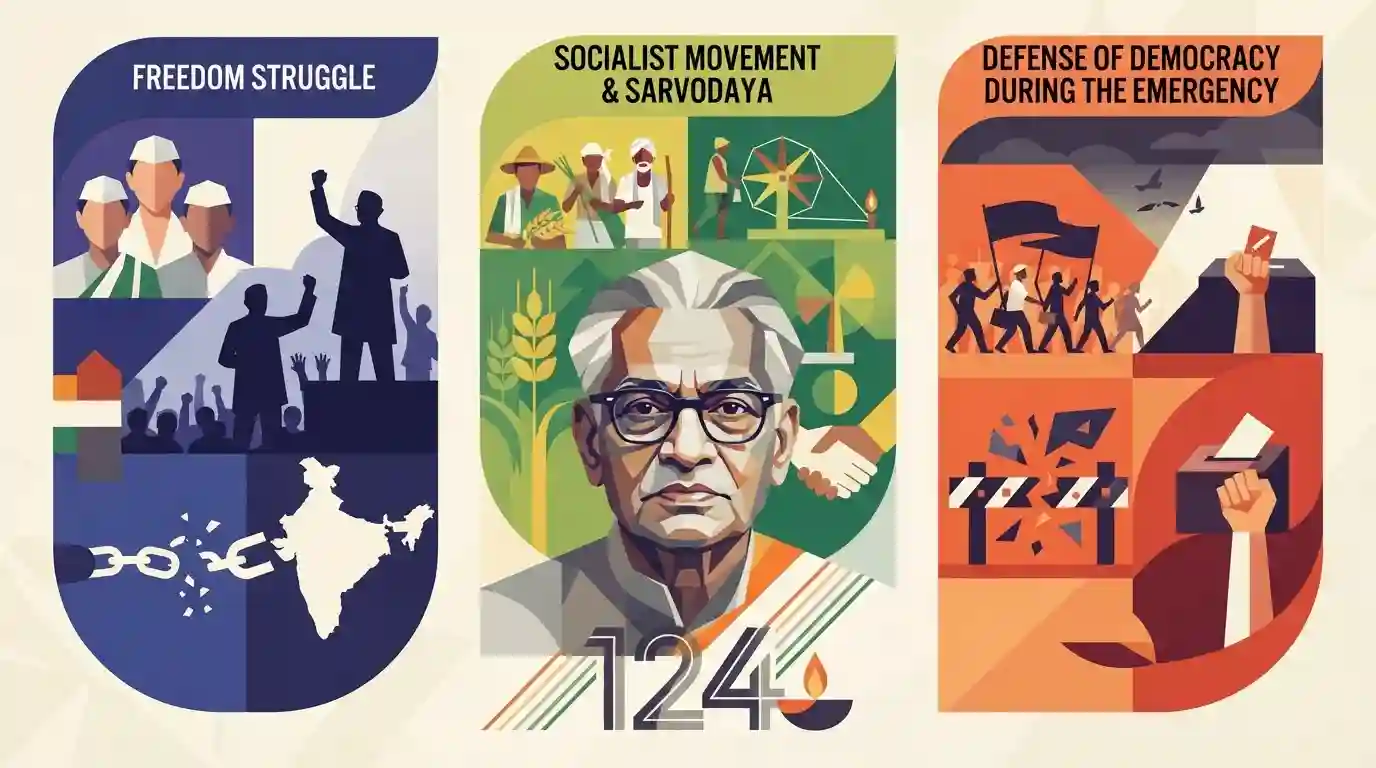
The article marks the 124th birth anniversary of Loknayak Jayaprakash Narayan, highlighting his contributions to India's freedom struggle, socialist movement, and defense of democracy during the Emergency.
ముఖ్య అంశాలు
- Tributes were paid to freedom fighter and social reformer Jayaprakash Narayan on his 124th birth anniversary.
- JP is widely remembered for his call for 'Total Revolution' (Sampoorna Kranti) and his leadership during the 1970s movement against authoritarianism.
- He played a monumental role in Indian politics, advocating for socialist ideals, democratic decentralization, and civil liberties.
ప్రిలిమ్స్ ఉచ్చు
Jayaprakash Narayan advocated for violent armed revolution to overthrow the post-independence state during the 1974 Bihar movement.
Aspirants often confuse JP's 'Total Revolution' with violent armed insurrection; in reality, JP explicitly grounded it in Gandhian non-violence and Sarvodaya principles.
అనుసంధానమైన స్థిర భావనలు
What are the core dimensions of Jayaprakash Narayan's concept of 'Total Revolution' (Sampoorna Kranti)?
- Multi-dimensional Scope: Seven Revolutions: Comprised social, economic, political, cultural, ideological, educational, and spiritual transformations to build an egalitarian society.
- Sarvodaya Root: Non-violent Ideology: Abandoned orthodox Marxism in favor of Gandhian Sarvodaya, Bhoodan movement, and party-less democracy.
- PUCL Foundation: Civil Liberties: Co-founded the People's Union for Civil Liberties (PUCL) in 1976 to defend fundamental rights against authoritarianism.
అంతర-అంశ నమూనాలు
Marxism to Sarvodaya: Evolution of Indian Socialism
JP's transition from Marxism to Sarvodaya mirrors Gandhi's philosophical evolution and provides a comparative lens for post-independence socialist thought in India.
Bihar Movement, Emergency, and Constitutional Resilience
The Bihar movement and 1975 Emergency tested the constitutional limits of executive power, federalism, and judicial review.

JP's 'Sampoorna Kranti' and his co-founding of PUCL are frequently paired in multi-statement questions on post-independence history.
అనుసంధాన PYQలు · 1
అనుసంధాన PYQలు · 1
- 2019MainsGS1
Many voices had strengthened and enriched the nationalist movement during the Gandhian phase. Elaborate.
