Tribunals Reforms Bill and Judicial Independence Issues
Source:Indian Express ↗
Why It Matters
Essential for understanding structural reforms in quasi-judicial bodies, the balance of power between the executive and judiciary, and adherence to Supreme Court guidelines on tribunal appointments.
Summary
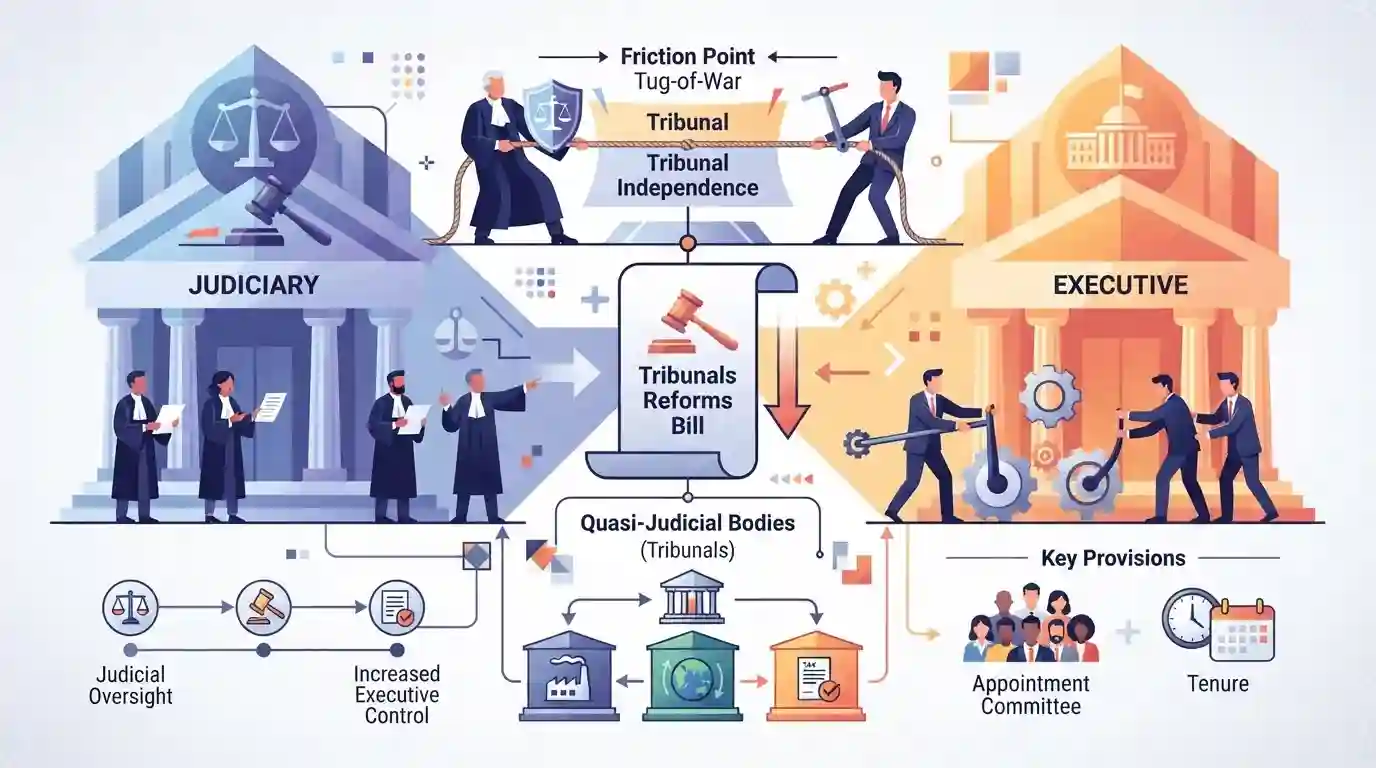
The article examines the Tribunals Reforms Bill, its evolution, key provisions regarding the appointment and tenure of tribunal members, and the ongoing friction between the judiciary and the executive concerning the independence of quasi-judicial bodies.
Key Points
- The Tribunals Reforms Bill relates to the restructuring, service conditions, and functioning of tribunals in India.
- It addresses recurring judicial scrutiny regarding the independence of tribunals and search-cum-selection committees.
- Tribunals are designed to reduce the backlog of ordinary courts, but face concerns over executive overreach and judicial independence.
Important Terms
Tribunals Reforms Bill

A legislative measure enacted to regulate the appointment, tenure, and service conditions of members of various quasi-judicial tribunals in India, often serving as a site of friction between the executive and judiciary regarding judicial independence.
UPSC context
UPSC GS Paper II (Polity and Governance - Separation of Powers, Structure and Functioning of Judiciary). Tests understanding of tribunal governance and judicial independence.
Supreme Court of India
The apex judicial body in India that holds the power of judicial review, ensuring that legislative and executive actions, including tribunal regulations, comply with the Constitution and core principles like separation of powers.
UPSC context
UPSC GS Paper II (Judiciary, Constitutional interpretation). Tests the role of the apex court in maintaining checks and balances against executive overreach.
Parliament
The supreme legislative body of India comprising the President, Lok Sabha, and Rajya Sabha, responsible for enacting laws on matters including tribunal administration and judicial structures.
UPSC context
UPSC GS Paper II (Parliament and State Legislatures - Structure, Functioning, and Conduct of Business). Tests legislative competence and law-making dynamics.
Static Concepts Connected
What are the constitutional provisions and key judicial rulings regarding tribunals in India?
- Constitutional Basis: Article 323A deals with administrative tribunals for public service matters, while Article 323B covers tribunals for other specified matters like taxation and industrial disputes.
- Amendment Origin: Added by the 42nd Constitutional Amendment Act, 1976, Parliament is empowered to establish these quasi-judicial bodies to reduce the burden on regular courts.
- Judicial Scrutiny: In Madras Bar Association (2021) and earlier rulings, the SC struck down short tenures, age bars, and executive dominance in search-cum-selection committees.
Cross-Topic Patterns
Tribunals Reform & NJAC Institutional Overreach
Executive restructuring of specialized tribunals often mirrors attempts to alter judicial appointment procedures via the NJAC, testing the boundaries of the basic structure doctrine.
Tribunal Abolition & High Court Dockets
Transferring appellate jurisdiction from abolished tribunals (like the IPAB) back to High Courts directly impacts already burdened docket management and judicial backlogs.

Tribunal independence, search-cum-selection committees, and the proposed National Tribunals Commission are prime fodder for a Mains GS-2 Q.
Linked PYQs · 3
Linked PYQs · 3
- 2025MainsGS2
Comment on the need of administrative tribunals as compared to the court system. Assess the impact of the recent tribunal reforms through rationalization of tribunals made in 2021.
- 2018MainsGS2
How far do you agree with the view that tribunals curtail the jurisdiction of ordinary courts? In view of the above, discuss the constitutional validity and competency of the tribunals in India.
- 2023MainsGS2
“Constitutionally guaranteed judicial independence is a prerequisite of democracy.” Comment.
