Tribunals Reforms Bill and Judicial Independence Issues
Source:Indian Express ↗
Why It Matters
Crucial for understanding the evolving dynamics between the judiciary and legislature, tribunalization of justice, and the protection of judicial independence under the Constitution.
Summary
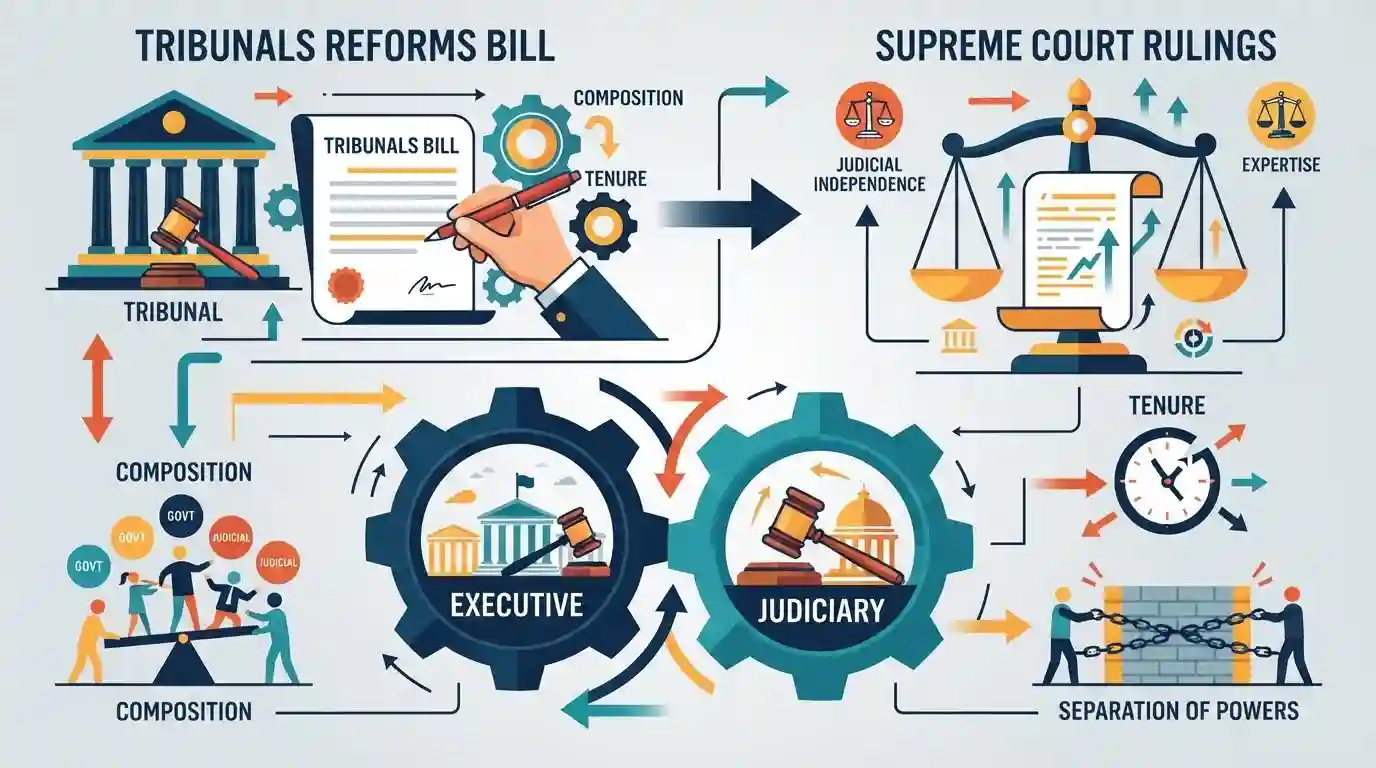
An analysis of the Tribunals Reforms Bill, its intersections with Supreme Court rulings, and the recurring friction points regarding judicial independence, tribunal composition, and the separation of powers in India.
Key Points
- The Tribunals Reforms Bill has sparked fresh legal and institutional debates concerning the balance of power between the judiciary and the legislature.
- Key concerns revolve around judicial independence, service conditions, tenure, and selection committees of tribunal members as scrutinized by the Supreme Court.
- Tribunals were originally envisioned to reduce the burden on regular courts and provide specialized justice, but recurring legislative changes often challenge constitutional guardrails.
- The Supreme Court's oversight highlights the doctrine of separation of powers and the essential requirements for fair adjudication.
Important Terms
Tribunals Reforms Bill

Legislative measures introduced to reorganize tribunal administration, modify service conditions, and address friction points between the executive and judiciary regarding judicial independence and the separation of powers.
UPSC context
UPSC GS Paper II: Structure, Organization and Functioning of the Judiciary and Executive, and Separation of Powers.
Supreme Court of India
The apex judicial body of India responsible for upholding the Constitution, protecting fundamental rights, and safeguarding judicial independence against executive overreach in tribunal appointments.
UPSC context
UPSC GS Paper II: Structure, Organization and Functioning of the Judiciary and Supreme Court jurisdiction.
Parliament of India
The supreme legislative body of India comprising the President and two Houses, responsible for enacting laws concerning tribunal governance and administrative structures.
UPSC context
UPSC GS Paper II: Parliament and State Legislatures—structure, functioning, conduct of business, powers & privileges.
Prelims Trap
Parliamentary supremacy in prescribing service conditions and tenures for tribunal members is absolute and immune to judicial review.
Aspirants often assume Parliament has absolute competence to fix service conditions of tribunal members without judicial scrutiny, overlooking basic structure doctrines.
Static Concepts Connected
What are the constitutional provisions and key Supreme Court rulings governing tribunals in India?
- Constitutional Basis: Articles 323A and 323B were introduced by the 42nd Constitutional Amendment Act, 1976, empowering Parliament and state legislatures to set up administrative and other tribunals.
- L. Chandra Kumar Case: The Supreme Court in the pioneering L. Chandra Kumar case (1997) held that the power of judicial review vested in High Courts under Article 226 is an integral part of the basic structure.
- Madras Bar Association Line: Landmark Madras Bar Association judgments have repeatedly struck down provisions violating judicial independence, such as short tenures and executive-heavy search-cum-selection committees.
Cross-Topic Patterns
Judicial Review vs Legislative Overreach
Repeated legislative re-enactment of provisions already struck down by the Supreme Court challenges the delicate institutional balance under Article 142 and separation of powers.

Tribunal appointments, short tenures, and the National Tribunals Commission are prime candidates for a multi-statement Prelims/Mains question.
Linked PYQs · 2
Linked PYQs · 2
- 2025MainsGS2
Comment on the need of administrative tribunals as compared to the court system. Assess the impact of the recent tribunal reforms through rationalization of tribunals made in 2021.
- 2018MainsGS2
How far do you agree with the view that tribunals curtail the jurisdiction of ordinary courts? In view of the above, discuss the constitutional validity and competency of the tribunals in India.
