Tribunals Reforms Framework and Judicial Review in India
Source:Indian Express ↗
ఇది ఎందుకు ముఖ్యం
It directly addresses the ongoing institutional friction between the judiciary and the executive regarding tribunal governance, judicial independence, and effective alternative dispute resolution mechanisms.
సారాంశం
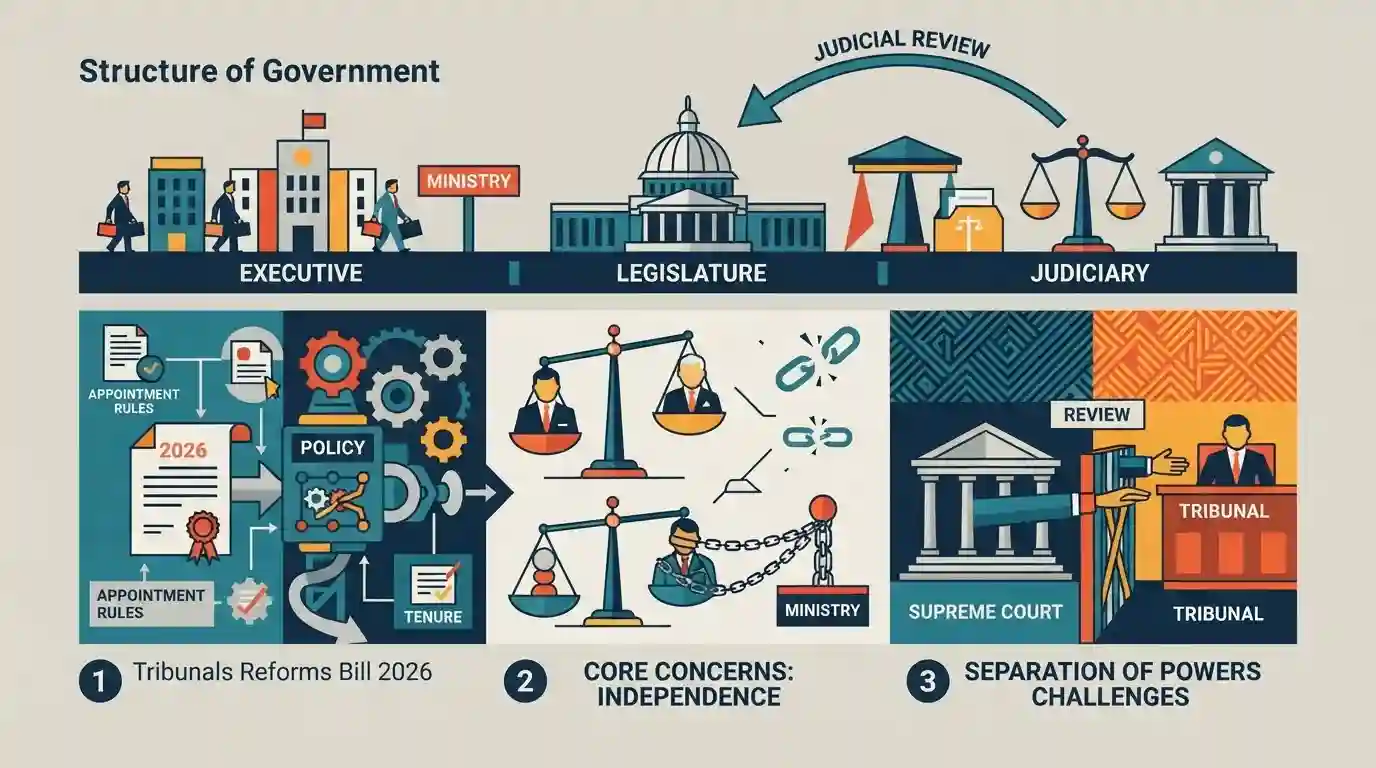
The article explains the Tribunals Reforms Bill 2026 and its interaction with judicial review by the Supreme Court, highlighting core concerns about tribunal appointments, independence, and the separation of powers in India's legal architecture.
ముఖ్య అంశాలు
- The Tribunals Reforms Bill 2026 addresses structural, appointment, and tenure issues related to tribunals in India, following judicial scrutiny.
- The Bill seeks to balance administrative efficiency with judicial independence, avoiding encroachment on the separation of powers.
- Tribunals were originally established to reduce the burden on traditional courts and bring domain expertise into adjudicatory processes.
- Concerns often raised regarding tribunals include executive overreach in appointments, tenure security, and lack of adequate infrastructure.
ముఖ్యమైన పదాలు
Tribunals Reforms Bill 2026

A legislative proposal that seeks to repeal earlier tribunal acts, establish an independent judiciary-led National Tribunals Commission, and regulate appointments, tenures, and service conditions of tribunal members.
UPSC context
GS Paper II (Polity & Governance) - Structure, Organization and Functioning of the Judiciary and Separation of Powers.
Supreme Court of India
The apex judicial court of India under the Constitution, vested with the power of judicial review to examine executive actions and legislative enactments affecting fundamental rights and basic structure.
UPSC context
GS Paper II (Polity & Governance) - Judiciary, Judicial Review, and Constitutional Interpretation.
Parliament
The supreme legislative body of India comprising the President and the two Houses (Lok Sabha and Rajya Sabha), responsible for enacting laws and policies.
UPSC context
GS Paper II (Polity & Governance) - Parliament and State Legislatures—Structure, Functioning, Conduct of Business, Powers & Privileges.
ప్రిలిమ్స్ ఉచ్చు
Tribunals are constitutional bodies established directly under the original text of the Constitution of India.
Aspirants often assume tribunals are constitutional bodies created directly by Articles of the Constitution, whereas they are statutory bodies created via parliamentary legislation under Articles 323A and 323B.
అనుసంధానమైన స్థిర భావనలు
What are the key constitutional provisions and differences between Article 323A and 323B of the Indian Constitution?
- Article 323A: Enabling provision allowing Parliament to establish administrative tribunals for public service matters of the Centre or States.
- Article 323B: Enabling provision allowing Parliament and State Legislatures to establish tribunals for other matters like taxation, foreign exchange, and labor.
- Judicial Review: Under the L. Chandra Kumar case (1997), the Supreme Court held that the power of judicial review vested in High Courts under Article 226/227 cannot be excluded by these tribunals.
అంతర-అంశ నమూనాలు
Tribunals + Separation of Powers + Judicial Review
Executive attempts to control tribunal appointments intersect with the doctrine of separation of powers, frequently inviting judicial review under Article 32 and Article 136.
Tribunals + Ease of Doing Business + Administrative Reform
The push for domain-specific tribunals mirrors international moves toward specialized commercial courts, directly impacting ease of doing business rankings.

Expect a statement-based question pairing tribunal tenure security with the basic structure doctrine and executive overreach in appointments.
అనుసంధాన PYQలు · 2
అనుసంధాన PYQలు · 2
- 2025MainsGS2
Comment on the need of administrative tribunals as compared to the court system. Assess the impact of the recent tribunal reforms through rationalization of tribunals made in 2021.
- 2020MainsGS2
Judicial Legislation is antithetical to the doctrine of separation of powers as envisaged in the Indian Constitution. In this context justify the filing of large number of public interest petitions praying for issuing guidelines to executive authorities.
