Tribunals Reforms Bill judicial review and autonomy
Source:Indian Express ↗
কেন এটি গুরুত্বপূর্ণ
Crucial for understanding the evolving dynamics between the judiciary and the legislature regarding tribunal reforms, judicial independence, and effective dispute resolution mechanisms in India.
সারসংক্ষেপ
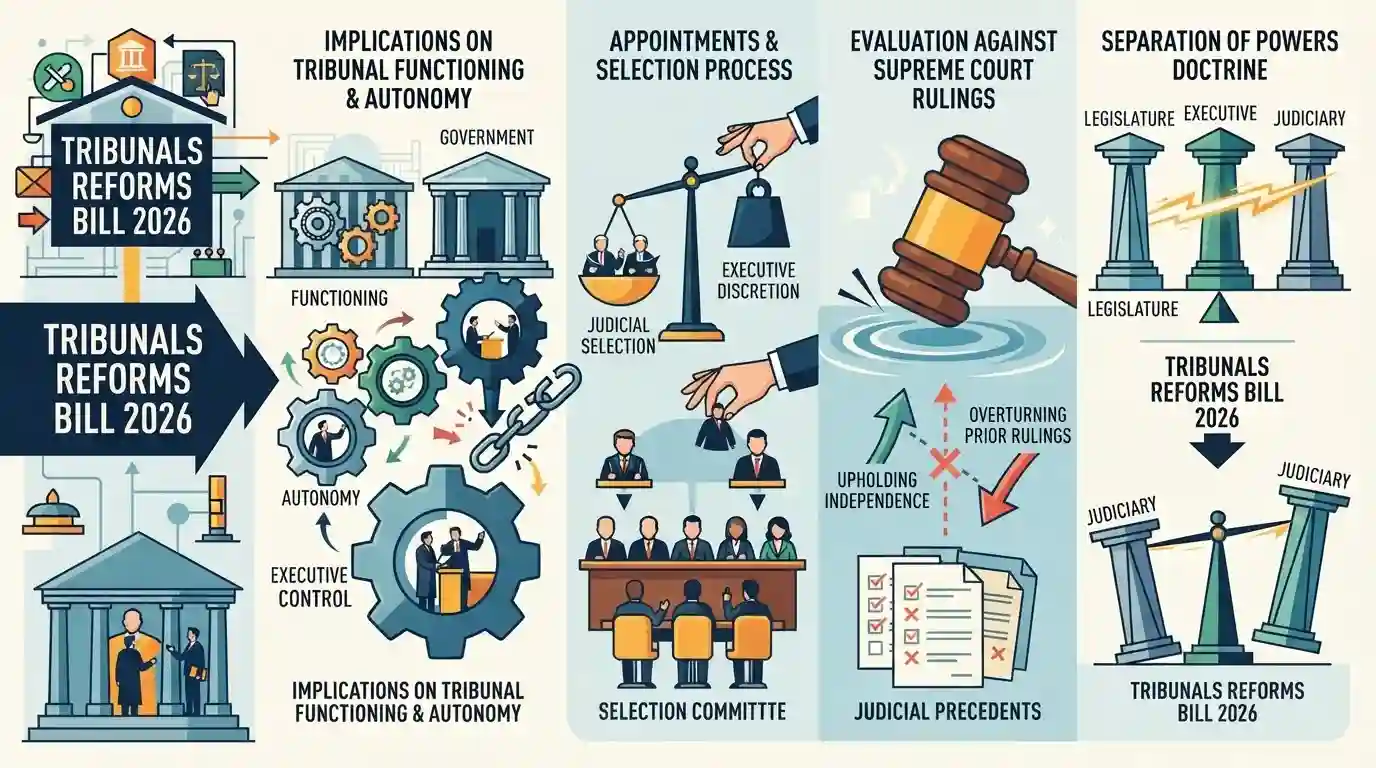
An analytical overview of the Tribunals Reforms Bill 2026 and its implications on the functioning, autonomy, and appointments of tribunals in India, evaluated against Supreme Court rulings and the doctrine of separation of powers.
মূল বিষয়
- The Tribunals Reforms Bill has brought renewed focus on the legislative framework governing tribunals and their alignment with constitutional principles.
- Judicial independence, separation of powers, and service conditions of tribunal members remain key friction points between the judiciary and the executive.
- The Supreme Court has consistently scrutinized executive overreach and provisions affecting the functional autonomy of tribunals.
গুরুত্বপূর্ণ শব্দ
Tribunals Reforms Bill 2026

A legislative enactment aimed at restructuring India's tribunal system by establishing a judiciary-led National Tribunals Commission to streamline appointments, tenure, and oversight while balancing executive-judicial oversight.
UPSC context
GS Paper II (Polity & Governance): Tests understanding of structural reforms, judicial independence, separation of powers, and tribunal governance in India.
Supreme Court of India
The apex judicial body in India mandated with safeguarding the Constitution, protecting fundamental rights, and maintaining the doctrine of separation of powers and judicial independence.
UPSC context
GS Paper II (Polity & Governance): Tests the role of the judiciary in judicial review and checking legislative/executive overreach.
Parliament
The supreme legislative body of India comprising the President, Lok Sabha, and Rajya Sabha, responsible for enacting laws on union and concurrent list subjects.
UPSC context
GS Paper II (Polity & Governance): Tests the legislative process, law-making powers, and parliamentary oversight over governance institutions.
প্রিলিমস ফাঁদ
Parliament can re-enact statutory provisions previously struck down by the Supreme Court simply by passing a new amendment or bill.
Aspirants often assume Parliament can override Supreme Court judgments on tribunal structures by passing a fresh law without curing the foundational constitutional defects struck down earlier.
সংযুক্ত স্থির ধারণা
What are the key constitutional principles laid down by the Supreme Court regarding Tribunals?
- Judicial Independence: Institutional Integrity: Tribunals are substitutes for High Courts and must possess judicial independence, security of tenure, and freedom from executive control.
- NTC Mandate: National Tribunals Commission: The SC directed the creation of an independent NTC to insulate appointments and service conditions from bureaucratic and executive dominance.
- Tenure Security: Tenure & Age: Short tenures (e.g., 4 years) and restrictive minimum age bars (e.g., 50 years) violate the basic structure of the Constitution.
আন্তঃবিষয় প্যাটার্ন
Tribunals vs. Separation of Powers
Tribunal appointments and service conditions intersect directly with Article 50 (separation of judiciary from executive) and Article 21 (due process and fair trial in administrative justice).
Executive Overreach & Institutional Autonomy
The debate over executive dominance in selection committees mirrors ongoing friction around the appointment of Election Commissioners and CBI Directors.

Tribunal reforms + SC judgments on tenures/NTC will likely be tested via a multi-statement prelims question on separation of powers.
সংযুক্ত PYQ · 3
সংযুক্ত PYQ · 3
- 2019MainsGS2
“The Central Administrative Tribunal which was established for redressal of grievances and complaints by or against central government employees, nowadays is exercising its powers as an independent judicial authority.” Explain.
- 2020MainsGS2
Judicial Legislation is antithetical to the doctrine of separation of powers as envisaged in the Indian Constitution. In this context justify the filing of large number of public interest petitions praying for issuing guidelines to executive authorities.
- 2020MainsGS2
The judicial systems in India and UK seem to be converging as well as diverging in recent times. Highlight the key points of convergence and divergence between the two nations in terms of their judicial practices.
