Appellate Tribunal Adjudication and FEMA Violation Penalties
Source:The Hindu ↗
ఇది ఎందుకు ముఖ్యం
The development is significant for UPSC aspirants as it practically demonstrates the functioning of India's regulatory and adjudicatory framework for economic offences. It highlights the distinction between the investigative powers of the Enforcement Directorate (ED) and the judicial review exercised by quasi-judicial appellate tribunals, emphasizing the checks and balances within the system of governance.
సారాంశం
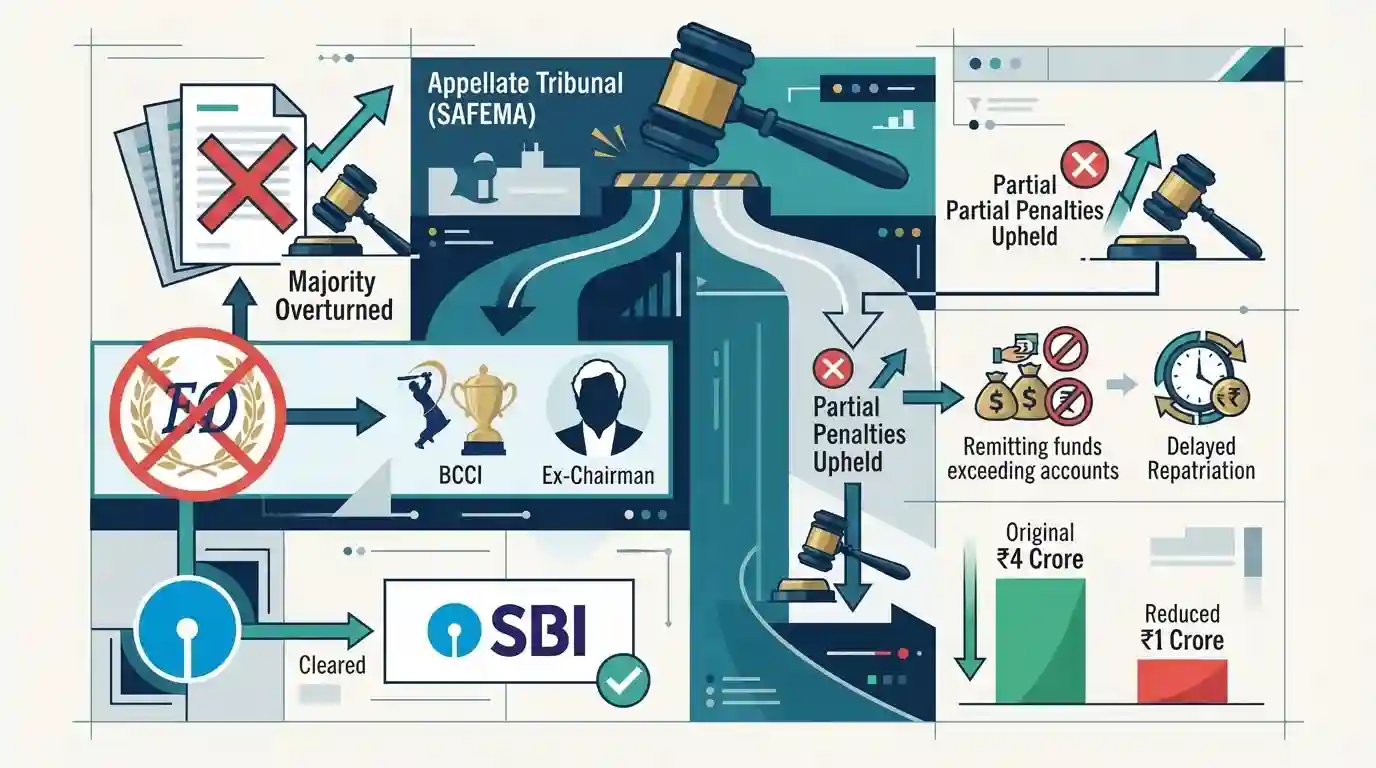
The Appellate Tribunal under the Smugglers and Foreign Exchange Manipulators Act (SAFEMA) has overturned the majority of the Enforcement Directorate’s (ED) charges against the BCCI and former IPL chairman Lalit Modi concerning Foreign Exchange Management Act (FEMA) violations during the 2009 IPL in South Africa. While clearing the State Bank of India (SBI) of any wrongdoing, the Tribunal upheld ED penalties against the BCCI for remitting funds exceeding its accounts and for delaying the repatriation of ticket sales proceeds. However, the penalty for the delayed repatriation was reduced from ₹4 crore to ₹1 crore.
ముఖ్య అంశాలు
- The Appellate Tribunal under SAFEMA has largely set aside the Enforcement Directorate's (ED) findings and penalties against the BCCI, Lalit Modi, and others regarding FEMA violations during the 2009 IPL in South Africa.
- The Tribunal exonerated the State Bank of India (SBI) and its former official, ruling that the foreign remittances they processed were part of ordinary banking operations.
- Penalties against the BCCI were upheld on two specific counts: remitting funds abroad that exceeded its books of accounts, and delaying the repatriation of ticket sales proceeds.
- The penalty for the delayed repatriation of ticket funds was reduced from ₹4 crore to ₹1 crore because the money was ultimately brought back to India.
- The ruling highlights the role of appellate tribunals in providing a check and balance against the actions of central enforcement agencies like the ED in economic offences.
ముఖ్యమైన పదాలు
Foreign Exchange Management Act (FEMA), 1999

An Indian act regulating cross-border payments, foreign exchange transactions, and external trade, treating violations as civil offenses rather than criminal ones.
UPSC context
GS Paper III (Indian Economy). Tests regulatory frameworks governing capital transactions and foreign exchange flows.
Enforcement Directorate (ED)
A multi-disciplinary law enforcement and economic intelligence agency under the Ministry of Finance responsible for investigating money laundering and foreign exchange violations.
UPSC context
GS Paper II (Statutory/Regulatory Bodies). Tests the mandate, power, and role of federal economic enforcement agencies.
Smugglers and Foreign Exchange Manipulators (Forfeiture of Property) Act (SAFEMA)
A 1976 economic law designed to confiscate illegally acquired properties of smugglers, foreign exchange manipulators, and their associates.
UPSC context
GS Paper III (Economic Offences). Tests statutory provisions targeting black money and illicit financial networks.
Appellate Tribunal under SAFEMA
A quasi-judicial national tribunal that adjudicates appeals against property forfeiture, seizure, and penalty orders passed under SAFEMA, FEMA, NDPS, PMLA, and PBPT.
UPSC context
GS Paper II (Quasi-Judicial Bodies). Tests the tribunal structure, merger of appellate bodies, and dispute redressal.
Board of Control for Cricket in India (BCCI)
The autonomous, private governing body for cricket in India, registered as a society, recently ruled by the CIC to not be a "public authority" under the RTI Act.
UPSC context
GS Paper II (Polity & Governance). Tests the scope of "public authority" and transparency requirements under RTI.
ప్రిలిమ్స్ ఉచ్చు
All violations under the Foreign Exchange Management Act (FEMA), 1999, are classified as criminal offences.
FEMA violations are civil offences resulting in monetary penalties. This is a crucial shift from its predecessor, FERA (1973), which treated forex violations as criminal offences.
అనుసంధానమైన స్థిర భావనలు
What is the consolidated jurisdiction of the SAFEMA Appellate Tribunal?
- Consolidation of Tribunals: Under the Finance Act 2016, the SAFEMA Appellate Tribunal was designated as the appellate authority to hear appeals under FEMA, PMLA, and the Benami Transactions Prohibition Act.
- Appellate Function: It acts as a critical quasi-judicial check, hearing appeals against the adjudicating orders passed by the Enforcement Directorate (ED) and other competent authorities.
- Composition: It is led by a Chairman (who is or has been a High Court or Supreme Court Judge) and includes judicial and administrative members.
How does FEMA (1999) differ structurally from FERA (1973)?
- Philosophical Shift: FERA focused strictly on the "conservation" of scarce foreign exchange, whereas FEMA aims to "facilitate" external trade and payments to develop forex markets.
- Decriminalisation: FERA violations were criminal offences with imprisonment options; FEMA turned violations into civil offences punishable by pecuniary penalties (arrest occurs only upon non-payment).
- Burden of Proof: Under FERA, the burden of proof was on the accused (presumption of guilt); under FEMA, standard civil parameters of proof and adjudication apply.
అంతర-అంశ నమూనాలు
Tribunal Rationalisation and Executive Control
Merging FEMA and PMLA appeals into the SAFEMA Tribunal reflects India's tribunal rationalisation reforms, balancing specialized adjudication with Concerns of judicial independence.
Forex Management and BOP Stability
FEMA regulations protect India's Balance of Payments (BoP) by preventing unauthorized capital flight, serving as a legal bridge between trade facilitation and macroeconomic stability.

Expect questions testing the civil nature of FEMA vs criminal PMLA, alongside the consolidated appellate jurisdiction under SAFEMA.
అనుసంధాన PYQలు · 5
అనుసంధాన PYQలు · 5
- 2025PrelimsGS1
With reference to the Government of India, consider the following information: Organization Some of its functions It works under I. Directorate of Enforcement Enforcement of the Fugitive Economic Offenders Act, 2018 Internal Security Division-I, Ministry of Home Affairs II. Directorate of Revenue Intelligence Enforces the Provisions of the Customs Act, 1962 Department of Revenue, Ministry of Finance III. Directorate General of Systems and Data Management Carrying out big data analytics to assist tax officers for better policy and nabbing tax evaders Department of Revenue, Ministry of Finance In how many of the above rows is the information correctly matched?
- 2026PrelimsGS1
With reference to the organisations under the Government of India, consider the following details : | Sl. No. | Organisation | Function | Controlling Union Ministry | | --- | --- | --- | --- | | 1. | Central Economic Intelligence Bureau (CEIB) | To coordinate between various law enforcement agencies | Ministry of Home Affairs | | 2. | Serious Fraud Investigation Office (SFIO) | To investigate complex corporate frauds | Ministry of Finance | | 3. | Central Bureau of Investigation (CBI) | To preserve values in public life and ensure the health of the national economy | Ministry of Personnel, Public Grievances and Pension | In how many of the above rows are the given details correctly matched ?
- 2016MainsGS2
What is a quasi-judicial body? Explain with the help of concrete examples.
- 2025MainsGS2
Comment on the need of administrative tribunals as compared to the court system. Assess the impact of the recent tribunal reforms through rationalization of tribunals made in 2021.
- 2021MainsGS3
Discuss how emerging technologies and globalisation contribute to money laundering. Elaborate measures to tackle the problem of money laundering both at national and international levels.
