Tribunal Reforms Act: Supreme Court questions adjournment request
Source:The Hindu ↗
Why It Matters
The Tribunal Reforms Act of 2021 has been a major point of contention regarding the independence of the judiciary and the separation of powers. This article highlights the friction between the judiciary and the executive concerning tribunal independence, as well as the roles and responsibilities of constitutional posts like the Attorney General.
Summary
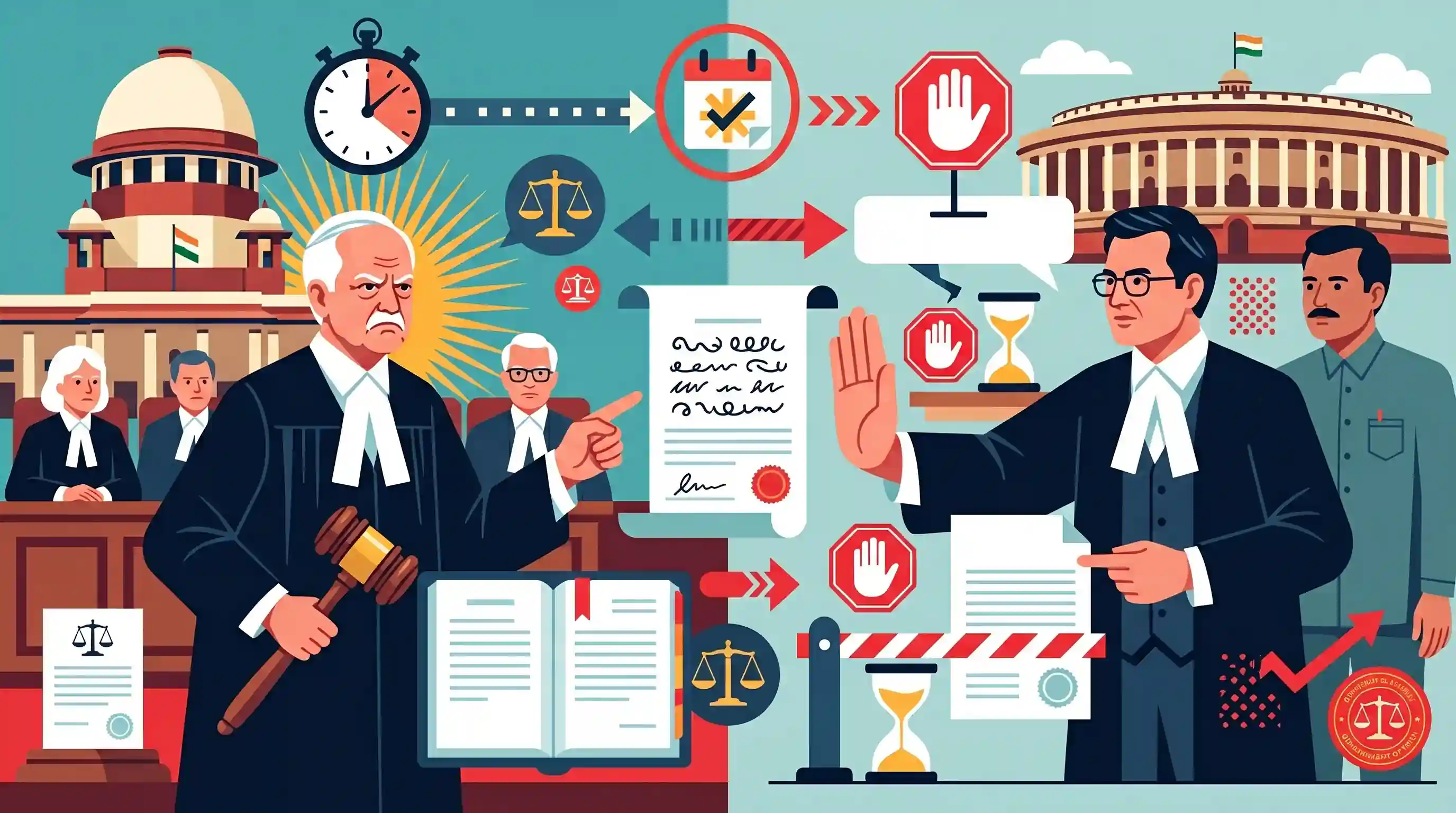
Chief Justice of India B.R. Gavai expressed strong displeasure over the Central government's request to adjourn a priority hearing challenging the Tribunal Reforms Act of 2021. The adjournment, sought on behalf of Attorney General R. Venkataramani, was criticized by the CJI as "unfair to the court," especially since the bench had cleared its schedule to conclude the matter and issue a judgment before the CJI's impending retirement on November 24.
Key Points
- The Supreme Court was scheduled to hear a crucial case challenging the Tribunal Reforms Act of 2021, which the court had given priority.
- Additional Solicitor General Aishwarya Bhati sought an adjournment on behalf of Attorney General R. Venkataramani, citing his engagement in an international arbitration.
- Chief Justice of India B.R. Gavai expressed severe displeasure, noting the court had cleared its board to finalize the hearing and deliver a judgment before his upcoming retirement on November 24.
- The CJI had previously questioned whether the Attorney General's suggestion to refer the case to a larger Bench was a delaying tactic, highlighting ongoing friction regarding the timely resolution of the matter.
Important Terms
Tribunal Reforms Act, 2021

Legislation enacted to dissolve specific appellate tribunals and transfer their functions to High Courts. It regulates appointments and service conditions for tribunal members through a CJI-led selection committee.
UPSC context
GS Paper 2: Statutory/Quasi-judicial bodies. Tests understanding of legislative-judicial conflicts and tribunal independence.
Tribunals
Quasi-judicial institutions established under Articles 323A and 323B to adjudicate specialized disputes (e.g., tax, administration), aiming to reduce the workload of traditional courts.
UPSC context
GS Paper 2: Structure and functioning of the Judiciary. Key for specialized justice delivery system questions.
Attorney General of India
A constitutional post under Article 76, serving as the Union Government's chief legal advisor and primary lawyer representing the State in the Supreme Court.
UPSC context
GS Paper 2: Constitutional Posts. Tests roles, duties, and relationship with the Executive.
Chief Justice of India (CJI)
The head of the Indian Judiciary and senior-most judge of the Supreme Court, responsible for administrative functions and case allocation as the 'Master of the Roster.'
UPSC context
GS Paper 2: Structure of Judiciary. Tests administrative powers and collegium system.
Judicial Review
The power of the Supreme Court and High Courts to examine the constitutionality of legislative and executive actions, considered a 'basic structure' of the Constitution.
UPSC context
GS Paper 2: Constitution/Governance. Tests checks and balances and constitutional supremacy.
Separation of Powers
A constitutional principle dividing governance into legislative, executive, and judicial branches to ensure mutual checks and prevent any one organ from exceeding its authority.
UPSC context
GS Paper 2: Constitutional Principles. Tests the relationship between the Judiciary and the Executive.
Prelims Trap
Both the Attorney General and Solicitor General of India are Constitutional posts created to advise the Central Government.
Only the Attorney General is a Constitutional post (Article 76). The Solicitor General and Additional Solicitor General are statutory/rules-based posts governed by the Law Officers Rules, 1987.
Static Concepts Connected
What are the key constitutional provisions and judicial rulings governing Tribunals in India?
- 42nd Amendment (1976): Inserted Part XIV-A into the Constitution, creating Article 323A (Administrative Tribunals) and Article 323B (Tribunals for other matters).
- L. Chandra Kumar Case: The Supreme Court ruled that tribunals cannot bypass the judicial review of High Courts under Articles 226/227, as judicial review is part of the basic structure.
- Tenure & Independence: Courts have repeatedly struck down executive rules prescribing short tenures (e.g., 4 years) for tribunal members, holding that insecure tenures compromise judicial independence.
What are the unique privileges and limitations of the Attorney General of India?
- Parliamentary Privileges: Has the right to speak and take part in proceedings of either House of Parliament or joint sittings, but is not entitled to vote (Article 88).
- Right of Audience: Enjoys the right of audience in all courts within the territory of India while discharging official duties.
- Private Practice Limits: Not a full-time government servant and not debarred from private practice, but cannot advise against the Government or defend accused in criminal cases without permission.
Cross-Topic Patterns
Tribunalisation vs. Judicial Independence
The executive's attempt to control tribunal tenures mirrors past clashes over the National Judicial Appointments Commission (NJAC), highlighting persistent friction regarding the separation of powers.
CJI transitions and judicial pendency
Adjournments sought near a CJI's retirement disrupt priority hearings, linking the CJI's role as 'Master of the Roster' to systemic challenges of judicial pendency and delayed constitutional bench verdicts.

Expect a Prelims question distinguishing the constitutional status of the AG from SG, or comparing tribunal tenure limits with High Courts.
Linked PYQs · 4
Linked PYQs · 4
- 2025MainsGS2
Comment on the need of administrative tribunals as compared to the court system. Assess the impact of the recent tribunal reforms through rationalization of tribunals made in 2021.
- 2019MainsGS2
“The Central Administrative Tribunal which was established for redressal of grievances and complaints by or against central government employees, nowadays is exercising its powers as an independent judicial authority.” Explain.
- 2023MainsGS2
“Constitutionally guaranteed judicial independence is a prerequisite of democracy.” Comment.
- 2022PrelimsGS1
Consider the following statements: 1. Attorney General of India and Solicitor General of India are the only officers of the Government who are allowed to participate in the meetings of the Parliament of India. 2. According to the Constitution of India, the Attorney General of India submits his resignation when the Government which appointed him resigns. Which of the statements given above is/are correct?
