Maharashtra Cabinet Approves Allowances Hike for Tribal Students
Source:Indian Express ↗
Why It Matters
This article exemplifies state-level affirmative action and targeted welfare initiatives designed to promote educational equity among Scheduled Tribes. It highlights the fiscal costs associated with expanding welfare measures and provides a concrete example for questions on government policies concerning vulnerable sections.
Summary
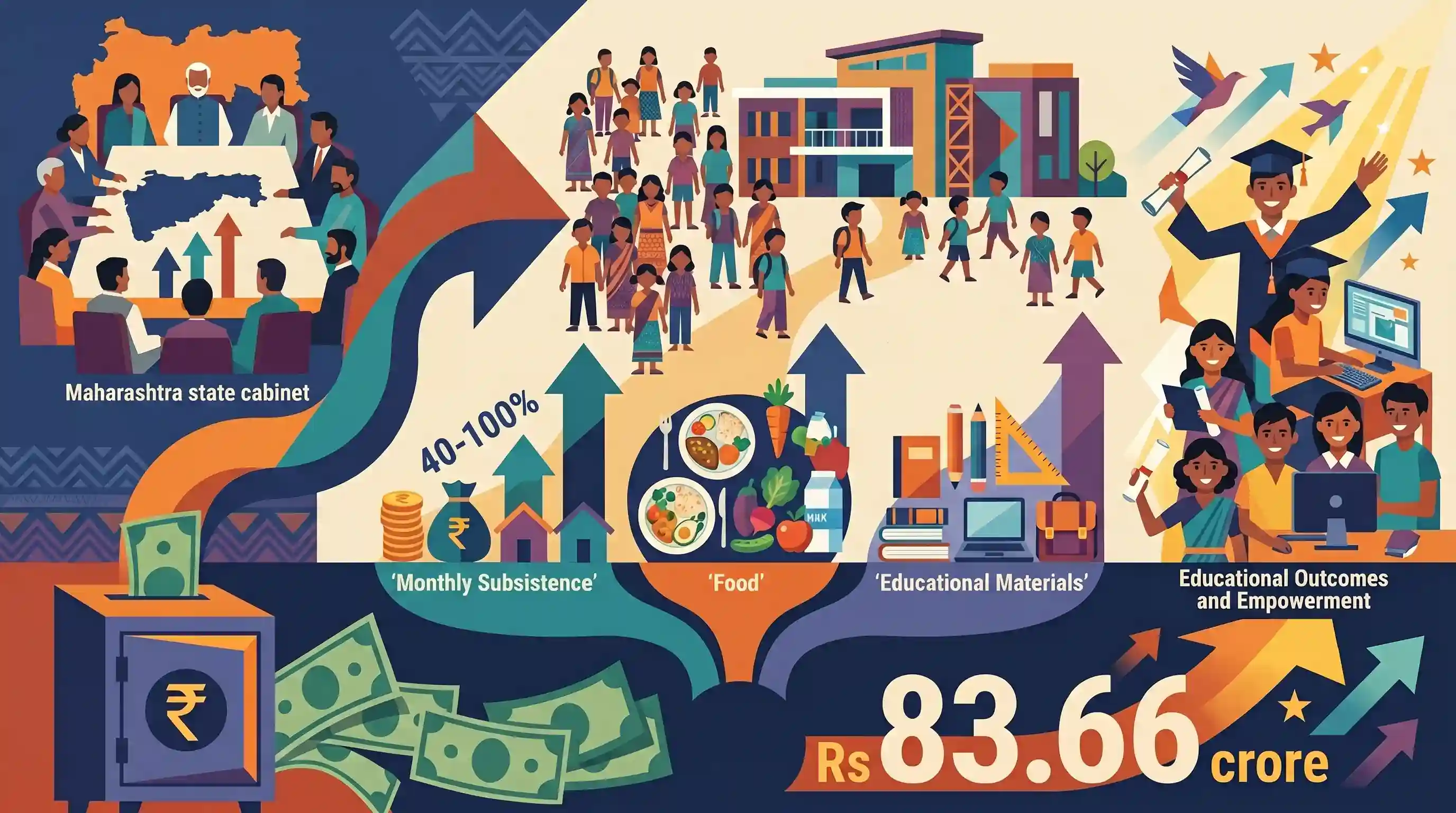
The Maharashtra cabinet has decided to significantly increase various allowances for over 58,000 tribal students residing in government hostels managed by the Tribal Development Department. Allowances for monthly subsistence, food, and educational materials have been hiked by 40% to 100%, scaled by administrative levels, to better support the students' educational needs. While this proactive welfare measure aims to improve educational outcomes for vulnerable communities, it will incur an additional cost of Rs 83.66 crore to the state exchequer.
Key Points
- The Maharashtra state cabinet has approved a substantial hike of 40% to 100% in various allowances for tribal students living in government hostels.
- Over 58,700 students residing in 490 state-run hostels (284 for boys and 206 for girls) under the Tribal Development Department will benefit from the measure.
- The increased allowances cover monthly subsistence, purchase of educational materials, and food, with specific rates based on the administrative level (taluka, district, or division).
- The decision will result in an additional financial burden of Rs 83.66 crore on the state exchequer.
Important Terms
Tribal Development Department (Maharashtra)

The nodal state agency in Maharashtra responsible for planning and implementing welfare, educational, and socio-economic programs for Scheduled Tribes.
UPSC context
Relevant for GS-II (Welfare Schemes) and administrative machinery for vulnerable sections.
Government Hostel Scheme for Tribal Students
A state-run residential initiative providing free lodging, food, and subsistence allowances to Scheduled Tribe students to support their higher education.
UPSC context
GS-II (Vulnerable Sections); tests knowledge of educational empowerment and social justice interventions.
Maharashtra State Cabinet
The supreme executive committee of the Maharashtra government, led by the Chief Minister, which approves major policy changes and budgetary expenditures.
UPSC context
GS-II (State Executive); pertains to governance, policy-making processes, and fiscal responsibility.
Scheduled Tribes (ST)
Communities designated under Article 342 of the Constitution, recognized for their distinct culture, geographical isolation, and historical socio-economic backwardness.
UPSC context
GS-I (Social Issues) and GS-II (Polity); central to discussions on affirmative action and marginalization.
Article 46 of the Indian Constitution
A Directive Principle of State Policy (DPSP) mandating the State to promote the educational and economic interests of Scheduled Tribes with special care.
UPSC context
GS-II (Polity); provides the constitutional mandate for state-led tribal welfare schemes.
Prelims Trap
Article 46 guarantees justiciable rights to free hostel facilities for tribal students.
Article 46 is a Directive Principle of State Policy (DPSP) directing the State to promote educational interests of weaker sections; it is non-justiciable.
Static Concepts Connected
What are the key Constitutional provisions for the educational upliftment of STs?
- Article 15(4): Allows the State to make special provisions for the advancement of socially and educationally backward classes or Scheduled Tribes.
- Article 46: A DPSP directing the State to promote the educational and economic interests of weaker sections, specifically SCs and STs, protecting them from social injustice.
- Article 275(1): Mandates statutory grants from the Consolidated Fund of India to States for promoting the welfare of Scheduled Tribes or raising the level of administration.
Which major Central schemes complement state tribal hostel initiatives?
- EMRS: Targeted at providing quality middle and high-level residential education to ST students in remote areas, funded under Article 275(1).
- PM-JUGA: Dharti Aaba Janjatiya Gram Utkarsh Abhiyan (PM-JUGA) focuses on saturating social infrastructure, including the upgrading and setting up of tribal hostels.
- Pre/Post-Matric Scholarships: Centrally sponsored financial assistance mechanisms aimed at bridging the economic gap and reducing high dropout rates among ST students.
Cross-Topic Patterns
Tribal Welfare vs. State Exchequer
Significant hikes in state welfare allowances link directly to the GS3 macro-economic debate on state fiscal deficit management, revenue expenditure limits, and the rationalisation of subsidies.
Dropout rates & Demographic Dividend
Hostels and subsistence allowances tackle high secondary-level dropout rates among STs, a prerequisite for integrating marginalized youth into the formal skill economy and realizing the demographic dividend.

Expect a GS2/Prelims question comparing Central vs. State models of tribal residential education (EMRS vs State Hostels) and their funding.
Linked PYQs · 2
Linked PYQs · 2
- 2019MainsGS2
Performance of welfare schemes that are implemented for vulnerable sections is not so effective due to absence of their awareness and active involvement at all stages of policy process. Discuss.
- 2023MainsGS2
“Development and welfare schemes for the vulnerable, by its nature, are discriminatory in approach.” Do you agree? Give reasons for your answer.
