Telangana Tribal Fifth Schedule Rights and Sand Mining CBI Probe
Source:The Hindu ↗
Why It Matters
This development acts as a highly relevant case study for multiple core UPSC syllabus areas: the gap between constitutional provisions (Fifth Schedule/PESA) and their on-ground implementation, the socio-economic impacts of development-induced displacement (GS1/GS2), and the environmental and administrative challenges surrounding minor mineral extraction like sand mining (GS3).
Summary
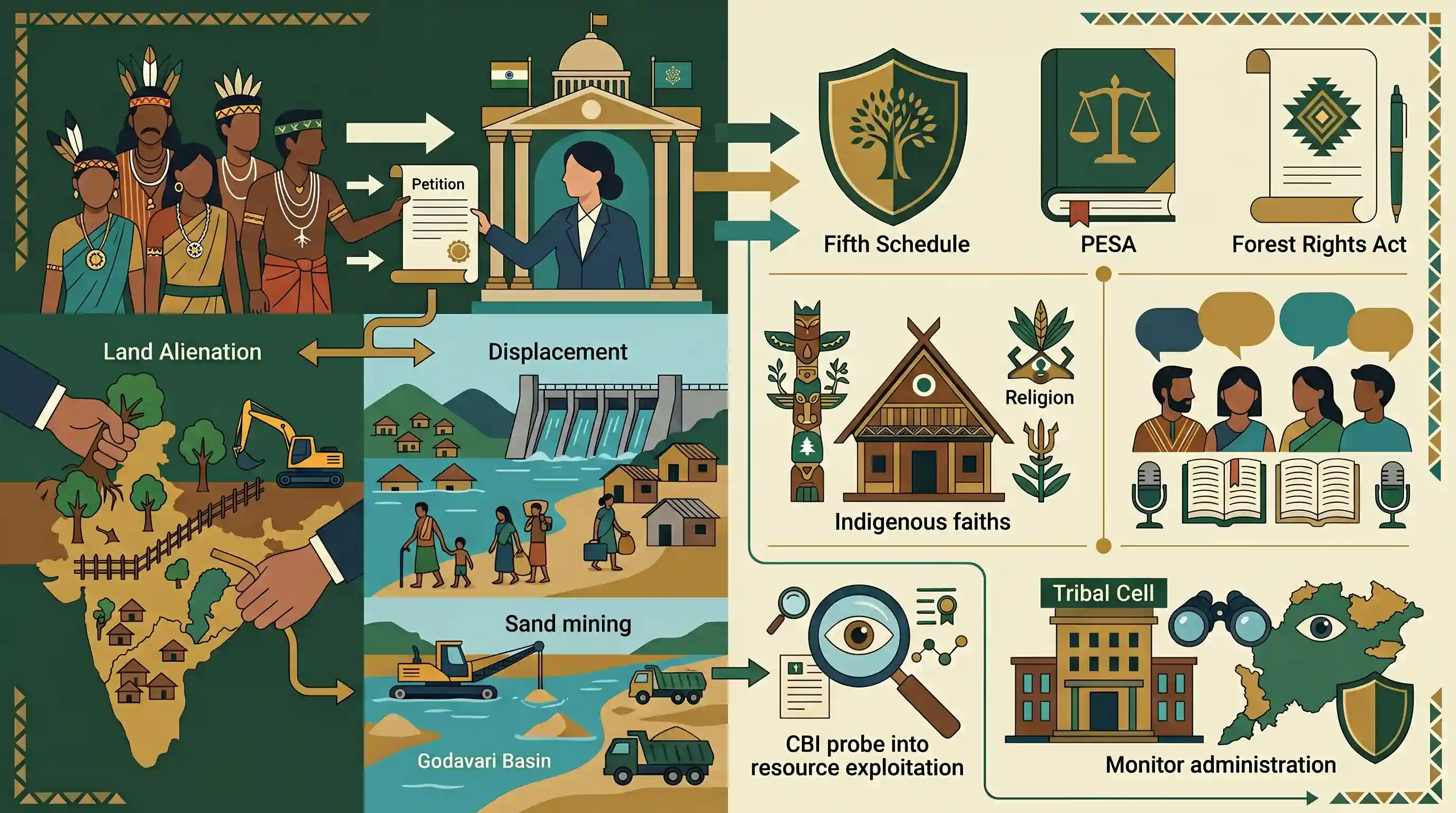
Tribal leaders in Telangana have petitioned the State Governor to intervene and enforce constitutional protections guaranteed under the Fifth Schedule, PESA, and the Forest Rights Act. They raised critical concerns over large-scale land alienation, displacement caused by projects like Polavaram without adequate rehabilitation, and the erosion of tribal institutions. To curb resource exploitation, they demanded a CBI probe into sand mining in the Godavari basin. Additionally, the leaders pressed for cultural protections, including a separate religion code for indigenous faiths, official recognition of tribal languages like Koya, and the establishment of a Tribal Cell to monitor administration in Scheduled Areas.
Key Points
- Tribal representatives in Telangana submitted a memorandum to the Governor, highlighting the continuous violation of their rights under the Fifth Schedule, PESA, and the Forest Rights Act (FRA).
- They demanded an immediate end to tribal land alienation and the restoration of lands illegally transferred to non-tribals.
- The leaders highlighted the plight of families displaced by the Polavaram project, calling for comprehensive rehabilitation and resettlement.
- A CBI investigation was demanded into the widespread sand mining operations in the Godavari basin, which are leading to environmental degradation and resource exploitation.
- Other demands included a dedicated 'Tribal Cell' at Lok Bhavan, a separate religion code for indigenous faiths, official recognition of the Koya (Koyatur) language, and a policy for sharing revenue generated from local natural resources.
- The delegation urged the Governor to use their constitutional powers to personally visit Scheduled Areas to assess and address these grievances.
Important Terms
Fifth Schedule of the Indian Constitution

Constitutional provisions under Article 244(1) for the administration and control of Scheduled Areas and Scheduled Tribes in states excluding the Northeast.
UPSC context
GS II: Polity & Governance. Essential for understanding tribal protections and federal administrative exceptions.
Panchayats (Extension to Scheduled Areas) Act (PESA)
Legislation extending the Panchayati Raj system to Scheduled Areas, empowering Gram Sabhas with significant control over resources, land acquisition, and local governance.
UPSC context
GS II: Governance. Tests knowledge of grassroots democracy and tribal self-rule mechanisms.
Forest Rights Act (FRA)
Act recognizing the legal land and resource rights of forest-dwelling Scheduled Tribes and traditional forest dwellers to correct historical injustices.
UPSC context
GS II/III: Social Justice & Environment. Evaluates rights-based conservation and historical redressal.
Land Alienation
The transfer of tribal land to non-tribals or corporations, often illegally, leading to socio-economic displacement and marginalization in Scheduled Areas.
UPSC context
GS I/II: Social Empowerment. Crucial for issues of internal security and tribal welfare.
Governor’s Powers (Scheduled Areas)
Special discretionary authority allowing the Governor to modify laws for "peace and good government" and report annually to the President on tribal administration.
UPSC context
GS II: Executive & Polity. Tests the unique role of Governors in Scheduled Areas versus general states.
Central Bureau of Investigation (CBI)
India’s premier investigative agency handling high-profile corruption, economic crimes, and cases referred by states, courts, or the Central Government.
UPSC context
GS II: Statutory/Constitutional Bodies. Relates to federalism, transparency, and anti-corruption mechanisms.
Prelims Trap
"The Governor is empowered to declare an area as a Scheduled Area under the Fifth Schedule."
The President, not the Governor, is empowered to declare an area as a Scheduled Area. The Governor only makes regulations for their administration, which require Presidential assent.
Static Concepts Connected
What are the Governor's special powers in Fifth Schedule areas?
- Annual Report: Must submit a report to the President annually, or whenever required, regarding the administration of Scheduled Areas.
- Law modification: Can publicly notify that specific Parliamentary or State legislative acts do not apply, or apply with exceptions/modifications.
- Tribal lands: Can frame regulations to prohibit or restrict the transfer of land by or among Scheduled Tribes to non-tribals.
How does the PESA Act regulate minor minerals like sand?
- Mandatory recommendation: Prior recommendation of the Gram Sabha or Panchayat is mandatory for granting prospecting licenses or mining leases for minor minerals.
- Auction concessions: Gram Sabha or Panchayat recommendation is also strictly required before granting concessions for exploiting minor minerals by auction.
Cross-Topic Patterns
Polavaram, Godavari & PVTG Displacement
The Polavaram dam links Godavari geography with tribal rights, displacing communities like the Koya and Konda Reddis (a PVTG), highlighting tensions between national infrastructure and FRA/PESA safeguards.
Sand mining, PESA and minor minerals
Sand is classified as a 'minor mineral' under the MMDR Act. In Scheduled Areas, PESA intertwines ecology with tribal autonomy by mandating Gram Sabha consent for extraction.

Expect a 2026 Prelims question testing the overlap of the Governor's Fifth Schedule powers, PESA's minor mineral rules, and Gram Sabhas.
Linked PYQs · 5
Linked PYQs · 5
- 2022PrelimsGS1
If a particular area is brought under the Fifth Schedule of the Constitution of India, which one of the following statements best reflects the consequence of it ?
- 2019PrelimsGS1
Under which Schedule of the Constitution of India can the transfer of tribal land to private parties for mining be declared null and void?
- 2013PrelimsGS1
The Government enacted the Panchayat Extension to Scheduled Areas (PESA) Act in 1996. Which one of the following is not identified as its objective?
- 2019MainsGS3
Coastal sand mining, whether legal or illegal, poses one of the biggest threats to our environment. Analyze the impact of sand mining along the Indian coasts, citing specific examples.
- 2025MainsGS1
Does tribal development in India centre around two axes, those of displacement and of rehabilitation? Give your opinion.
