Tribal Children Intercepted and Brought Back to Rajasthan
Source:hindustantimes ↗
Why It Matters
The event highlights critical constitutional and social issues, directly relating to the protection of vulnerable sections (Article 46) against exploitation and human trafficking (Article 23), as well as the constitutional debates surrounding the freedom of religion and forced religious conversions (Article 25).
Summary
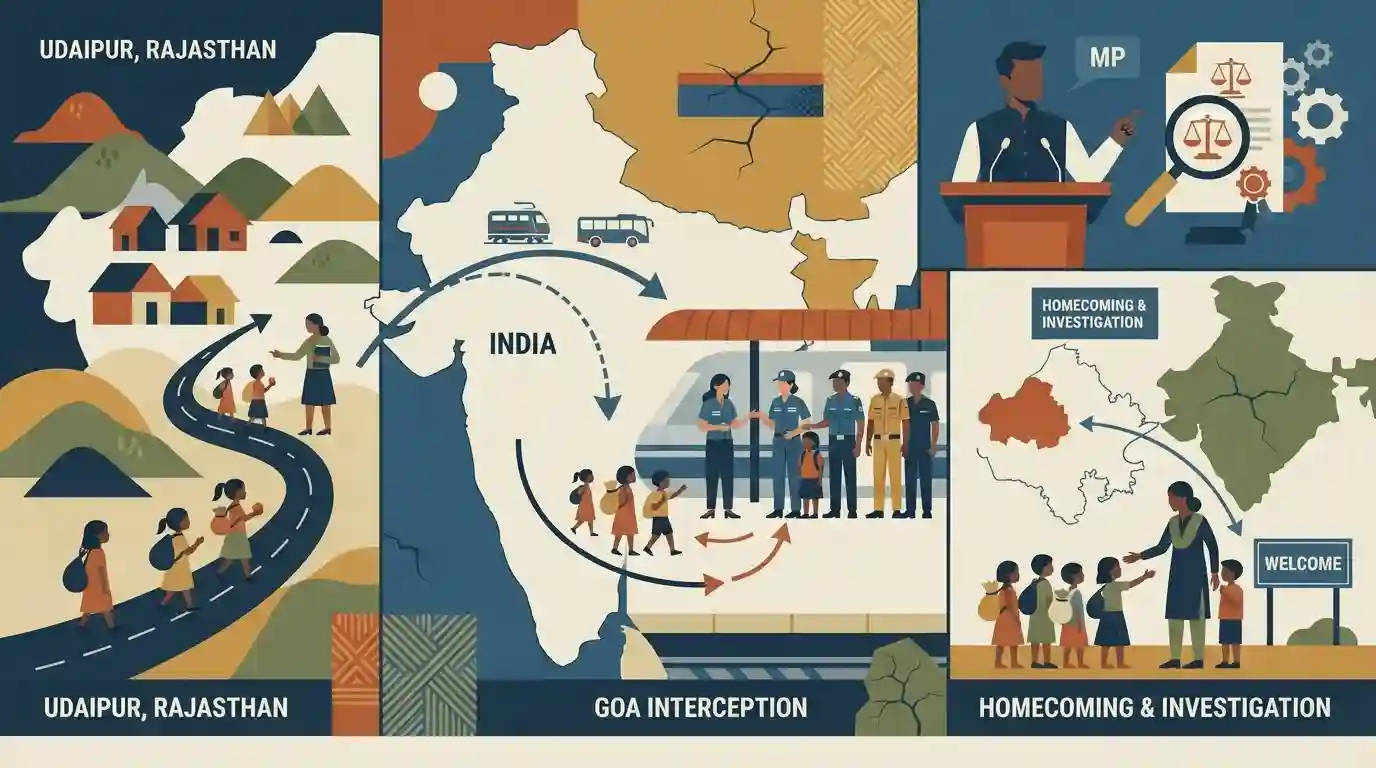
Seven tribal children from Udaipur, Rajasthan, who were being taken to Tamil Nadu under the pretext of receiving free education, were intercepted in Goa and successfully brought back to their home state. Following their return, Udaipur BJP MP Mannalal Rawat sought a detailed investigation, alleging the existence of an organized inter-state racket focused on the religious conversion of vulnerable tribal children. The incident has brought attention to the ongoing threats of child trafficking and the exploitation of marginalized communities through deceptive welfare promises.
Key Points
- Seven tribal children from Udaipur, Rajasthan, being taken to Tamil Nadu under the pretext of free education, were intercepted in Goa and brought back.
- Udaipur BJP MP Mannalal Rawat has demanded a high-level probe into the matter.
- The MP alleged that an organized inter-state syndicate is targeting tribal children for religious conversion under the guise of providing educational opportunities.
- The incident raises critical concerns regarding the trafficking of children from vulnerable communities across state borders.
Important Terms
Human Trafficking

The recruitment, transportation, transfer, harboring, or receipt of persons through force, deception, or coercion for the purpose of exploitation, such as forced labor, servitude, or sexual exploitation.
UPSC context
GS Paper II (Social Justice) and GS III (Internal Security); tests governance framework, law enforcement, and vulnerability.
Child Welfare Committee
A district-level statutory body established under the Juvenile Justice Act, 2015, acting as the final authority for the care, protection, treatment, and rehabilitation of children in need.
UPSC context
GS Paper II (Polity & Governance); tests statutory bodies and welfare mechanisms for vulnerable children.
Article 23 of the Indian Constitution
A fundamental right that prohibits human trafficking, begar (forced labor), and similar forms of compulsory unpaid labor, making any violation a punishable offense.
UPSC context
GS Paper II (Polity); tests fundamental rights, human rights protection, and constitutional safeguards.
Scheduled Tribes
Indigenous communities in India recognized under Article 342 of the Constitution, designated for special protections and affirmative action due to distinct culture and socioeconomic backwardness.
UPSC context
GS Paper II (Social Justice & Polity); tests safeguards, affirmative action, and welfare of vulnerable groups.
Bharatiya Janata Party (BJP)
A prominent national political party in India, founded in 1980, known for its right-wing, nationalist ideology, and currently leading the ruling government coalition.
UPSC context
GS Paper II (Polity); tests political parties, electoral politics, and pressure groups.
Prelims Trap
"The Constitution under Article 25 guarantees the fundamental right to convert another person to one's own religion."
The Supreme Court (Rev. Stanislaus case, 1977) clarified that the right to 'propagate' does not include the right to convert another person, as forced conversion infringes upon the other's freedom of conscience.
Static Concepts Connected
What are the key Constitutional provisions against human trafficking and child exploitation?
- Article 23: Prohibits traffic in human beings, begar (forced labor), and other similar forms of forced labor, making contraventions punishable by law.
- Article 24: Prohibits the employment of children below the age of 14 years in any factory, mine, or other hazardous employment.
- Article 39(e) & (f): Directive Principles directing state policy to ensure children are given opportunities to develop healthily and are protected against exploitation and moral/material abandonment.
What is the mandate and nature of the National Commission for Protection of Child Rights (NCPCR)?
- Statutory Body: It is a statutory body established under the Commissions for Protection of Child Rights (CPCR) Act, 2005.
- Core Mandate: Ensures all laws and policies align with the Child Rights outlined in the Constitution and the UN Convention on the Rights of the Child.
- Inquiry Powers: Can take suo motu cognizance of the deprivation of child rights, non-implementation of child protection laws, and issues involving inter-state child trafficking.
Cross-Topic Patterns
State Anti-Conversion Laws vs Fundamental Rights
Multiple states have enacted Freedom of Religion Acts. UPSC frequently links this to federalism (Public Order is a State list subject) and the specific limitations placed on Article 25.
Inter-State Migrant Vulnerability and Trafficking
Migration of tribals from central India to southern/western states exposes them to organized trafficking networks, linking tribal welfare to the Inter-State Migrant Workmen Act and organized crime modules.

Expect a 2026 prelims multi-statement question testing the distinction between the right to 'propagate' (Art 25) and forced conversion.
Linked PYQs · 1
Linked PYQs · 1
- 2013RPSC_PRELIMSGS1
According to Article 25 of the Constitution, the right to freedom of religion is not subject to:
