Tribal Knowledge Systems and Environmental Sustainability
Source:The Hindu ↗
কেন এটি গুরুত্বপূর্ণ
This article provides a direct contemporary example of the 'uniqueness of tribal knowledge systems'—a recurring theme in UPSC GS1 (Society). It connects indigenous traditions with modern environmental challenges, emphasizing how tribal integration of conservation into daily life contrasts with mainstream developmental paradigms.
সারসংক্ষেপ
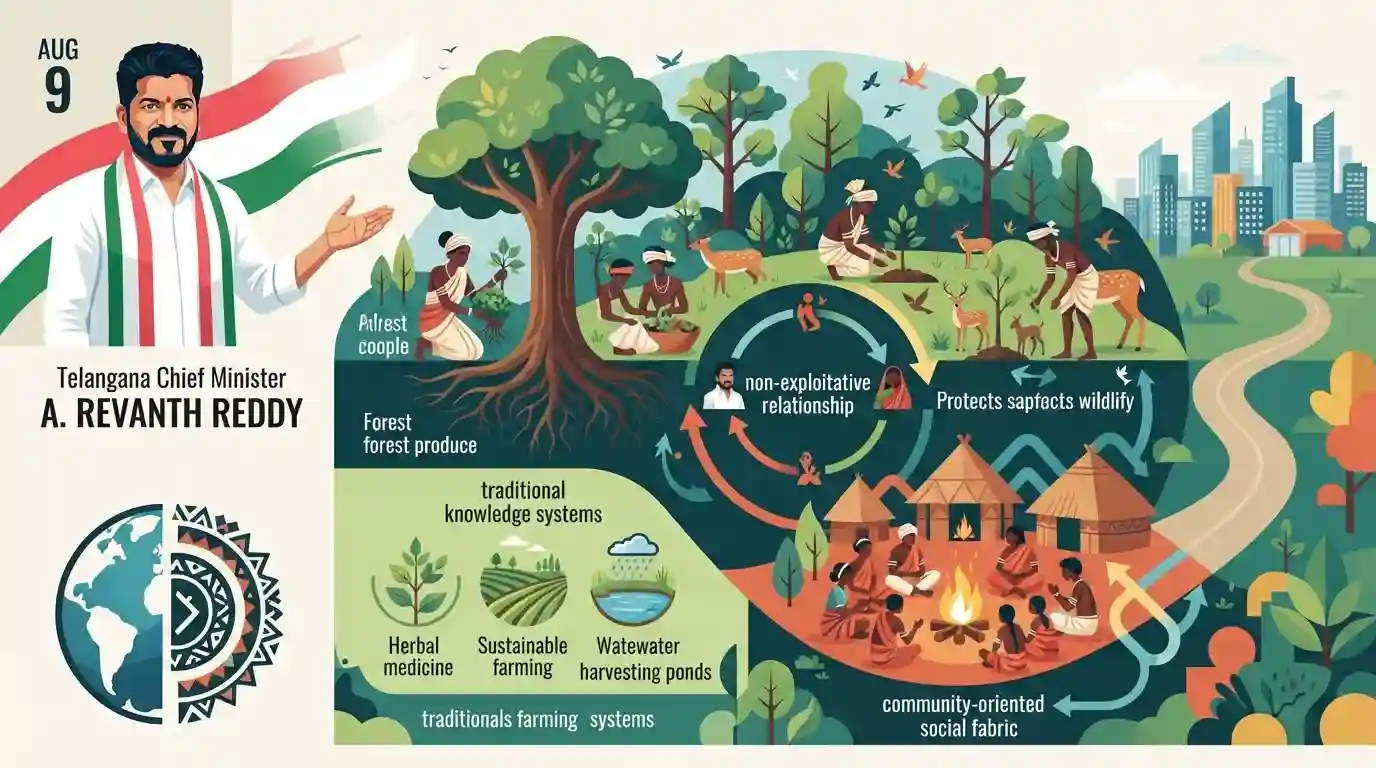
On the occasion of World Tribal Day (World Indigenous People's Day), Telangana Chief Minister A. Revanth Reddy underscored the global significance of tribal culture as a guiding light for sustainable living. He emphasized that the Adivasi way of life is fundamentally intertwined with environmental conservation, relying on unique traditional knowledge systems that protect biodiversity and forest ecosystems. The Chief Minister pointed out that mainstream society has much to learn from tribal communities, particularly their harmonious, non-exploitative relationship with nature and their strong, community-oriented social fabric.
মূল বিষয়
- World Tribal Day (World Indigenous People's Day) is celebrated to recognize the contributions and preserve the identity of tribal communities.
- Telangana CM highlighted that tribal culture, which is deeply rooted in harmony with nature, offers valuable lessons in sustainable living for all of humanity.
- The 'unique knowledge systems' and traditions of Adivasis act as crucial safeguards for environmental conservation, biodiversity, and forest ecosystems.
- Adivasis demonstrate a non-exploitative relationship with natural resources, fostering community-oriented social structures rather than individualized consumption.
প্রিলিমস ফাঁদ
The Forest Rights Act (FRA), 2006, exclusively grants forest rights to recognized Scheduled Tribes (STs).
The Act also protects Other Traditional Forest Dwellers (OTFDs) who have resided in the forest for three generations (75 years) prior to 2005.
সংযুক্ত স্থির ধারণা
What are the identification criteria and origins of PVTGs in India?
- Origin: Created as 'Primitive Tribal Groups' in 1975 based on Dhebar Commission recommendations; renamed PVTGs in 2006.
- Criteria: Identified by four criteria: pre-agricultural technology, stagnant/declining population, extremely low literacy, and a subsistence-level economy.
- Distribution: There are 75 identified PVTGs spread across 18 States and 1 UT, with Odisha hosting the highest number.
How does the Forest Rights Act (FRA), 2006, recognize community ecological rights?
- Community Forest Resources: Grants rights to protect, regenerate, conserve, or manage any community forest resource which they have been traditionally protecting.
- Minor Forest Produce: Grants ownership, access to collect, use, and dispose of minor forest produce (MFP) like bamboo, tendu leaves, honey, and wax.
- Habitat Rights for PVTGs: Explicitly guarantees habitat rights for PVTGs and pre-agricultural communities over their customary territories.
আন্তঃবিষয় প্যাটার্ন
Traditional Knowledge vs IPR regimes
Clash between orally transmitted, community-owned indigenous ecological knowledge and Western, individual-centric intellectual property systems (patents), managed through India's TKDL database.
Fortress Conservation vs Co-existence
The paradigm shift from exclusive, human-free 'fortress conservation' to inclusive 'co-existence models' under the Kunming-Montreal Global Biodiversity Framework targets.

Mains 2026: Expect questions on how traditional ecological knowledge (TEK) can help meet India's Kunming-Montreal 30x30 targets.
সংযুক্ত PYQ · 4
সংযুক্ত PYQ · 4
- 2021MainsGS1
Examine the uniqueness of tribal knowledge system when compared with mainstream knowledge and cultural systems.
- 2025MainsGS1
Achieving sustainable growth with emphasis on environmental protection could come into conflict with poor people's needs in a country like India – Comment.
- 2019PrelimsGS1
Consider the following statements: 1. As per recent amendment to the Indian Forest Act, 1927, forest dwellers have the right to fell the bamboos grown on forest areas. 2. As per the Scheduled Tribes and Other Traditional Forest Dwellers (Recognition of Forest Rights) Act, 2006, bamboo is a minor forest produce. 3. The Scheduled Tribes and Other Traditional Forest Dwellers (Recognition of Forest Rights) Act, 2006 allows ownership of minor forest produce to forest dwellers. Which of the statements given above is/are correct?
- 2021PrelimsGS1
At the national level, which ministry is the nodal agency to ensure effective implementation of the Scheduled Tribes and Other Traditional Forest Dwellers (Recognition of Forest Rights) Act, 2006?
