Tribal Heritage and Adavi Thalli Baata Connectivity Initiative
Source:The Hindu ↗
ఇది ఎందుకు ముఖ్యం
Highlights specific state government initiatives (such as Adavi Thalli Baata) and global themes concerning indigenous peoples' rights, traditional knowledge, and social welfare, which are critical for GS-II (Social Justice) and GS-III (Environment).
సారాంశం
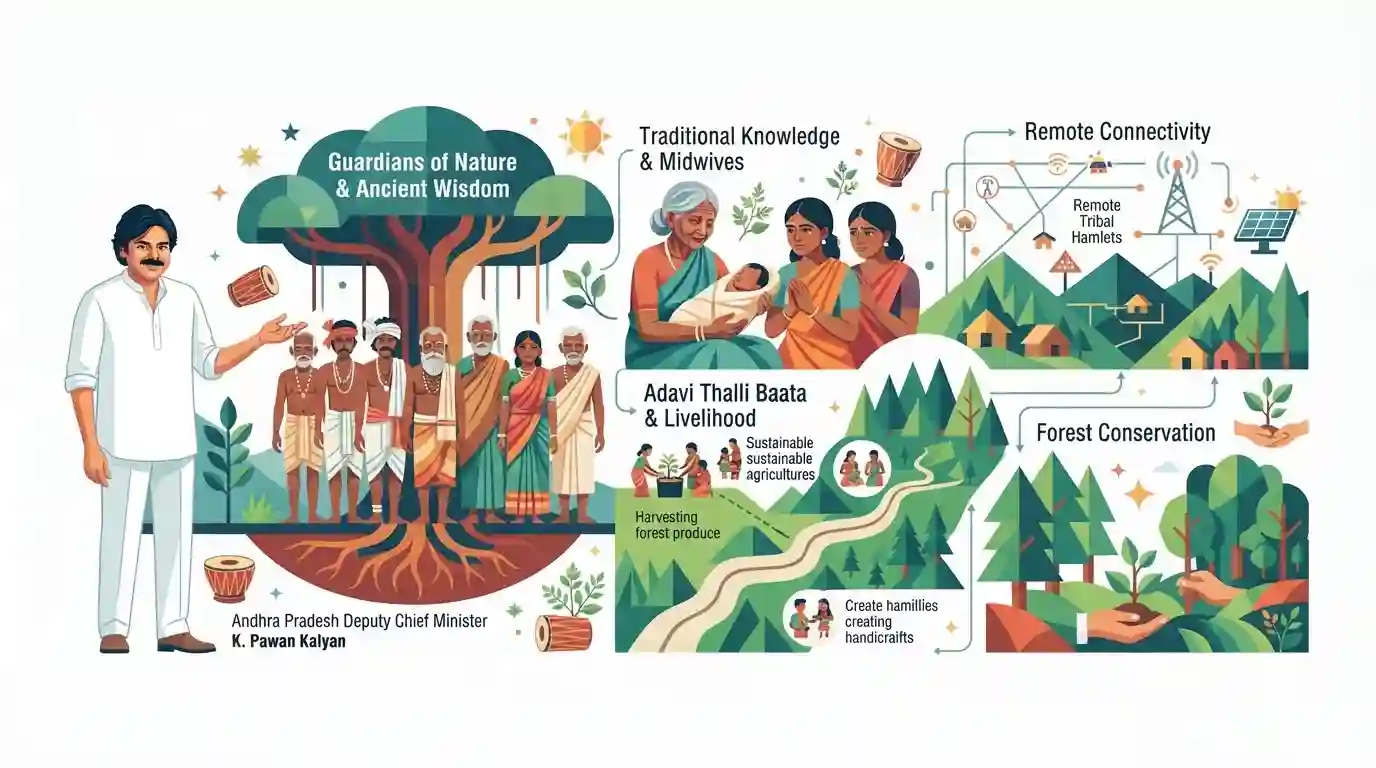
On the occasion of the International Day of the World's Indigenous Peoples, Andhra Pradesh Deputy Chief Minister K. Pawan Kalyan highlighted the role of tribal communities as guardians of nature, culture, and ancient wisdom. Acknowledging the 2026 theme centered on honoring indigenous midwives, he underscored the value of traditional knowledge passed down through generations. He also highlighted state welfare initiatives like 'Adavi Thalli Baata' and efforts to improve remote connectivity, livelihood opportunities, and forest conservation to ensure inclusive development for tribal families.
ముఖ్య అంశాలు
- International Day of the World's Indigenous Peoples was observed to recognize the vital role of tribal communities in preserving nature and heritage.
- The 2026 theme, 'Honouring Indigenous Midwives: Safeguarding Life and Well-being', highlights the importance of traditional knowledge and indigenous women in healthcare and culture.
- Andhra Pradesh Deputy Chief Minister Pawan Kalyan praised tribal populations as the guardians of forests, culture, and ancient wisdom.
- The state government is advancing tribal welfare through initiatives such as 'Adavi Thalli Baata', alongside improving remote connectivity and strengthening forest protection.
ముఖ్యమైన పదాలు
Adavi Thalli Baata

An Andhra Pradesh government initiative to improve connectivity in remote tribal areas. By building adequate roads, it aims to eliminate traditional carriers like dollies, enhancing tribal access to healthcare, education, and livelihood opportunities.
UPSC context
GS Paper 2 (Welfare Schemes) & GS 3 (Infrastructure). Tests state interventions for inclusive development and tribal upliftment.
International Day of the World's Indigenous Peoples
Observed annually on August 9, this UN-designated day raises awareness about the rights, cultures, and contributions of indigenous populations. It commemorates the 1982 inaugural meeting of the UN Working Group on Indigenous Populations.
UPSC context
GS Paper 2 (Social Justice, International Institutions). Relevant for tribal rights, global governance, and safeguarding vulnerable demographics.
Traditional Knowledge (TK)
The practices, skills, and innovations developed and passed down through generations within indigenous communities. It plays a critical role in biodiversity conservation, sustainable agriculture, and traditional medicine systems.
UPSC context
GS Paper 3 (Intellectual Property Rights, Environment). Important for questions on biopiracy, traditional ecological knowledge, and patent protections.
Indigenous Midwives
Traditional maternal caregivers within indigenous communities. The 2026 UN theme honors their vital role as knowledge holders who provide culturally appropriate approaches to well-being and safeguard maternal health using ancestral practices.
UPSC context
GS Paper 1 (Society) & GS Paper 2 (Health). Links indigenous cultural practices with modern public health and maternal mortality.
ప్రిలిమ్స్ ఉచ్చు
'Adavi Thalli Baata' is a centrally sponsored afforestation scheme under MoEFCC.
It is not an afforestation or central scheme. It is an Andhra Pradesh state government initiative focused on infrastructure—building concrete roads to connect remote tribal habitations.
అనుసంధానమైన స్థిర భావనలు
What are the criteria for identifying Particularly Vulnerable Tribal Groups (PVTGs)?
- Technology: Reliance on a pre-agricultural level of technology.
- Population: A stagnant or declining population growth rate.
- Literacy: Extremely low levels of literacy compared to other Scheduled Tribes.
- Economy: A subsistence level of economy, often dependent on hunting, gathering, or basic agriculture.
What key rights are recognized under the Forest Rights Act (FRA), 2006?
- Title Rights: Ownership of land being farmed by tribals or forest dwellers as of December 13, 2005, max 4 hectares.
- Use Rights: Access to minor forest produce (MFP), grazing areas, and pastoralist routes.
- Management Rights: Right to protect, regenerate, or conserve any community forest resource for sustainable use.
అంతర-అంశ నమూనాలు
Traditional Knowledge & Bio-piracy
Recognizing indigenous wisdom often links with GS3 topics like the Traditional Knowledge Digital Library (TKDL) and preventing bio-piracy under the Biological Diversity Act, 2002.
Remote Connectivity & LWE
State schemes like 'Adavi Thalli Baata' map directly onto GS3 Internal Security—building roads in remote tribal belts is a core strategy to counter Left Wing Extremism.

A multi-statement Prelims question mixing PVTG criteria, FRA 2006 provisions, and traditional knowledge protection is highly likely.
అనుసంధాన PYQలు · 4
అనుసంధాన PYQలు · 4
- 2024APPSC_PRELIMSGS1
Match the following : | List-I (Hunters/ Nomadic tribes) | List-II (Region) | |---|---| | A. Pygmies | I. East Africa | | B. Masai | II. Congo basin | | C. Semangs | III. Borneo | | D. Punan | IV. Malaysia | Choose the correct answer using the codes given below : Code: A B C D
- 2023APPSC_PRELIMSGS1
According to the Indian Forest Act, 1927, which of the following is the most appropriate sequence which shows the degree of protection between different forest types ?
- 2019APPSC_PRELIMSGS1
Zulu tribes are found in
- 2024APPSC_PRELIMSGS1
In India, Sholas are:
