Supreme Court orders interim stay on tribal burials dispute
Source:Indian Express ↗
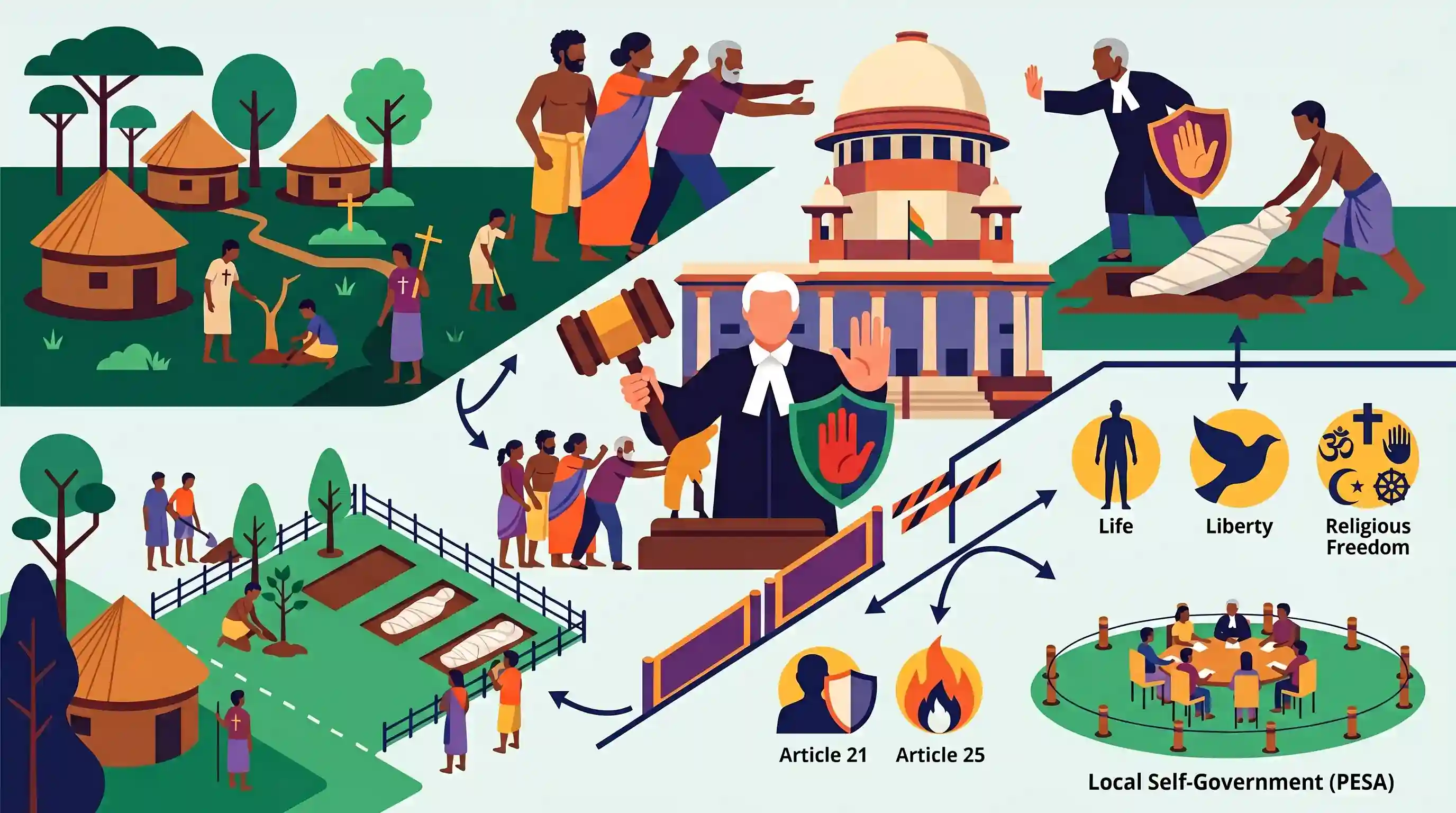
Why It Matters
The issue serves as a critical case study on the friction between individual fundamental rights (Right to Life and Religion) and the collective rights/autonomy of tribal Gram Sabhas under the Fifth Schedule and PESA Act. It also touches upon sensitive socio-political themes of religious conversion and tribal identity in Central India.
Summary
The Supreme Court of India has issued an interim stay on the forcible exhumation of tribal Christians' bodies in Chhattisgarh. The directive came in response to a PIL filed by the Chhattisgarh Association for Justice and Equality, which alleged that tribal Christians are being systematically denied the right to bury their deceased in their ancestral villages. The petition highlights instances of bodies being forcibly shifted due to opposition from local Gram Sabhas, often fueled by fears of forced religious conversions. The petitioners argue that the right to a decent burial is integral to life and personal liberty (Article 21) and religious freedom (Article 25), urging that Gram Panchayats be mandated to demarcate specific burial areas. This issue brings to the forefront the ongoing tension between individual constitutional rights and the collective autonomy granted to tribal bodies under the PESA Act.
Key Points
- The Supreme Court ordered an interim stay on the forcible exhumation of bodies of tribal Christians in Chhattisgarh.
- A PIL alleged that tribal Christians are being denied the right to bury their dead in their native villages, and bodies already buried are being forcibly relocated.
- The plea argues that every citizen, regardless of religion or caste, has a fundamental right to a decent burial in their village.
- In certain areas, Gram Sabhas have barred Christian pastors due to fears of forced religious conversions, leading to conflicts over burial grounds.
- The case highlights the complex intersection of fundamental rights (Articles 21 and 25) and the authority of local Gram Sabhas empowered by the PESA Act in tribal areas.
Important Terms
PESA Act (Panchayat Extension to Scheduled Areas)

A 1996 law extending Part IX of the Constitution to Fifth Schedule areas, empowering tribal communities through self-governance and mandatory Gram Sabha consultation on local resources and customs.
UPSC context
GS II: Governance and Tribal Administration. Tests understanding of decentralization and tribal autonomy in scheduled areas.
Article 21
Guarantees the right to life and personal liberty, which the judiciary interprets as including the right to a decent burial and dignity after death.
UPSC context
GS II: Fundamental Rights. Tests knowledge of the 'expansive' nature of the right to life.
Article 25
Provides freedom of conscience and the right to freely profess, practice, and propagate religion, subject to public order, morality, and health.
UPSC context
GS II: Secularism and Fundamental Rights. Tests the balance between religious freedom and societal regulations.
Gram Sabha
The primary unit of governance under PESA, consisting of all voters in a village; it is empowered to safeguard community traditions and approve development plans.
UPSC context
GS II: Local Self-Government. Tests the distinction between direct democracy (Sabha) and representative bodies (Panchayat).
Fifth Schedule
Constitutional provision for the administration and control of Scheduled Areas and Scheduled Tribes in states other than Assam, Meghalaya, Tripura, and Mizoram.
UPSC context
GS II: Indian Constitution. Tests understanding of special administrative frameworks for tribal welfare.
Public Interest Litigation (PIL)
Legal action initiated in a court of law for the enforcement of public interest or constitutional rights, often by parties not directly affected.
UPSC context
GS II: Judiciary. Tests knowledge of judicial activism and tools for protecting marginalized groups.
Prelims Trap
The Right to a decent burial is explicitly guaranteed under Article 25's Freedom of Religion.
It is an IMPLICIT right read into Article 21 (Right to Life and Personal Liberty) by the Supreme Court, not an explicit provision of Article 25.
Static Concepts Connected
What are the key powers of Gram Sabhas under the PESA Act 1996?
- Cultural Safeguards: Statutory authority to preserve traditions, customs, cultural identity, and community resources of tribal populations.
- Resource Control: Ownership of minor forest produce and control over local plans and resources for such plans.
- Land Protection: Power to prevent alienation of land in Scheduled Areas and restore any unlawfully alienated tribal land.
How is the freedom of religion restricted under Article 25?
- Standard Exceptions: Subject to public order, morality, and health, allowing the State to restrict practices violating these norms.
- Part III Primacy: Explicitly subject to other Fundamental Rights, meaning religious practices cannot violate rights like Article 21 (Life).
- Secular Regulation: The State can regulate economic, financial, political, or secular activities associated with religious practice.
Cross-Topic Patterns
Tribal autonomy vs Fundamental Rights
This mirrors broader constitutional tensions where collective tribal protections under the Fifth Schedule and PESA clash with individual rights, similar to debates around tribal inheritance and customary laws.
Anti-conversion laws & Article 25
Underlying this burial conflict are state anti-conversion fears, linking back to the Rev. Stainislaus judgment which ruled that the right to 'propagate' does not include the right to forcibly convert.

A 2026 Prelims question will likely contrast PESA Gram Sabha powers with implicit Article 21 rights like the right to a dignified burial.
Linked PYQs · 5
Linked PYQs · 5
- 2024MainsGS2
Right to privacy is intrinsic to life and personal liberty and is inherently protected under Article 21 of the constitution. Explain. In this reference discuss the law relating to D.N.A. testing of child in the womb to establish its paternity.
- 2017MainsGS2
Examine the scope of Fundamental Rights in the light of the latest judgement of the Supreme Court on Right to Privacy.
- 2022PrelimsGS1
If a particular area is brought under the Fifth Schedule of the Constitution of India, which one of the following statements best reflects the consequence of it ?
- 2015PrelimsGS1
The provisions in Fifth Schedule and Sixth Schedule in the Constitution of India are made in order to
- 2019PrelimsGS1
Under which Schedule of the Constitution of India can the transfer of tribal land to private parties for mining be declared null and void?
