Bhopal Tribal Museum Hosts Mahua Festival Highlighting Indigenous Arts
Source:timesofindia ↗
Why It Matters
MPPSC Prelims consistently features questions on tribal culture, local handicrafts, and cultural institutions in Madhya Pradesh. This article highlights key geographic craft centers in MP, such as traditional handlooms in Chhatarpur (Harpalpur) and brass casting in Betul (Tigariya), which align directly with MPPSC's history, culture, and geography syllabus.
Summary
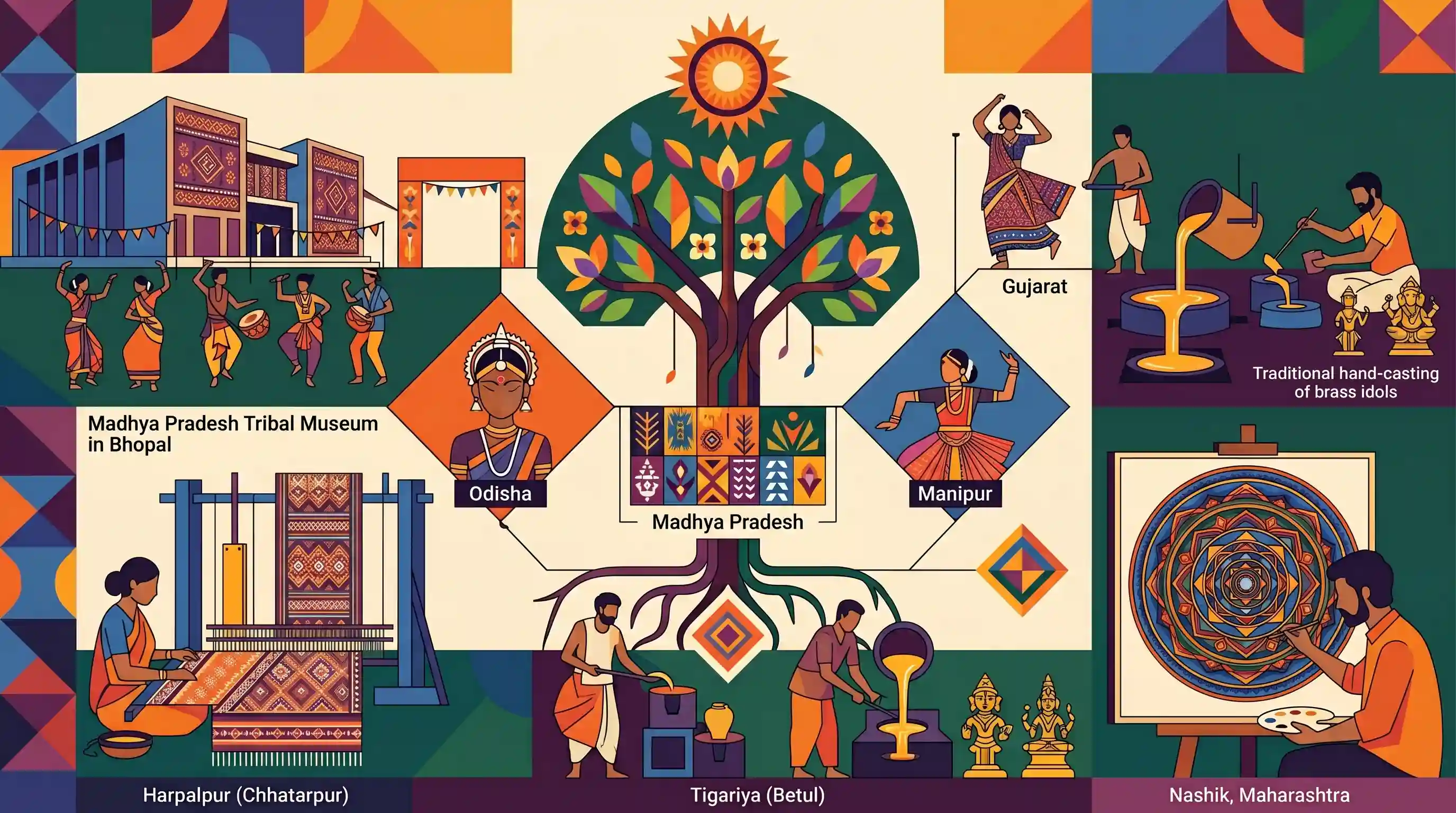
The five-day Mahua Festival, held at the Madhya Pradesh Tribal Museum in Bhopal, celebrated the vibrant artistic heritage of tribal communities. The festival featured works from tribal artisans representing Odisha, Gujarat, Manipur, and Madhya Pradesh. Key regional highlights included loom-woven handloom articles from Harpalpur (Chhatarpur) and traditional hand-cast brass idols from Tigariya village (Betul). Additionally, highly detailed Mandala paintings on canvas were showcased by an artist from Nashik, Maharashtra. Named after the culturally and economically significant Mahua tree, the event served as a vital platform for preserving and promoting indigenous tribal craftsmanship.
Key Points
- The five-day Mahua Festival was hosted at the Madhya Pradesh Tribal Museum in Bhopal, showcasing tribal art, crafts, and heritage.
- The festival brought together indigenous artisans from four different states: Odisha, Gujarat, Manipur, and Madhya Pradesh, along with regional artisans from Maharashtra.
- Artisans from Harpalpur in MP's Chhatarpur district displayed traditional loom-woven handloom products, including bedsheets, towels, shawls, and prayer mats (aasans).
- Tribal craftspersons from Tigariya village in MP's Betul district showcased traditional brass idols of deities, which are crafted using ancient casting techniques.
- A woman artist from Dindori village in Nashik, Maharashtra, showcased elaborate handmade Mandala paintings on canvas, which require months of meticulous work.
- Mahua is a vital botanical, dietary, and economic element for tribal communities in Central India, serving as the symbolic theme of this cultural confluence.
Important Terms
Madhya Pradesh Tribal Museum

An anthropological museum in Bhopal designed by Revathi Kamath, displaying the living heritage, myths, housing, and diverse art forms of Madhya Pradesh's major tribal groups, including Gonds, Bhils, and Korkus.
UPSC context
GS Paper I: Art & Culture; GS Paper II: Protection of vulnerable tribal communities and preservation of indigenous heritage.
Mahua Festival
A five-day annual cultural festival celebrated at Bhopal’s Tribal Museum, functioning as an economic and promotional platform for indigenous tribal artisans, cuisines, and performing arts from multiple Indian states.
UPSC context
GS Paper I: Indian Culture and Festivals; tests awareness of institutional efforts in tribal livelihood and cultural preservation.
Mahua Tree
A culturally and economically significant tropical deciduous tree (Madhuca longifolia) in Central India. Its flowers and seeds serve as vital non-timber forest produce for tribal food, medicine, and livelihoods.
UPSC context
GS Paper I: Indian Geography (vegetation); GS Paper III: Environment, Forestry, and sustainable tribal economy.
Dhokra Art of Betul
An ancient metal-casting handicraft using the lost-wax technique. Locally known as Bharewa craft, it is traditionally practiced by the Bharewas (a sub-tribe of Gonds) in Betul, Madhya Pradesh.
UPSC context
GS Paper I: Traditional Indian Art and Craft; tests knowledge of indigenous metal-casting techniques and regional crafts.
Prelims Trap
The Forest Rights Act, 2006 classifies Mahua as minor forest produce, but its ownership and disposal rights remain vested with State Forest Departments.
Under the FRA 2006, ownership, access to collect, use, and dispose of minor forest produce (including Mahua) is legally vested in forest-dwelling communities and Gram Sabhas, not State Forest Departments.
Static Concepts Connected
What is the Lost-Wax (Cire-Perdue) casting technique?
- Historical origin: Dates back to the Harappan civilization, with the iconic bronze 'Dancing Girl' of Mohenjo-daro being the earliest known Indian specimen.
- The Process: A wax model is coated with clay, heated to drain out melted wax, and replaced by molten metal to create solid or hollow figurines.
- Regional variants: Dhokra (Chhattisgarh/Odisha) and Bharewa (Betul, Madhya Pradesh) are prominent indigenous tribal metal crafts utilizing this ancient casting process.
What defines Minor Forest Produce (MFP) under Indian law?
- Legal Definition: Section 2(i) of the Forest Rights Act (FRA), 2006, defines MFP as all non-timber forest produce of plant origin, including leaves, fruits, seeds, wild-honey, and Mahua flowers.
- Ownership Rights: The FRA 2006 uniquely recognizes and vests ownership, collection, use, and disposal rights of MFP directly to forest-dwelling Scheduled Tribes and traditional forest dwellers.
- State Support: TRIFED, under the Ministry of Tribal Affairs, administers the 'Minimum Support Price (MSP) for MFP' scheme to protect tribal gatherers from market exploitation.
Cross-Topic Patterns
NTFP & Tribal Economic Resilience
Non-Timber Forest Produce (like Mahua) forms the bedrock of tribal cash economies, linking environment conservation under PESA to market-access initiatives like TRIFED's Van Dhan Vikas Kendras.
GI Tags & Tribal Heritage Protection
Granting Geographical Indication (GI) tags to traditional crafts like Betul's Bharewa metal craft bridges intellectual property rights (IPR) with the socio-economic upliftment of indigenous craft clusters.

Expect a 2026 question linking ancient lost-wax casting techniques (Bharewa/Dhokra) with modern legal definitions of Minor Forest Produce.
Linked PYQs · 2
Linked PYQs · 2
- 2020MPPSC_PRELIMSGS1
In which city Madhya Pradesh Tribal Museum is situated?
- 2025MPPSC_PRELIMSGS1
Uchehara is a large centre of bronze craft. In which district of Madhya Pradesh is Uchehara located?
