Inter Ministerial Friction Threatens Forest Rights Act Implementation
Source:The Hindu ↗
কেন এটি গুরুত্বপূর্ণ
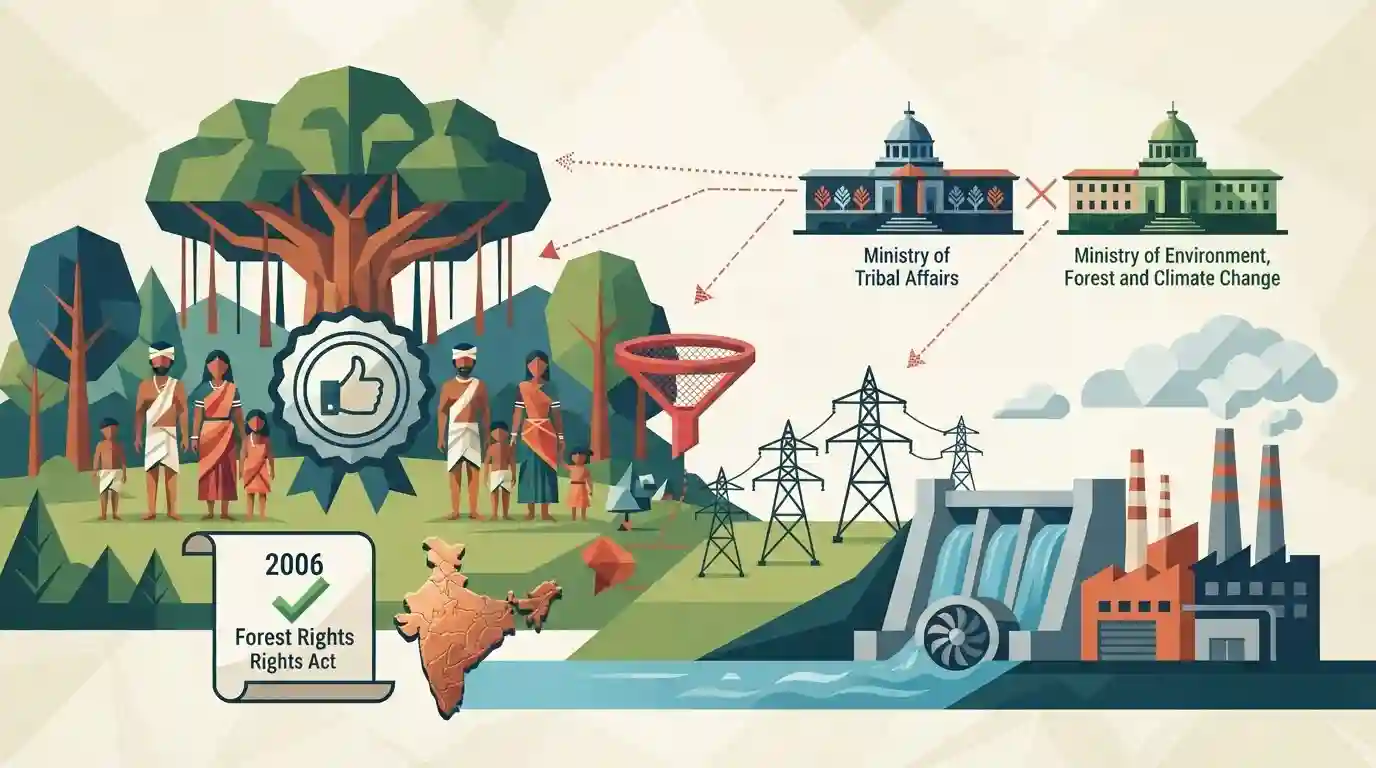
It highlights the structural challenges and policy friction surrounding the implementation of the Forest Rights Act, 2006, directly impacting constitutional safeguards, decentralized democracy (Gram Sabhas), and tribal livelihoods in the context of infrastructure development.
সারসংক্ষেপ
This article examines the growing challenges to India's forest rights regime, focusing on how administrative measures and inter-ministerial dynamics between the Tribal Affairs and Environment ministries are weakening the Scheduled Tribes and Other Traditional Forest Dwellers (Recognition of Forest Rights) Act, 2006. It highlights concerns over the dilution of Gram Sabha consent, particularly for power and infrastructure projects, raising questions about balancing developmental needs with tribal rights.
মূল বিষয়
- The Forest Rights Act (FRA), 2006, is facing institutional erosion due to conflicting policies and administrative actions by various ministries.
- Gram Sabha consent provisions are increasingly being bypassed or diluted for linear and power infrastructure projects.
- Tensions persist between developmental imperatives (such as power transmission and infrastructure) and the rights of tribal and forest-dwelling communities.
- Inter-ministerial coordination gaps between the Ministry of Tribal Affairs and the Ministry of Environment, Forest and Climate Change undermine statutory safeguards for forest dwellers.
গুরুত্বপূর্ণ শব্দ
Scheduled Tribes and Other Traditional Forest Dwellers (Recognition of Forest Rights) Act, 2006

Landmark 2006 legislation recognizing the rights of forest-dwelling Scheduled Tribes and Other Traditional Forest Dwellers over individual and community forest lands, aiming to redress historical injustices and empower Gram Sabhas.
UPSC context
UPSC Mains GS Paper II & III (Governance, Social Justice, Environment): Frequently tested for tribal rights, conservation conflicts, and federal implementation bottlenecks.
Ministry of Tribal Affairs
The nodal central government ministry responsible for the overall policy, planning, and coordination of socio-economic development programs for Scheduled Tribes and the implementation of the FRA, 2006.
UPSC context
UPSC Prelims & Mains GS Paper II (Governance): Tests institutional mandates, ministerial jurisdiction, and welfare policies concerning vulnerable sections.
Ministry of Environment, Forest and Climate Change
The apex central ministry tasked with regulating environmental protection, wildlife conservation, forestry laws, and climate change policies, often intersecting with development and tribal land use.
UPSC context
UPSC Mains GS Paper III (Environment & Biodiversity): Evaluates trade-offs between environmental clearances, infrastructure projects, and forest governance.
সংযুক্ত স্থির ধারণা
What is the three-tier institutional mechanism for recognizing rights under the Forest Rights Act (FRA), 2006?
- Gram Sabha: Initiates the claims process, verifies traditional boundaries, and passes resolutions at the village level.
- Sub-Divisional Level Committee: Examines and processes claims forwarded by the Gram Sabha before submission to the district committee.
- District Level Committee: The final decision-making body chaired by the District Collector that issues titles for individual and community forest rights.
আন্তঃবিষয় প্যাটার্ন
FRA Dilution vs. Infrastructure Expediency
Infrastructure development exemptions under the Forest Conservation Amendment Act intersect with FRA consent mandates, highlighting the clash between rapid project clearance and decentralized grassroots democracy.
PVTG Habitat Rights & Bureaucratic Apathy
Delays in recognizing PVTG habitat rights reflect broader challenges in safeguarding vulnerable demographics amidst top-down bureaucratic priority shifts.

FRA implementation bottlenecks, Gram Sabha authority, and MoEFCC-MoTA jurisdiction overlaps are high-yield for Mains and Prelims statements.
সংযুক্ত PYQ · 2
সংযুক্ত PYQ · 2
- 2019MainsGS2
Performance of welfare schemes that are implemented for vulnerable sections is not so effective due to absence of their awareness and active involvement at all stages of policy process. Discuss.
- 2024MainsGS3
What role do environmental NGOs and activists play in influencing Environmental Impact Assessment (EIA) outcomes for major projects in India? Cite four examples with all important details.
