Trial Courts Form Backbone of Justice Delivery System
Source:The Hindu ↗
Why It Matters
The lower judiciary/subordinate courts handle the bulk of litigation in India. Improving their infrastructure, ensuring institutional capacity, and facilitating legal aid are pivotal areas of discussion in GS-2 (Polity and Governance) regarding judicial reforms and the delivery of timely justice.
Summary
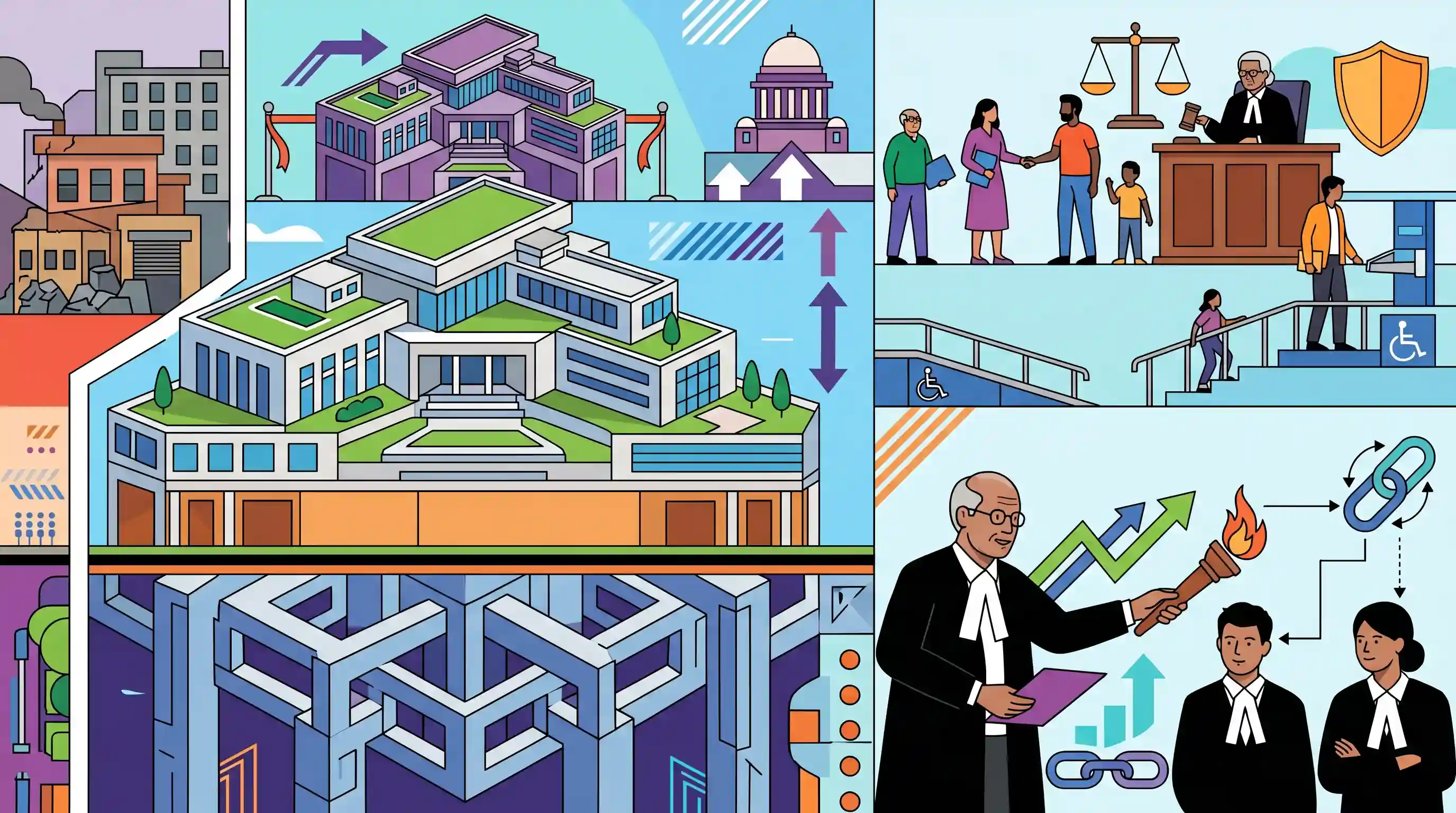
Supreme Court Judge K.V. Viswanathan described trial courts as the vital backbone of India's justice delivery system during the inauguration of a new ₹40.57 crore combined court complex in Pollachi, Tamil Nadu. He stressed that courts are constitutional institutions that must safeguard citizens' rights and uphold the rule of law. Additionally, he advocated for structured mentorship programs within Bar associations for junior lawyers. Madras High Court Chief Justice S.A. Dharmadhikari noted that the state-of-the-art facility will replace congested spaces, marking a major step forward in strengthening subordinate judicial infrastructure.
Key Points
- Supreme Court Judge K.V. Viswanathan emphasized that trial courts are the 'backbone of the justice delivery system' because they serve as the first and often only point of contact with the judiciary for the majority of citizens.
- A court is not merely physical infrastructure ('bricks and mortar') but a constitutional institution designed to inspire confidence in the rule of law and the protection of citizens' rights.
- The judge called on Bar associations to establish structured mentorship programmes where senior advocates actively guide and train junior lawyers to bolster professional competence.
- The newly inaugurated combined court complex at Pollachi (built at ₹40.57 crore) features modern amenities like 10 court halls, legal aid facilities, videoconferencing, a library, and dedicated residential quarters for judicial officers.
- Madras High Court Chief Justice Sushrut Arvind Dharmadhikari highlighted that 48 out of 59 courts in the Coimbatore district have now transitioned to dedicated judicial buildings, resolving the challenges of functioning from congested, shared government premises.
Important Terms
Subordinate Judiciary

The tier of Indian courts operating below the High Courts at district and lower levels, handling civil, criminal, and revenue cases, and serving as the primary interface between citizens and the justice system.
UPSC context
GS Paper II: Structure, organization, and functioning of the Judiciary; tests knowledge of lower courts, their jurisdiction, challenges, and judicial reforms.
Judicial Infrastructure
The physical, digital, and human resources—including court complexes, digital connectivity, personnel, and civic amenities—essential for the efficient functioning of courts and the equal, dignified, and timely delivery of justice.
UPSC context
GS Paper II: Issues relating to development of Judiciary; tests understanding of pendency challenges, funds utilization, and structural judicial reforms.
Supreme Court of India
The apex judicial body under the Indian Constitution, acting as the final court of appeal, the ultimate interpreter of the Constitution, and the protector of citizens' fundamental rights.
UPSC context
GS Paper II: Structure, organization, and functioning of the Judiciary; tests fundamental concepts of judicial review, separation of powers, and landmark judgments.
Madras High Court
One of the oldest High Courts in India, established in 1862, exercising appellate and original jurisdiction over Tamil Nadu and Puducherry, and administering the subordinate judiciary within its state jurisdiction.
UPSC context
GS Paper II: Structure and functioning of State Judiciary; tests federal judicial administration, writ jurisdiction under Article 226, and supervisory control.
Legal Services Authorities Act, 1987
A landmark Indian law enacted to provide free and competent legal services to weaker sections of society, ensuring equal justice under Article 39A, and establishing the statutory framework for Lok Adalats and NALSA.
UPSC context
GS Paper II: Welfare schemes, legal aid, and ADR mechanisms; tests understanding of statutory bodies (NALSA) and constitutional mandates for access to justice.
Bar Association
A voluntary, local professional collective of advocates that represents lawyers' interests, promotes legal ethics, and organizes welfare programs, operating alongside the regulatory statutory body, the Bar Council of India.
UPSC context
GS Paper II: Important aspects of governance and the legal profession; tests professional legal ethics, constitutional rights to counsel, and judicial administration.
Prelims Trap
Administrative control over subordinate courts, including postings and promotions, is vested directly in the state Governor.
Under Article 235, administrative control is vested solely in the High Court. The Governor only makes appointments and postings in consultation with the High Court under Article 233.
Static Concepts Connected
How is the subordinate judiciary controlled under the Indian Constitution?
- Article 233: District judges are appointed, posted, and promoted by the Governor of the State in consultation with the High Court.
- Article 234: Appointments of other judicial officers are made by the Governor after consulting the State Public Service Commission and the High Court.
- Article 235: The administrative control over district courts and subordinate courts is vested entirely in the respective state High Court.
What is the statutory framework for free legal aid in India?
- Statutory Origin: Enacted to fulfill the mandate of Article 39A (DPSP) to ensure access to justice is not denied due to economic disabilities.
- Targeted Eligibility: Women, children, SC/ST members, and industrial workmen qualify automatically for free legal aid, irrespective of their annual income.
- NALSA Structure: Formulates policies and monitors legal aid implementation, headed by the Chief Justice of India as Patron-in-Chief.
Cross-Topic Patterns
CSS funding + State execution bottlenecks
Centrally Sponsored Schemes for judicial infrastructure often face severe underutilization by states, showing how administrative friction slows down lower-court modernization.
Legal Tech + Grassroots Access
Deploying AI translation tools like SUVAS in trial courts helps bridge linguistic divides, ensuring vernacular-speaking litigants understand proceedings in real-time.

Subordinate judiciary vacancies and the proposed NJIAI's structural friction with executive powers will likely dominate GS2 Mains 2026.
Linked PYQs · 3
Linked PYQs · 3
- 2013PrelimsGS1
With reference to National Legal Services Authority, consider the following statements : 1. Its objective is to provide free and competent legal services to the weaker sections of the society on the basis of equal opportunity. 2. It issues guidelines for the State Legal Services Authorities to implement the legal programmes and schemes throughout the country. Which of the statements given above is/are correct?
- 2020PrelimsGS1
In India, Legal Services Authorities provide free legal services to which of the following type of citizens? 1. Person with an annual income of less than ₹ 1,00,000 2. Transgender with an annual income of less than ₹ 2,00,000 3. Member of Other Backward Classes (OBC) with an annual income of less than ₹ 3,00,000 4. All Senior Citizens Select the correct answer using the code given below:
- 2023MainsGS2
“Constitutionally guaranteed judicial independence is a prerequisite of democracy.” Comment.
