Salem forest trekking ban and mitigation strategies for wildfires
Source:The Hindu ↗
Why It Matters
Forest fires are a recurring natural/man-made disaster in India that devastate biodiversity and local livelihoods. Understanding grassroots mitigation strategies—such as fire lines, temporary trekking bans, and provisioning water to prevent human-animal conflict—is essential for answering GS3 questions on disaster preparedness, sustainable tourism, and ecosystem management.
Summary
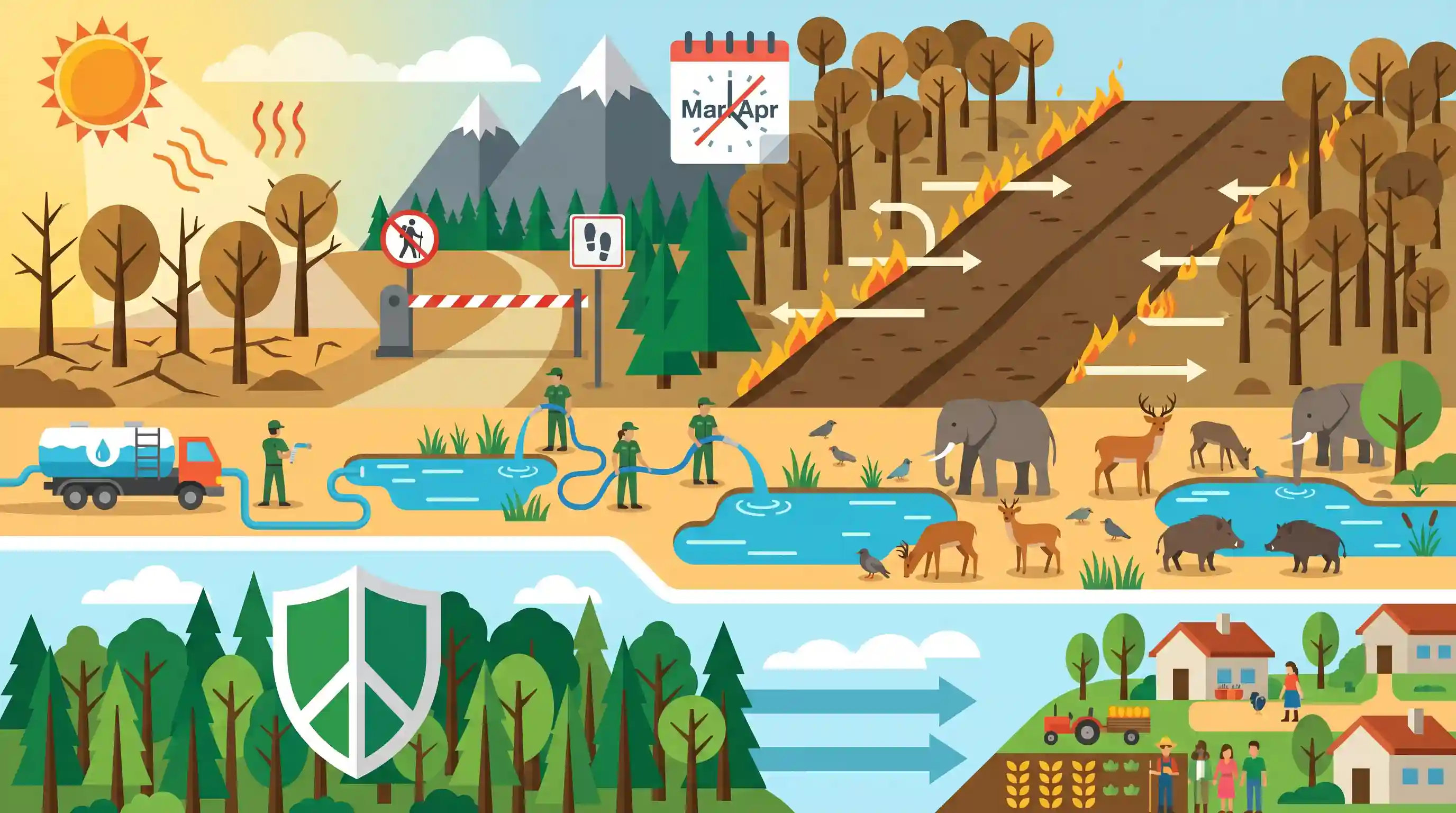
In a proactive step to prevent summer forest fires, the Forest Department in Salem has banned trekking in vulnerable areas such as Yercaud until mid-April. Alongside restricting human access, authorities have created extensive fire lines to contain potential outbreaks and are artificially filling forest water bodies to sustain wildlife. These measures not only safeguard the ecosystem from fire disasters but also mitigate human-animal conflicts by ensuring animals do not leave the forest in search of water.
Key Points
- Trekking activities in sensitive forest spots in Salem district have been suspended from mid-February to mid-April to mitigate summer forest fire risks.
- Forest officials have established over 200 km of 'fire lines' across multiple ranges to halt the potential spread of wildfires.
- To prevent wild animals from straying into human settlements in search of water, the department is actively filling water tubs and percolation ponds inside the forests.
- Village Forest Committees are engaging with local communities to raise awareness and discourage practices that could ignite accidental fires.
Important Terms
Forest Fire

Uncontrolled combustion of vegetation in forest areas, often intensified by dry summer conditions and anthropogenic factors like unattended campfires or land clearing.
UPSC context
GS III: Disaster Management and Environment; covers causes, mitigation strategies, and the National Action Plan on Forest Fires.
Fire Line
A gap in vegetation or a cleared strip of land, kept free of combustible materials, acting as a barrier to stop or slow the progress of wildfires.
UPSC context
GS III: Disaster Management; tests technical knowledge of proactive forest fire prevention and traditional management techniques.
Human-Wildlife Conflict
Interactions between humans and wildlife that result in negative impacts on people, animals, or resources, frequently triggered by habitat fragmentation or seasonal water scarcity.
UPSC context
GS III: Biodiversity and Environment; focuses on ecological drivers, socio-economic impacts, and integrated mitigation strategies.
Village Forest Committee (VFC)
A village-level body formed under Joint Forest Management (JFM) to involve local communities in protecting and managing forests in exchange for forest produce.
UPSC context
GS II: Governance and GS III: Environment; tests decentralized management and community-led conservation models.
Eastern Ghats
A discontinuous range of mountains along India's eastern coast, including hills like Yercaud, known for high biodiversity and significant ecological vulnerability to climate change.
UPSC context
GS I: Geography; covers physiography, drainage patterns, and the ecological distinction from the Western Ghats.
Joint Forest Management (JFM)
A partnership-based forest management strategy established by the 1988 National Forest Policy, involving state forest departments and local village-level committees.
UPSC context
GS III: Environment and Conservation; essential for understanding participatory governance and sustainable forest resource use.
Prelims Trap
"Village Forest Committees are statutory bodies established under the Forest Rights Act (FRA), 2006."
VFCs are actually non-statutory institutions created under the Joint Forest Management (JFM) guidelines of the National Forest Policy, 1988.
Static Concepts Connected
What are 'Fire Lines' in forest disaster management?
- Fuel Breaks: Strips of land cleared of dry biomass and flammable vegetation to break fuel continuity and halt the spread of wildfires.
- Classification: Classified as 'Kachha' (retaining mature trees while clearing undergrowth) and 'Pucca' (completely clear-felled zones) as per NDMA guidelines.
How do forest fires impact ecology and soil health?
- Succession Control: Periodic, low-intensity natural fires prevent trees from overtaking grasslands, aiding ecological succession and maintaining savanna ecosystems.
- Soil Degradation: High-intensity, unseasonal fires destroy the soil's top organic layer, accelerating surface runoff and drastically reducing groundwater retention capacity.
- Anthropogenic Dominance: Over 90% of forest fires in India are anthropogenic, primarily driven by slash-and-burn agriculture and human negligence along forest fringes.
Cross-Topic Patterns
Forest fires & human-wildlife conflict
Forest fires and drying water bodies force wildlife into human settlements, making the artificial provisioning of water in percolation ponds a critical tool for mitigating human-animal conflict during summer.
Eastern Ghats ecotourism carrying capacity
Yercaud (Shevaroy Hills) is a crucial biodiversity node in the Eastern Ghats. Unregulated ecotourism here heightens anthropogenic fire risks, making seasonal trekking bans vital for ecosystem preservation.

Expect a 2026 multi-statement question linking anthropogenic forest fires, the ecological utility of fire lines, and Joint Forest Management.
Linked PYQs · 3
Linked PYQs · 3
- 2019MainsGS3
Vulnerability is an essential element for defining disaster impacts and its threat to people. How and in what ways can vulnerability to disasters be characterized? Discuss different types of vulnerability with reference to disasters.
- 2019MainsGS3
Define the concept of carrying capacity of an ecosystem as relevant to an environment. Explain how understanding this concept is vital while planning for sustainable development of a region.
- 2013PrelimsGS1
In the grasslands, trees do not replace the grasses as a part of an ecological succession because of
