Tejashwi Demands Equal Status for Urdu and Sanskrit in Bihar
Source:The Hindu ↗
Why It Matters
Highlights the administrative challenges in Bihar\'s education system regarding minority and classical languages, touching upon themes of linguistic heritage, minority institutions, and state governance policies relevant to BPSC exams.
Summary
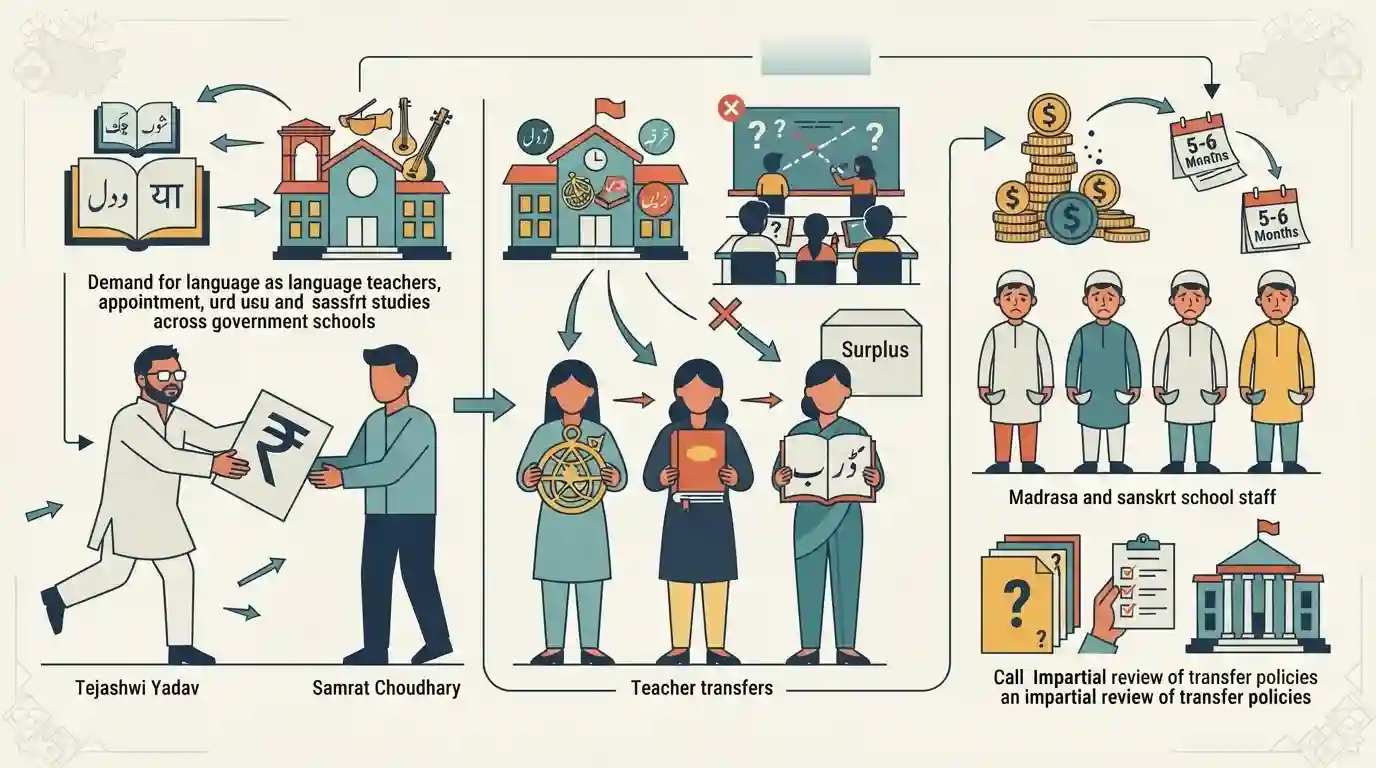
RJD leader Tejashwi Yadav has written to Bihar Chief Minister Samrat Choudhary, demanding the appointment of Urdu and Sanskrit teachers across all government schools to preserve India\'s cultural heritage. He raised serious concerns about the irregular transfer of Urdu, Arabic, and Persian teachers who have been wrongly categorized as \'surplus\', halting education in these subjects. Furthermore, Yadav highlighted the financial distress of staff in aided Madrasas and Sanskrit schools due to 5-6 months of unpaid salaries, calling for an immediate, impartial review of the government\'s teacher transfer policies.
Key Points
- Leader of Opposition Tejashwi Yadav urged Bihar CM Samrat Choudhary to appoint Urdu and Sanskrit teachers in all state government schools.
- He criticized the discriminatory transfer policy where Urdu, Arabic, and Persian teachers are being irregularly declared \'surplus\', effectively halting instruction in these languages.
- Yadav highlighted that salaries for teaching and non-teaching staff in aided Madrasas and Sanskrit schools have been pending for 5-6 months.
- He emphasized that both Urdu and Sanskrit are vital to India\'s cultural heritage and should be treated with equal academic respect.
- Demanded an independent review of the transfer list and the cancellation of irregular transfers to ensure transparency in Bihar\'s education system.
Important Terms
Rashtriya Janata Dal (RJD)

A regional political party primarily active in Bihar, founded in 1997. It focuses on social justice and secularism, currently playing a major role in the state's coalition politics and legislative opposition.
UPSC context
GS Paper 2 (Indian Polity). Relevant for studying regional political parties, coalition dynamics, and electoral behavior.
State Legislative Assembly
The lower house of Bihar's bicameral state legislature (Vidhan Sabha). Comprising directly elected Members of Legislative Assembly (MLAs), it enacts state laws, oversees government policies, and holds the executive accountable.
UPSC context
GS Paper 2 (State Legislature). Crucial for understanding constitutional provisions of state governance, legislative processes, and executive accountability.
Minority Educational Institutions (Article 30)
Schools or colleges established and administered by religious or linguistic minorities. Article 30 of the Indian Constitution grants them fundamental rights to preserve their distinct cultural identity.
UPSC context
GS Paper 2 (Fundamental Rights). Tests the constitutional protections for minorities, cultural rights, and Right to Education (RTE) Act exemptions.
Three-Language Formula
An educational policy introduced in 1968 to promote national integration. It requires students to learn three languages in school—typically Hindi, English, and a modern regional language—to balance linguistic diversity with unity.
UPSC context
GS Paper 2 (Education Policy). Important for analyzing the National Education Policy (NEP) 2020, cultural preservation, and linguistic inclusivity.
Prelims Trap
The Right to Education (RTE) Act mandates standardized teacher recruitment and curriculum norms for all aided Madrasas and Vedic schools.
The RTE Amendment Act of 2012 explicitly exempts Madrasas, Vedic Pathshalas, and institutions imparting religious instruction from the Act's regulatory and teacher-eligibility provisions.
Static Concepts Connected
What constitutional provisions safeguard linguistic minorities in India?
- Article 350B: Inserted by the 7th Constitutional Amendment (1956), it directs the President to appoint a Special Officer for Linguistic Minorities to monitor constitutional safeguards.
- Article 350A: Directs every state and local authority to provide adequate facilities for instruction in the mother-tongue at the primary stage of education to children belonging to linguistic minority groups.
- State-wise Determination: Linguistic minorities are determined on a state-by-state basis, referring to a community whose mother tongue is distinct from the majority language of that specific state.
What are the constitutional protections for minority-run educational institutions?
- Article 30(1): Grants all minorities (religious or linguistic) the fundamental right to establish and administer educational institutions of their choice.
- Article 30(2): Prohibits the State, when granting aid to educational institutions, from discriminating against any institution on the ground that it is under the management of a minority.
- Regulatory Limits: While the State can regulate academic standards, health, and sanitation, it cannot impose regulations that completely destroy the minority character of the institution.
Cross-Topic Patterns
Federalism and Linguistic Diversity
Balancing official state languages (Article 345) with safeguards for minority mother tongues (Article 350A) frequently triggers administrative and fiscal friction over language teacher funding.
Minority Rights vs. State Regulation
The intersection of Article 30 (minority institution autonomy) with state funding and teacher salary regularisation highlights the complex boundary between minority rights and state educational standards.

Linguistic minority safeguards under Article 350B, paired with the RTE Act's institutional exemptions, are prime target areas for GS-2.
Linked PYQs · 3
Linked PYQs · 3
- 2024-IBPSC_PRELIMSGS1
In April, 2020 the Bihar Education Department started the following program through DD Bihar
- 2025BPSC_PRELIMSGS1
What is the primary objective of Bihar’s Mission Daksh?
- 2025BPSC_PRELIMSGS1
Which Indian languages are accorded the status of Classical Language?
