Parliamentary procedures and inter-house rules in Rajya Sabha
Source:The Hindu ↗
Why It Matters
This clash underscores the operational dynamics of the Indian Parliament, specifically the principle of mutual exclusivity and independence of the two Houses (the Nehruvian precedent). It highlights the challenges of maintaining parliamentary decorum, the critical role of Presiding Officers in managing political conflicts, and the impact of frequent disruptions on executive accountability during major debates like the Motion of Thanks.
Summary
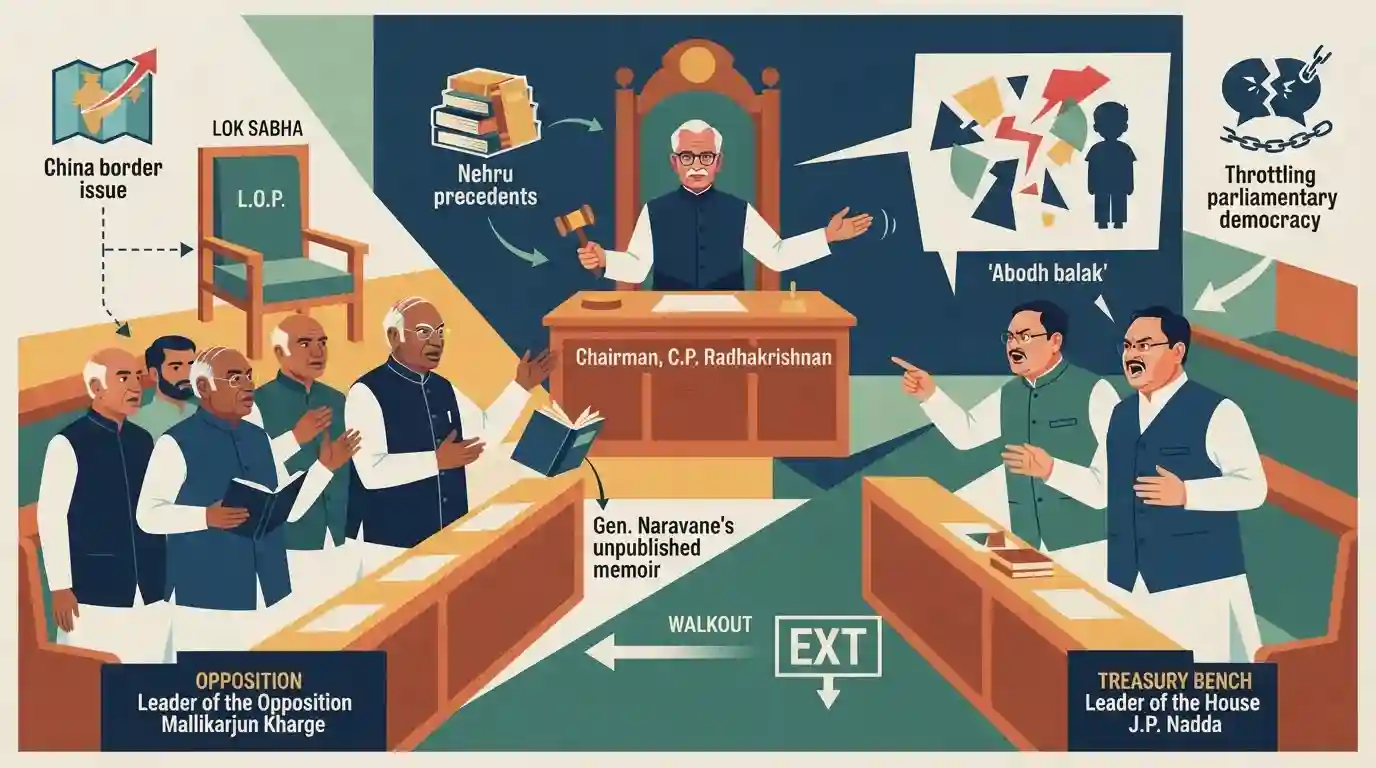
During the Budget Session in February 2026, tensions escalated in the Rajya Sabha when Opposition MPs staged a walkout over allegations that Lok Sabha LoP Rahul Gandhi was prevented from speaking on the China border issue. When Rajya Sabha LoP Mallikarjun Kharge tried to raise the Lok Sabha issue and quote Gen. M.M. Naravane's unpublished memoir, Chairman C.P. Radhakrishnan disallowed it, ruling that Lok Sabha proceedings cannot be discussed in the Rajya Sabha based on a precedent established by Jawaharlal Nehru. This led to a fierce war of words, with Leader of the House J.P. Nadda terming Rahul Gandhi an 'abodh balak' and Kharge accusing the Treasury benches of throttling parliamentary democracy.
Key Points
- Opposition MPs staged a walkout in the Rajya Sabha during the debate on the Motion of Thanks to the President's Address, protesting the alleged blocking of LoP Rahul Gandhi's speech in the Lok Sabha.
- Rajya Sabha Chairman C.P. Radhakrishnan ruled that proceedings of the Lok Sabha cannot be discussed or questioned in the Rajya Sabha, citing a historical precedent established by India's first Prime Minister, Jawaharlal Nehru, to maintain inter-house decorum.
- The Chairman disallowed Rajya Sabha LoP Mallikarjun Kharge from reading excerpts from an unpublished memoir of former Army Chief Gen. M.M. Naravane regarding the China border issue.
- Leader of the House J.P. Nadda criticized the Congress leadership and referred to Rahul Gandhi as an 'abodh balak' (ignorant child), prompting strong objections from Kharge, who accused the government of stifling democracy and using unparliamentary language.
Important Terms
Motion of Thanks to the President's Address

A formal parliamentary motion moved in both Houses to express gratitude for the President's Special Address, which outlines the government's policy agenda, achievements, and roadmap.
UPSC context
GS Paper II (Parliamentary Procedures & Accountability); tests understanding of constitutional devices like Article 87 and executive-legislative relations.
Rajya Sabha
The permanent upper house of India's bicameral Parliament representing the states and union territories, where one-third of the members retire every two years.
UPSC context
GS Paper II (Parliamentary Structure & Functioning); tests knowledge of bicameralism, federal representation, and Rajya Sabha's unique powers.
Lok Sabha
The directly elected lower house of India's Parliament, whose members represent constituencies for a five-year term unless the house is dissolved earlier.
UPSC context
GS Paper II (Parliamentary Structure); tests direct democratic representation, legislative procedures, and Lok Sabha's financial primacy.
Congress
Officially the Indian National Congress (INC), it is one of India's oldest national political parties, currently acting as a key parliamentary opposition.
UPSC context
GS Paper II (Political Parties & Electoral Dynamics); tests understanding of party systems and the opposition's democratic role.
Bharatiya Janata Party (BJP)
One of India's primary national political parties, advocating a nationalist ideology and currently leading the ruling National Democratic Alliance (NDA) coalition.
UPSC context
GS Paper II (Political Parties); tests insights into India's party system, coalition politics, and federal electoral dynamics.
Prelims Trap
An amendment or defeat of the Motion of Thanks in either House of Parliament forces the resignation of the Council of Ministers.
Only a defeat or amendment in the Lok Sabha forces resignation due to collective responsibility (Article 75). Rajya Sabha has amended it five times without government collapse.
Static Concepts Connected
What is the constitutional and procedural basis for bicameral independence and inter-house relations?
- Independent operation: Neither House can criticize, discuss, or question the internal proceedings, debates, or decisions of the other, preserving bicameral independence.
- The Nehru Precedent: Established in 1954 and codified in Rajya Sabha Rule 238(ii), it strictly prohibits discussing Lok Sabha proceedings on the Rajya Sabha floor.
- Judicial immunity: Article 122 insulates parliamentary proceedings from judicial scrutiny over alleged procedural irregularities, leaving control solely with the presiding officers.
What is the procedural significance of the Motion of Thanks under Article 87?
- Constitutional mandate: Article 87(1) requires the President to address a joint sitting at the start of the first session after elections and the first session of each year.
- Confidence test: Passage of the Motion of Thanks in the Lok Sabha is mandatory; its defeat or amendment there amounts to a vote of no-confidence.
- Rajya Sabha variance: The Rajya Sabha can amend the motion (done five times in history) without forcing the government to resign, as collective responsibility applies only to Lok Sabha.
Cross-Topic Patterns
Parliamentary Privileges vs Rule of Law
Article 105 shields MPs' speech, but Rule 238A limits defamatory statements and unauthenticated documents, showing how parliamentary privilege is constitutionally balanced by inner-house rules of decorum.
Bicameral Federal Balance
Rajya Sabha's power to amend the President's address without collapsing the government showcases its role as a deliberate federal chamber resisting majoritarian pressure from the lower house.

Expect 2026 prelims to test the statutory origin of the LoP alongside the exact procedural difference of amending the Motion of Thanks in RS.
Linked PYQs · 3
Linked PYQs · 3
- 2023MainsGS2
Discuss the role of Presiding Officers of state legislatures in maintaining order and impartiality in conducting legislative work and in facilitating best democratic practices.
- 2019MainsGS2
Individual Parliamentarian's role as the national law maker is on a decline, which in turn, has adversely impacted the quality of debates and their outcome. Discuss.
- 2021MainsGS2
To what extent, in your view, the Parliament is able to ensure accountability of the executive in India?
