Logistics Vulnerability and Supply Chain Disruption in Manipur
Source:The Hindu ↗
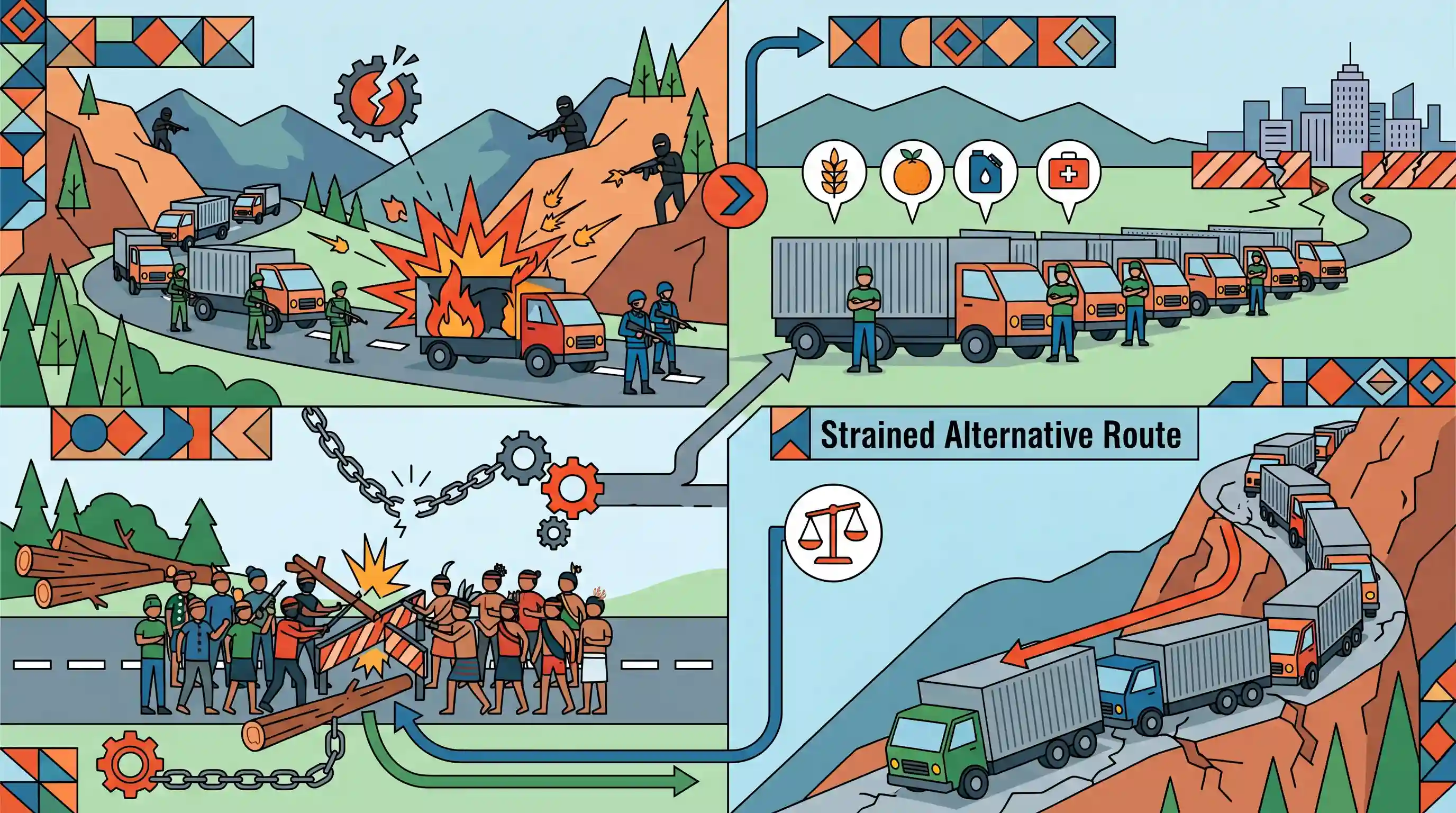
Why It Matters
Highlights the persistent fragility of internal security in the Northeast and the direct socio-economic impact of ethnic violence. It specifically points out the severe vulnerability of logistics networks and national highways in landlocked, conflict-prone areas where chokepoints can easily disrupt the supply of basic essentials.
Summary
Transporters in Manipur have suspended operations following the ambush and killing of a trucker by Kuki militants on National Highway 202. The incident, involving a supply convoy escorted by Central and State security forces, has severely disrupted the delivery of essential commodities to Imphal. The region's logistical fragility is compounded by the ongoing blockade of NH-2 due to ethnic tensions between Kuki and Naga communities, forcing over-reliance on the strained NH-37 route and highlighting the socio-economic costs of continuous ethnic strife.
Key Points
- Transporters suspended operations in Manipur after a truck driver transporting FCI rice was killed by Kuki militants in an ambush on National Highway 202.
- The convoy was attacked despite being escorted by a joint security team comprising BSF, CRPF, RAF, and Manipur Police.
- The strike threatens to sever the supply of essential commodities to Imphal from Assam's Barak Valley via NH-37.
- Manipur's logistical vulnerability is worsened by the concurrent blockade of NH-2, triggered by a hostage crisis between the Kuki and Naga communities.
- Transporters are demanding foolproof security guarantees and the reopening of NH-2, which is a shorter and better-maintained supply route than NH-37.
Important Terms
Kuki militants

Armed insurgent groups from the Kuki-Zo community seeking self-determination (Kukiland). Major groups like the KNA operate under Suspension of Operation (SoO) agreements, though recent ethnic violence has strained these pacts.
UPSC context
GS-III Internal Security; pertains to North East insurgency, ethnic conflicts, and the complexities of peace-building and border management.
Central Reserve Police Force (CRPF)
India’s largest Central Armed Police Force (CAPF) under the Ministry of Home Affairs. It is the primary agency for internal security, counter-insurgency, and maintaining law and order during civil unrest.
UPSC context
GS-III Security forces and their mandate; crucial for understanding the state’s response to internal security crises.
Rapid Action Force (RAF)
A specialized wing of the CRPF established in 1992 for riot control and crowd management. It uses non-lethal weapons to handle communal disturbances with minimal force.
UPSC context
GS-III Internal Security; focuses on specialized wings of CAPFs and their role in stabilizing communally sensitive zones.
Food Corporation of India (FCI)
A statutory body responsible for procuring, storing, and distributing foodgrains across India. It ensures national food security and manages the Public Distribution System (PDS) supply chain.
UPSC context
GS-III Public Distribution System (PDS) and Food Security; highlights logistical challenges in delivering essentials to conflict-prone regions.
Border Security Force (BSF)
India’s primary border-guarding organization for the borders with Pakistan and Bangladesh. In sensitive zones like Manipur, it is often requisitioned for internal security and convoy protection.
UPSC context
GS-III Security forces and their mandate; tests the operational diversity of CAPFs in varied security landscapes.
All Manipur Road Transport Drivers and Motor Workers' Union
A representative body of transport workers in Manipur. It functions as a pressure group, negotiating with the government for driver safety and highway security amidst ethnic blockades.
UPSC context
GS-II Role of Pressure Groups; relevant to how civil society and labor unions influence state policy on security and logistics.
Prelims Trap
"Meiteis predominantly inhabit the hill districts of Manipur, while Nagas and Kukis live in the central valley."
The central Imphal Valley is Meitei-dominated, while the surrounding hills are inhabited by Kuki-Zo and Naga tribes. UPSC often flips these geographical distributions.
Static Concepts Connected
What are the key National Highways serving as logistical lifelines to landlocked Manipur?
- NH-2: Connects Imphal to Dimapur (Nagaland). It is the shortest, best-maintained, and most vital supply route for the state.
- NH-37: Connects Imphal to Assam's Barak Valley via Jiribam. It serves as the primary alternative when NH-2 is subjected to economic blockades.
- NH-202: Connects Imphal to the Naga-dominated Ukhrul district and extends further into Nagaland.
What are the primary mandates of the Central Armed Police Forces (CAPFs) in the North East?
- Assam Rifles: Primary border guarding force for the unfenced Indo-Myanmar border and the lead counter-insurgency force in the North East.
- CRPF: The primary Union force for internal security duties, riot control, and guarding critical infrastructure, including providing armed escorts for logistical convoys.
- Rapid Action Force: A specialized, highly trained wing of the CRPF designed specifically for rapid deployment during communal riots, ethnic clashes, and crowd control.
Cross-Topic Patterns
Topography as an insurgent force multiplier
The valley-hill geographical divide in Manipur allows armed groups in the surrounding hills to effortlessly choke arterial highways, weaponizing the state's natural logistical fragility.
PDS supply chains and extremism
Food security mechanisms, such as FCI rice convoys, frequently become tactical targets in ethnic conflicts, worsening humanitarian crises and compounding the socio-economic costs in landlocked border states.

Expect a Map-based Prelims question matching North East highways (NH-2, NH-37) to their routes, or a Mains Q on weaponizing logistics.
Linked PYQs · 3
Linked PYQs · 3
- 2025MainsGS3
What are the major challenges to internal security and peace process in the North-Eastern States? Map the various peace accords and agreements initiated by the government in the past decade.
- 2019MainsGS3
Cross-border movement of insurgents is only one of the several security challenges facing the policing of the border in North-East India. Examine the various challenges currently emanating across the India-Myanmar border. Also, discuss the steps to counter the challenges.
- 2017MainsGS3
The North-East region of India has been infested with insurgency for a very long time. Analyze the major reasons for the survival of armed insurgency in this region.
