Decarbonization challenges in the Indian steel industry
Source:The Hindu ↗
Why It Matters
The steel industry is the backbone of infrastructure development but also one of the hardest sectors to decarbonize. Understanding the transition to green steel is critical for analyzing the intersection of India's industrial policy, international climate commitments, and energy security.
Summary
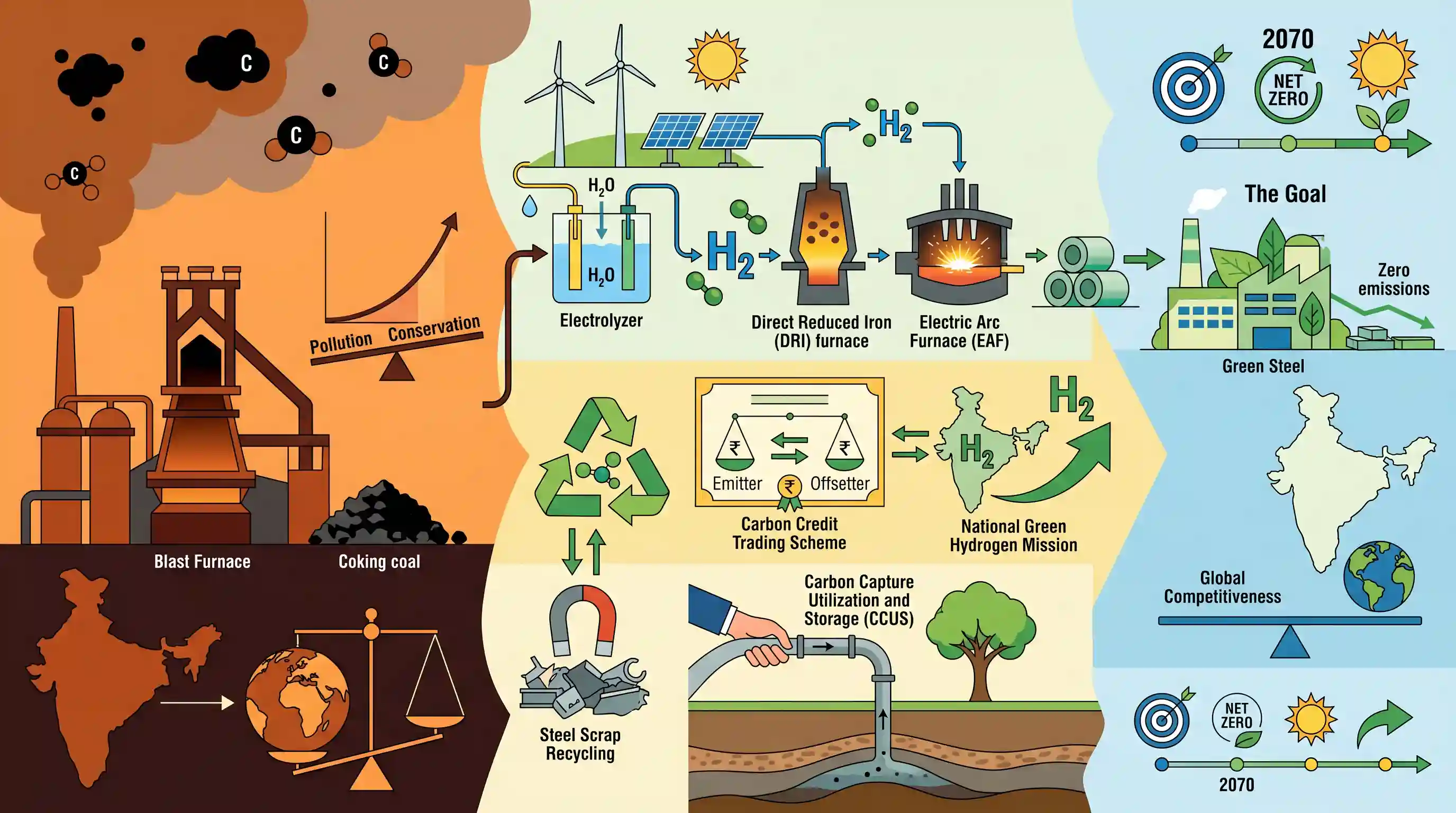
The article explores the imperative to decarbonize India's steel industry—a major greenhouse gas emitter—to align with the country's net-zero 2070 goals. It highlights the technological shift required to produce 'green steel', moving away from coking coal-dependent blast furnaces toward Direct Reduced Iron (DRI) processes utilizing green hydrogen and Electric Arc Furnaces. While green hydrogen offers a long-term solution, its current high costs necessitate transitional strategies such as enhanced steel scrap recycling and the adoption of Carbon Capture, Utilization, and Storage (CCUS) technologies. The piece underscores that robust policy frameworks, including the Carbon Credit Trading Scheme and the National Green Hydrogen Mission, will be critical to subsidizing the transition, incentivizing industrial adaptation, and safeguarding the global competitiveness of Indian steel in an increasingly carbon-conscious global market.
Key Points
- The steel sector is a significant 'hard-to-abate' industry, contributing heavily to India's total carbon footprint and necessitating decarbonization for the net-zero 2070 target.
- Transitioning to 'green steel' requires replacing traditional coal-reliant blast furnaces with methods like Direct Reduced Iron (DRI) and Electric Arc Furnaces powered by renewable energy.
- Green hydrogen plays a pivotal role as a clean reducing agent to replace coking coal, though high production costs and infrastructure gaps remain major barriers to commercial scalability.
- Alongside green hydrogen, India must increase the utilization of domestic steel scrap and invest in Carbon Capture, Utilization, and Storage (CCUS) technologies to manage near-term emissions.
- Effective policy mechanisms, including carbon markets and targeted subsidies under the National Green Hydrogen Mission, are essential to incentivize the industry and ensure its global competitiveness.
Important Terms
National Green Hydrogen Mission

A flagship initiative launched in 2023 to make India a global hub for green hydrogen production (5 MMT/year by 2030), aimed at decarbonizing hard-to-abate sectors like steel and shipping.
UPSC context
GS Paper III: Energy and Environmental Pollution. Tests knowledge of India's clean energy transition and net-zero strategies.
Carbon Credit Trading Scheme (CCTS)
A market-based mechanism under the Energy Conservation (Amendment) Act 2022 that enables the trading of Carbon Credit Certificates (CCC) to incentivize greenhouse gas emission reductions across industrial sectors.
UPSC context
GS Paper III: Economic Development and Environment. Relevant for climate finance and market-based environmental regulations.
Steel Scrap Recycling Policy (SSRP)
A 2019 framework aimed at promoting a circular economy by facilitating the scientific collection and processing of ferrous scrap, reducing dependency on iron ore and imported coking coal.
UPSC context
GS Paper III: Industrial Growth and Conservation. Focuses on resource efficiency and sustainable manufacturing.
Green Steel
Steel produced using low-carbon energy sources like green hydrogen or renewable electricity, rather than traditional fossil-fuel-intensive processes like coal-based blast furnaces.
UPSC context
GS Paper III: Infrastructure and Environment. Tests understanding of industrial decarbonization and technological innovation.
Carbon Capture, Utilization, and Storage (CCUS)
A suite of technologies that capture CO2 emissions from industrial sources, then either reuse it for industrial processes or store it permanently underground to prevent atmospheric release.
UPSC context
GS Paper III: Science & Technology and Environment. Critical for understanding technical solutions to climate change.
Ministry of Steel
The nodal agency spearheading the 'Green Steel Mission' and formulating roadmaps to align India's steel production with the 2070 net-zero goal through standards and financial incentives.
UPSC context
GS Paper II: Government Policies and Interventions. Tests understanding of departmental roles in sectoral transformation.
Prelims Trap
Green hydrogen in steelmaking is solely used as a renewable heating fuel.
In the DRI process, green hydrogen acts as a chemical reducing agent to strip oxygen from iron ore (releasing water vapor), not just a heat source.
Static Concepts Connected
How do Electric Arc Furnaces (EAF) differ from traditional Blast Furnaces in steelmaking?
- Blast Furnaces: Use coking coal to both melt iron ore and chemically reduce it to molten pig iron, generating massive CO2 emissions.
- Electric Arc Furnaces: Use electrical currents to melt recycled steel scrap or solid Direct Reduced Iron (DRI), eliminating the need for coal as a chemical reducing agent.
What is the difference between CCUS and general Carbon Sequestration?
- CCUS: Captures CO2 directly at the industrial source before it enters the atmosphere; the captured carbon is then permanently stored or used in commercial products.
- Carbon Sequestration: The broader process of removing CO2 already present in the atmosphere via natural sinks (forests, oceans, wetlands) or artificial means.
Cross-Topic Patterns
EU's CBAM and Indian Steel Exports
The shift to green steel is critical to shield Indian exports from the EU's Carbon Border Adjustment Mechanism (CBAM), which levies carbon taxes on high-emission imports like steel and aluminum.
Green Hydrogen Mission demand linkage
The National Green Hydrogen Mission targets hard-to-abate sectors (steel, fertilizers, refineries). The steel industry serves as the primary demand-creator necessary to scale domestic green hydrogen production.

Expect a multi-statement prelims question combining Green Hydrogen's role as a chemical reducing agent and the mechanics of CCUS in steel.
Linked PYQs · 5
Linked PYQs · 5
- 2023PrelimsGS1
Consider the following heavy industries: 1. Fertilizer plants 2. Oil refineries 3. Steel plants Green hydrogen is expected to play a significant role in decarbonizing how many of the above industries?
- 2015PrelimsGS1
In India, the steel production industry requires the import of
- 2025PrelimsGS1
With reference to 'Direct Air Capture', an emerging technology, which of the following statements is/are correct? I. It can be used as a way of carbon sequestration. II. It can be a valuable approach for plastic production and in food processing. III. In aviation, it can be a source of carbon for combining with hydrogen to create synthetic low-carbon fuel. Select the correct answer using the code given below.
- 2023PrelimsGS1
Consider the following activities: 1. Spreading finely ground basalt rock on farmlands extensively 2. Increasing the alkalinity of oceans by adding lime 3. Capturing carbon dioxide released by various industries and pumping it into abandoned subterranean mines in the form of carbonated waters How many of the above activities are often considered and discussed for carbon capture and sequestration?
- 2011PrelimsGS1
Regarding “carbon credits”, which one of the following statements is not correct?
