Rajasthan High Court Deletes Critique on Transgender Rights Bill
Source:Indian Express ↗
Why It Matters
The incident provides an important case study for GS2, linking the evolving jurisprudence on transgender rights (NALSA judgment vs. statutory certification requirements) with the procedural dynamics of the judiciary, specifically a High Court's inherent power to modify or review its own judgments when it exceeds the scope of a petition.
Summary
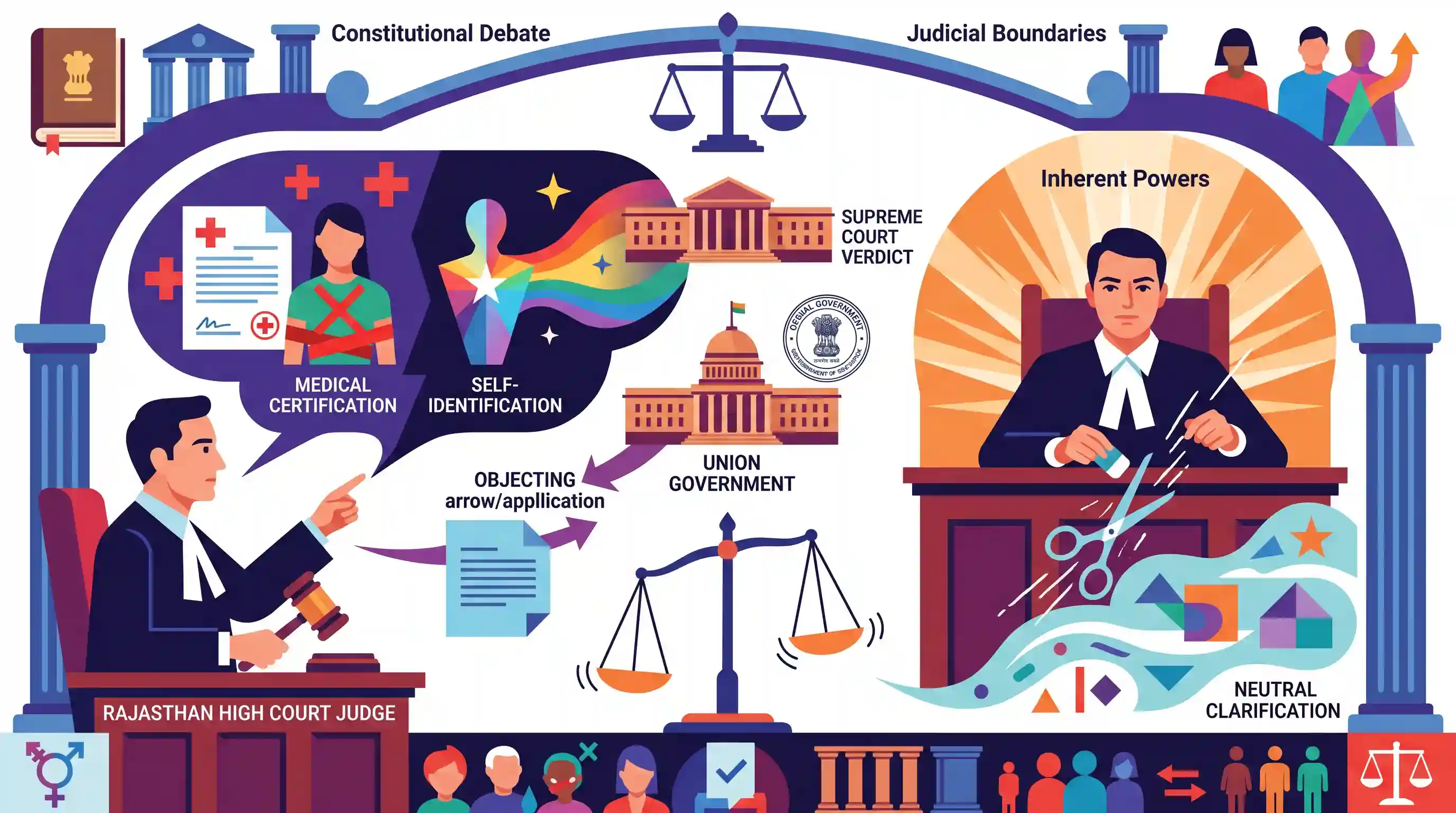
The Rajasthan High Court has expunged a critical epilogue from a recent judgment that condemned the Transgender Persons (Protection of Rights) Amendment Bill, 2026. Initially, Justice Anoop Kumar Dhand had ruled that the Bill's requirement for medical certification to legally recognize gender identity marked a regressive departure from the self-identification principle enshrined in the Supreme Court's 2014 NALSA verdict. Following an application by the Union Government arguing that the observations exceeded the scope of the original case, the judge invoked the High Court's inherent powers to delete the critique, replacing it with a neutral clarification about the prevailing legal position. The case underscores the ongoing constitutional debate over transgender rights and the limits of judicial commentary on pending legislation.
Key Points
- The Rajasthan High Court recalled three paragraphs from a previous order that had sharply rebuked the Transgender Persons (Protection of Rights) Amendment Bill, 2026.
- The original epilogue asserted that the Bill's mandate for medical or bureaucratic certification of gender identity violates the right to self-identification established by the Supreme Court's 2014 NALSA judgment.
- The Union Government filed an application for modification, arguing the court's remarks on pending legislation were beyond the scope of the original petition, which merely sought police protection.
- Invoking its inherent powers, the High Court replaced the critique with a narrow clarification that its prior directions were based on the legal position prevailing on the date of the original order.
Important Terms
Transgender Persons (Protection of Rights) Amendment Bill, 2026

A 2026 legislative amendment that mandates medical board certification for gender recognition, effectively removing the right to self-identification established by the Supreme Court in 2014.
UPSC context
GS Paper II/Social Justice. Tests knowledge of legislative changes affecting marginalized groups and their impact on fundamental rights.
NALSA vs. Union of India (2014)
A landmark 2014 Supreme Court ruling that recognized transgender people as the 'third gender' and affirmed the right to self-identify one's gender identity as a fundamental right.
UPSC context
GS Paper II/Judiciary. Essential for understanding constitutional protections (Articles 14, 19, 21) and the evolution of gender identity rights.
Right to Self-identification
The legal principle that an individual's gender identity is based on their innate psychological perception rather than biological characteristics or mandatory medical certification.
UPSC context
GS Paper II/Fundamental Rights. Tests the balance between personal autonomy/privacy and state-mandated administrative or medical procedures.
Transgender Persons (Protection of Rights) Act, 2019
The primary Indian law aimed at protecting transgender rights. It provides for identity certificates and prohibits discrimination, though it has been criticized for its administrative certification requirements.
UPSC context
GS Paper II/Social Justice. Focuses on statutory frameworks for welfare and the socio-legal status of the transgender community.
Rajasthan High Court
The highest court of the state of Rajasthan. In the 'Ganga Kumari' case, it recently addressed transgender reservations and the constitutional validity of gender certification.
UPSC context
GS Paper II/Judiciary. Examines the role of High Courts in upholding constitutional values and exercising judicial oversight over state policies.
Expunction (Judicial)
The judicial act of striking out specific remarks or paragraphs from a judgment, typically because they are deemed unnecessary, irrelevant, or added by mistake.
UPSC context
GS Paper II/Judiciary. Tests understanding of judicial discipline, inherent powers of courts, and the difference between binding rulings and obiter dicta.
Prelims Trap
Transgender persons in India can legally self-identify their gender without any bureaucratic certification.
While the 2014 NALSA judgment upheld self-identification, current statutory frameworks mandate a District Magistrate or Medical Board certificate, meaning the process is legally bureaucratic.
Static Concepts Connected
How did the NALSA (2014) judgment establish transgender rights?
- Third Gender: Recognized transgender persons as a legally distinct 'third gender' entitled to full fundamental rights under Part III of the Constitution.
- Self-Identification: Declared that gender identity is an integral part of dignity under Article 21, allowing self-identification without requiring biological or medical proof.
- Affirmative Action: Directed governments to treat transgender persons as socially and educationally backward classes to extend affirmative action in education and employment.
What is the constitutional basis for High Courts modifying their own orders?
- Court of Record: Under Article 215, High Courts act as Courts of Record, possessing inherent powers to review, recall, or expunge their own erroneous records or remarks.
- Expunging Obiter Dicta: Courts often delete incidental remarks (observations made 'by the way') if they overstep judicial bounds, such as preempting parliamentary legislative debates.
- Inherent Powers: Under Section 528 of the BNSS (formerly CrPC Sec 482), High Courts wield inherent jurisdiction to prevent abuse of process or secure the ends of justice.
Cross-Topic Patterns
Judicial Restraint & Pending Bills
The judiciary traditionally avoids substantive commentary on legislative Bills before they are enacted, respecting the Separation of Powers doctrine and parliamentary supremacy.
Fundamental Rights vs. Statutory Friction
This mirrors privacy debates: the Supreme Court establishes a fundamental right (NALSA/Puttaswamy), but subsequent Union laws introduce bureaucratic friction, triggering constitutional challenges.

Mains GS2 is highly likely to test the tension between the NALSA self-identification principle and statutory bureaucratic requirements.
Linked PYQs · 2
Linked PYQs · 2
- 2023MainsGS2
Explain the constitutional perspectives of Gender Justice with the help of relevant Constitutional Provisions and case laws.
- 2021PrelimsGS1
With reference to Indian judiciary, consider the following statements : 1. Any retired judge of the Supreme Court of India can be called back to sit and act as a Supreme Court judge by the Chief Justice of India with prior permission of the President of India. 2. A High Court in India has the power to review its own judgement as the Supreme Court does. Which of the statements given above is/are correct?
