Transgender Amendment Bill Provisions and Constitutional Morality
Source:The Hindu ↗
Why It Matters
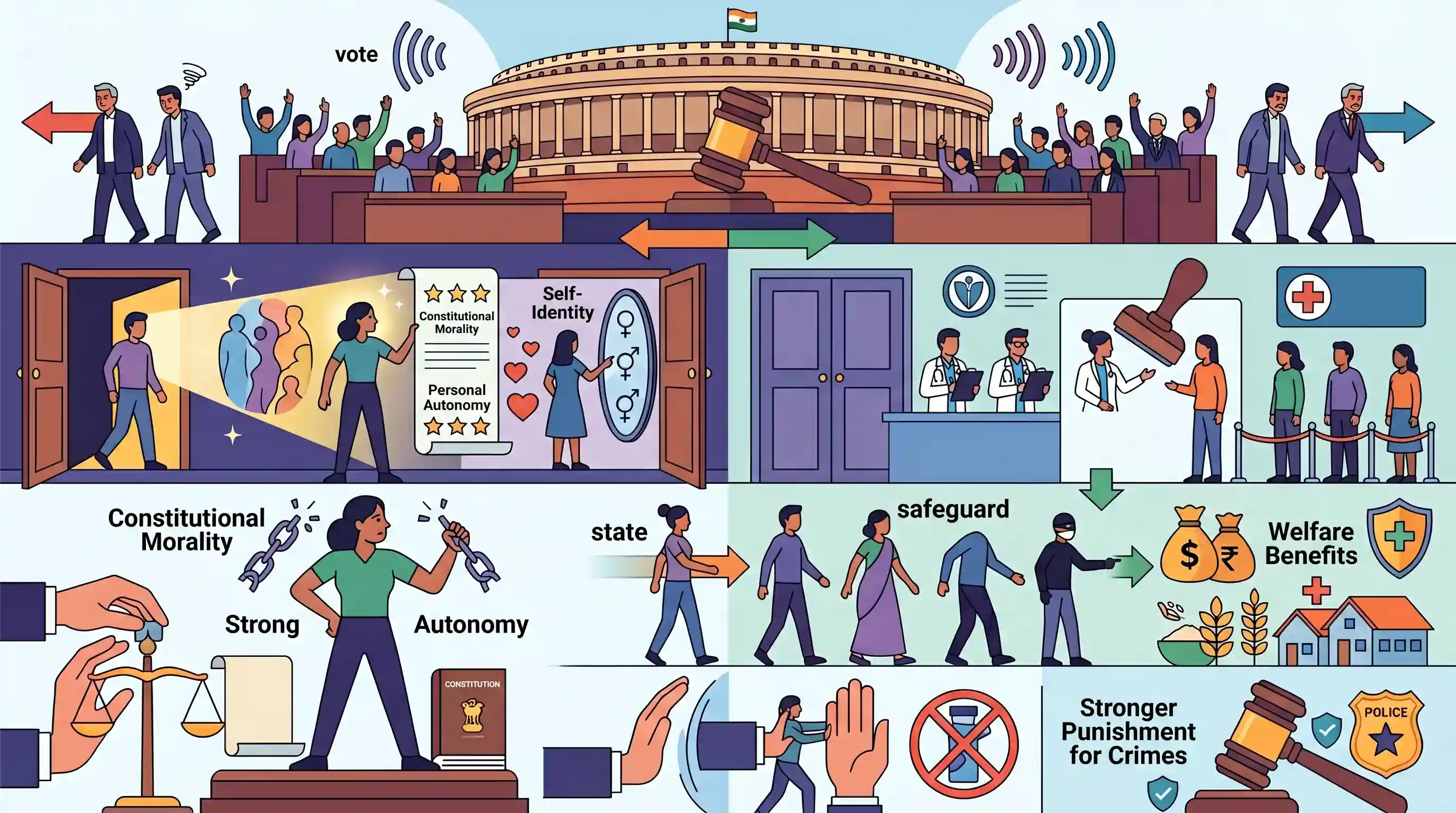
The amendment represents a significant pivot in India's legal framework regarding transgender rights. By shifting from self-determination to medical certification, the State is actively regulating gender identity. This creates a direct clash between the administrative need to curb welfare fraud and the fundamental rights to privacy, dignity, and autonomy guaranteed under Article 21 and the landmark NALSA judgment, making it a critical case study for Constitutional morality and social justice.
Summary
The Lok Sabha passed the Transgender Persons (Protection of Rights) Amendment Bill, 2026 by voice vote, triggering widespread Opposition criticism and a walkout. The most contentious provision of the Bill removes the right to self-identify one's gender—a right affirmed by the 2014 NALSA judgment—and mandates certification by a medical board. The legislation also penalizes those forcing others to undergo gender transition therapies while purportedly strengthening punishments for crimes against transgender individuals. While the Opposition slammed the move as an assault on Constitutional morality and personal autonomy, the NDA government defended the medical certification as a necessary safeguard to prevent fraudulent claims for state welfare benefits reserved for the transgender community.
Key Points
- The Transgender Persons (Protection of Rights) Amendment Bill, 2026 was passed in the Lok Sabha via a voice vote amid an Opposition walkout.
- The legislation removes the right to self-determination of gender, a principle previously established by the Supreme Court's 2014 NALSA judgment, replacing it with a requirement for examination by a medical board.
- The Bill introduces penalties for "forcing or compelling" adults or children to undergo hormone therapy or other gender transition interventions.
- The government argues the medical board requirement is a scientific approach necessary to prevent "infiltrators" from fraudulently claiming welfare benefits meant for the transgender community.
- The Opposition heavily criticized the Bill as an attack on Constitutional morality and the fundamental right to personal autonomy.
Important Terms
Transgender Persons (Protection of Rights) Amendment Bill, 2026

Proposed legislation mandating medical board certification for gender recognition, replacing self-identification and narrowing the 'transgender' definition to specific sociocultural/biological categories.
UPSC context
GS II (Social Justice). Tests legislative reforms for vulnerable sections and the state's role in identity regulation.
NALSA v. Union of India (2014)
Landmark Supreme Court ruling recognizing transgender persons as a 'third gender' and affirming their constitutional right to self-identify their gender identity.
UPSC context
GS II (Judiciary). Tests knowledge of landmark cases establishing rights for marginalized communities.
Right to Self-Identification
The right of an individual to determine their own gender based on personal perception (innate perception) without requiring medical intervention or state certification.
UPSC context
GS II (Vulnerable Sections). Tests understanding of personal autonomy under Article 21 and the Right to Privacy.
Constitutional Morality
A doctrine prioritizing core values like dignity, equality, and liberty over social or public morality to protect individual rights from majoritarian impulses.
UPSC context
GS II (Constitution/Polity). Tests the application of judicial principles in balancing individual rights vs state interest.
Medical Board Certification
A mandatory provision in the 2026 Bill requiring a panel of medical experts to verify an individual’s identity before issuing a gender certificate.
UPSC context
GS II (Governance). Examines administrative hurdles and state intrusion in the lives of vulnerable populations.
Voice Vote
A parliamentary voting method where the Speaker assesses the collective volume of 'Ayes' and 'Noes' to decide if a motion has passed.
UPSC context
GS II (Parliament). Tests knowledge of legislative procedures and their role in democratic accountability.
Prelims Trap
The NALSA judgment mandated medical board certification for transgender individuals to access state welfare benefits.
NALSA explicitly established the right to self-identify gender based on psychological perception, without medical intervention. It is the 2026 Bill that introduces medical boards.
Static Concepts Connected
What were the key directives of the NALSA vs. Union of India (2014) judgment?
- Self-Identification: Established the right to self-identify one's gender as male, female, or transgender, independent of surgical or medical intervention.
- Third Gender Status: Legally recognized transgender individuals as a distinct 'Third Gender' entitled to fundamental rights under Part III of the Constitution.
- Affirmative Action: Directed the Centre and States to treat the community as socially and educationally backward classes (SEBCs) to extend affirmative action.
What constitutes the doctrine of 'Constitutional Morality'?
- Core Definition: Adherence to core constitutional principles—such as dignity, equality, and liberty—rather than conforming to orthodox or majoritarian public morality.
- Judicial Application: Employed heavily by the Supreme Court in recent years (e.g., Navtej Singh Johar, Sabarimala) to protect individual autonomy and minority rights against societal prejudices.
Cross-Topic Patterns
Privacy vs. State Verification in Welfare
Echoes the Aadhaar (Puttaswamy) debate, balancing a citizen's fundamental right to bodily autonomy and privacy against the State's mandate to prevent fraudulent leakage of welfare benefits.
Legislative Override of Judicial Precedents
Connects to a broader trend (like the CEC Appointment Act) where the legislature modifies or overrides core judicial principles (here, NALSA's self-identification) via statutory amendments, sparking Separation of Powers debates.

Mains GS2 will likely test the clash between legislative welfare targeting (2026 Bill) and judicial precedents (NALSA, Puttaswamy) on autonomy.
Linked PYQs · 5
Linked PYQs · 5
- 2023MainsGS2
Explain the constitutional perspectives of Gender Justice with the help of relevant Constitutional Provisions and case laws.
- 2024MainsGS2
Right to privacy is intrinsic to life and personal liberty and is inherently protected under Article 21 of the constitution. Explain. In this reference discuss the law relating to D.N.A. testing of child in the womb to establish its paternity.
- 2024PrelimsGS1
Under which of the following Articles of the Constitution of India, has the Supreme Court of India placed the Right to Privacy ?
- 2021PrelimsGS1
'Right to Privacy' is protected under which Article of the Constitution of India?
- 2018PrelimsGS1
Right to Privacy is protected as an intrinsic part of Right to Life and Personal Liberty. Which of the following in the Constitution of India correctly and appropriately imply the above statement?
