Transgender Rights Legislation and Self-Determination Evolution
Source:Indian Express ↗
Why It Matters
The evolution of rights for the transgender community is a crucial part of the GS-II syllabus under 'Social Justice' and 'Vulnerable Sections'. Understanding the progression from the NALSA judgement to the 2019 Act, and now the 2026 Amendment, is essential for analyzing the intersection of Fundamental Rights (Articles 14, 15, 21) and statutory law in ensuring gender justice and inclusivity.
Summary
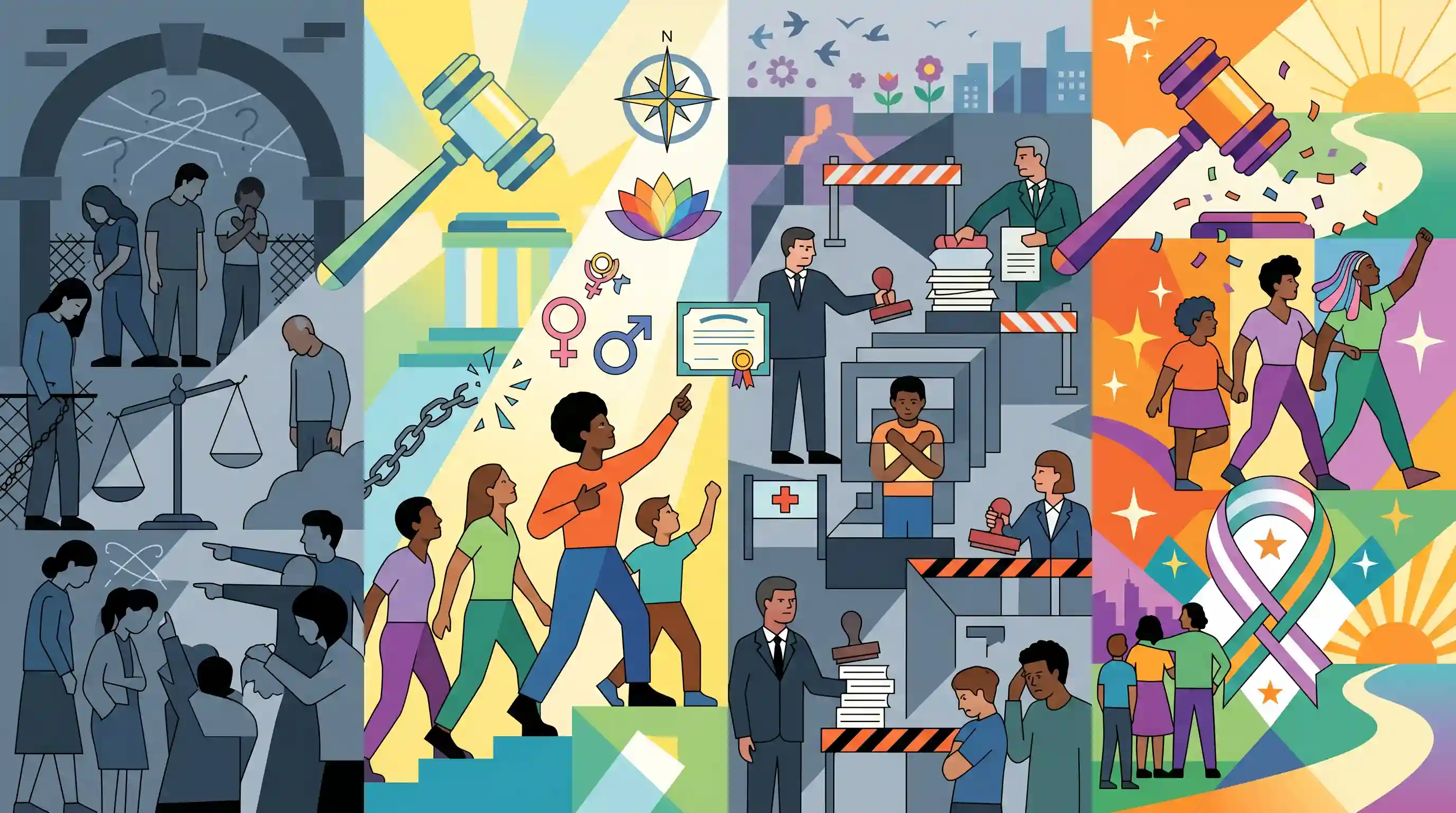
The article explains the context and significance of the Transgender Persons Amendment Act, 2026, mapping a decade of legal battles over gender identity in India. Following the foundational 2014 NALSA judgement that recognized self-identified gender and basic constitutional rights for transgender people, the community faced continued challenges under the 2019 Act—particularly concerning medical interventions and bureaucratic certifications. The 2026 amendment aims to rectify these issues, emphasizing self-determination, dignity, and true constitutional gender justice.
Key Points
- The Transgender Persons Amendment Act, 2026 addresses concerns surrounding gender identity and the right to self-determination.
- The legislation builds upon the landmark 2014 NALSA judgement, which recognized transgender persons as the 'third gender' and upheld their fundamental rights under Articles 14, 15, 19, and 21.
- The article outlines a decade of legal battles regarding transgender rights, specifically criticizing bureaucratic hurdles in the 2019 Act, such as the requirement of a District Magistrate's certificate for gender recognition.
- The 2026 amendment focuses on ensuring that gender identity is based on self-identification rather than medical or administrative gating, marking a significant step toward gender justice.
Important Terms
Transgender Persons (Protection of Rights) Amendment Act, 2026

A law mandating medical board certification for legal gender recognition. It narrows the 'transgender' definition to specific socio-cultural groups and intersex variations, effectively ending the right to self-perceived identification.
UPSC context
GS Paper II (Social Justice). Tests understanding of legislative shifts in rights and judicial vs. executive approaches to gender justice.
Transgender Persons (Protection of Rights) Act, 2019
The primary law protecting transgender rights in India. It prohibits discrimination in education and employment but was criticized for its certification process and lack of affirmative action (reservations).
UPSC context
GS Paper II (Vulnerable Sections). Relevant for understanding the evolution of social justice laws and institutional frameworks like the NCTP.
NALSA v. Union of India (2014)
A landmark Supreme Court ruling recognizing transgender people as the 'third gender.' It affirmed the right to self-identify gender as a fundamental right under Articles 14, 19, and 21.
UPSC context
GS Paper II (Judiciary). Essential for questions on landmark judgments, fundamental rights, and the 'living constitution' doctrine.
Gender Identity
A person’s deeply felt internal sense of their own gender. In Indian jurisprudence, it is recognized as a core component of personal autonomy, dignity, and freedom of expression.
UPSC context
GS Paper I (Social Issues) and GS II. Important for themes of gender justice, individual liberty, and identity-based rights.
National Council for Transgender Persons (NCTP)
A statutory body established under the 2019 Act to advise the government on transgender policies, monitor implementation of rights, and handle community grievances.
UPSC context
GS Paper II (Statutory Bodies). Tests knowledge of specialized institutions designed to protect the rights of vulnerable populations.
Self-determination
The legal principle that an individual’s self-perceived gender identity should be recognized by the state without requiring medical, surgical, or psychological validation.
UPSC context
GS Paper II (Fundamental Rights). Crucial for discussions on the tension between bureaucratic regulation and constitutional freedoms of dignity and privacy.
Prelims Trap
The Transgender Persons Amendment Act, 2026 ensures that gender recognition is based purely on self-identification.
While NALSA (2014) upheld self-identification, the 2026 Amendment actually introduces a mandatory Medical Board for clinical examination, replacing self-perceived identity with medical gatekeeping.
Static Concepts Connected
How did the NALSA (2014) judgement expand Fundamental Rights?
- Third Gender: Recognized transgender individuals as a distinct 'third gender' for all constitutional, legal, and welfare purposes.
- Article 21: Declared that self-determination of gender identity is an intrinsic part of personal autonomy and dignity under the Right to Life.
- Articles 14 & 15: Interpreted the prohibition of discrimination on grounds of 'sex' to naturally include protection against discrimination based on gender identity.
What was the certification mechanism under the Transgender Persons Act, 2019?
- DM Certification: Individuals were required to apply to the District Magistrate (DM) to receive a basic 'Certificate of Identity' as a transgender person.
- Medical proof for transition: To obtain a revised certificate explicitly stating 'male' or 'female', proof of medical intervention (surgery) verified by a Medical Superintendent was required.
Cross-Topic Patterns
Bodily Autonomy + Right to Privacy
The debate over medical certification for gender identity links directly to the Puttaswamy judgement (2017), where the Supreme Court established bodily autonomy and privacy as fundamental rights.
Transgender rights + Horizontal Reservation
The legal definition of transgender persons directly impacts ongoing social justice demands for horizontal reservation in education and public employment—an unresolved constitutional mandate post-NALSA.

Expect a Prelims question contrasting NALSA's 'self-identification' principle with the 2019/2026 Acts' bureaucratic and medical gatekeeping.
Linked PYQs · 2
Linked PYQs · 2
- 2023MainsGS2
Explain the constitutional perspectives of Gender Justice with the help of relevant Constitutional Provisions and case laws.
- 2023MainsGS2
Who are entitled to receive free legal aid? Assess the role of the National Legal Services Authority (NALSA) in rendering free legal aid in India.
