Transforming Tribal Education and Eklavya Schools
Source:Indian Express ↗
Why It Matters
EMRS and tribal education initiatives are critical for the socio-economic empowerment of Scheduled Tribes, making it an important topic for governance and social justice in GS Paper 2.
Summary
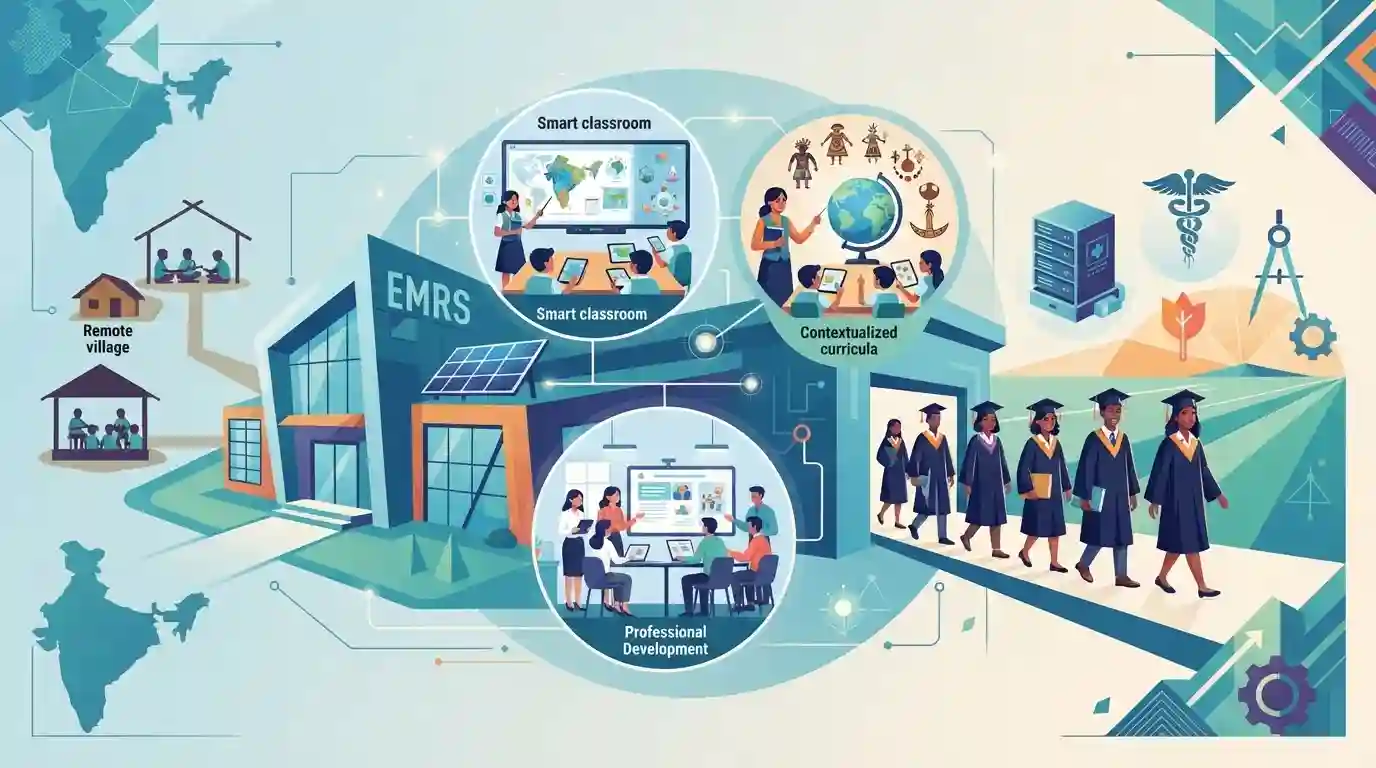
The article discusses the transformation of tribal education in India, focusing on the role of Eklavya Model Residential Schools (EMRS). It highlights the need to transition from mere access to educational infrastructure to achieving educational excellence through modern technology, contextualized curricula, and better teacher capacity building to empower tribal youth.
Key Points
- Eklavya Model Residential Schools (EMRS) are pivotal in providing quality education to tribal children in remote areas.
- Transforming tribal education requires moving beyond basic infrastructure to focus on excellence, digital literacy, and holistic development.
- Challenges include teacher recruitment, contextualised curricula, and bridging the digital divide for tribal students.
- Integrating vocational training and local cultural heritage preserves indigenous identity while enhancing employability.
Important Terms
Eklavya Model Residential Schools

Residential schools established to provide quality middle and high-level education to Scheduled Tribe (ST) students in remote areas, ensuring holistic development alongside academic excellence.
UPSC context
GS Paper II: Government policies and interventions for the development of vulnerable sections (Scheduled Tribes) and social sector education issues.
Eklavya Model Residential Schools Scheme
A central government flagship scheme aimed at setting up residential schools across tribal blocks to provide quality education and bridge educational disparities for Scheduled Tribe children.
UPSC context
GS Paper II: Welfare schemes for vulnerable sections of the population and performance of these schemes.
Ministry of Tribal Affairs
The apex central government ministry responsible for formulating policies, planning, and coordinating programs for the socio-economic development of Scheduled Tribes in India.
UPSC context
GS Paper II: Structure, organization, and functioning of Ministries and Departments of the Government.
Prelims Trap
Eklavya Model Residential Schools (EMRS) are administered directly by the Union Ministry of Education as part of national secondary education policy.
Aspirants often assume EMRS is administered by the Ministry of Education because they follow the CBSE curriculum, but they are established and run under the Ministry of Tribal Affairs via NESTS.
Static Concepts Connected
What are the key institutional mechanisms and criteria governing Eklavya Model Residential Schools (EMRS) in India?
- Target Criteria: Ministry mandate under Ministry of Tribal Affairs targeting blocks with 50% or more ST population and at least 20,000 tribal persons.
- Implementation Body: Autonomous body National Education Society for Tribal Students (NESTS) oversees the implementation and management nationwide.
- Curriculum & Standard: Affiliation follows CBSE standards, aiming to provide free residential education from Class 6 to Class 12 on par with Navodaya Vidyalayas.
Cross-Topic Patterns
Tribal Education and Schedule V & VI Governance
The push for contextualized education in tribal areas intersects directly with the Fifth and Sixth Schedules, where local self-governance must align with administrative capacity building.
EMRS and Sustainable Development Goals (SDG 4 & 10)
Integrating vocational training and digital literacy within residential schooling bridges equity gaps outlined in SDG 4 (Quality Education) and SDG 10 (Reduced Inequalities).

EMRS scheme mandate (block criteria, NESTS, CBSE affiliation) paired with NEP 2020 tribal pedagogy is a prime match for a multi-statement prelims question.
Linked PYQs · 1
Linked PYQs · 1
- 2023MainsGS2
“Development and welfare schemes for the vulnerable, by its nature, are discriminatory in approach.” Do you agree? Give reasons for your answer.
