Transatlantic relations strain and European strategic autonomy
Source:The Hindu ↗
Why It Matters
The fragmentation of the US-Europe strategic partnership and the weakening of NATO directly impact global geopolitics, presenting both challenges and opportunities for India's foreign policy, especially concerning a multipolar world order and strategic autonomy.
Summary
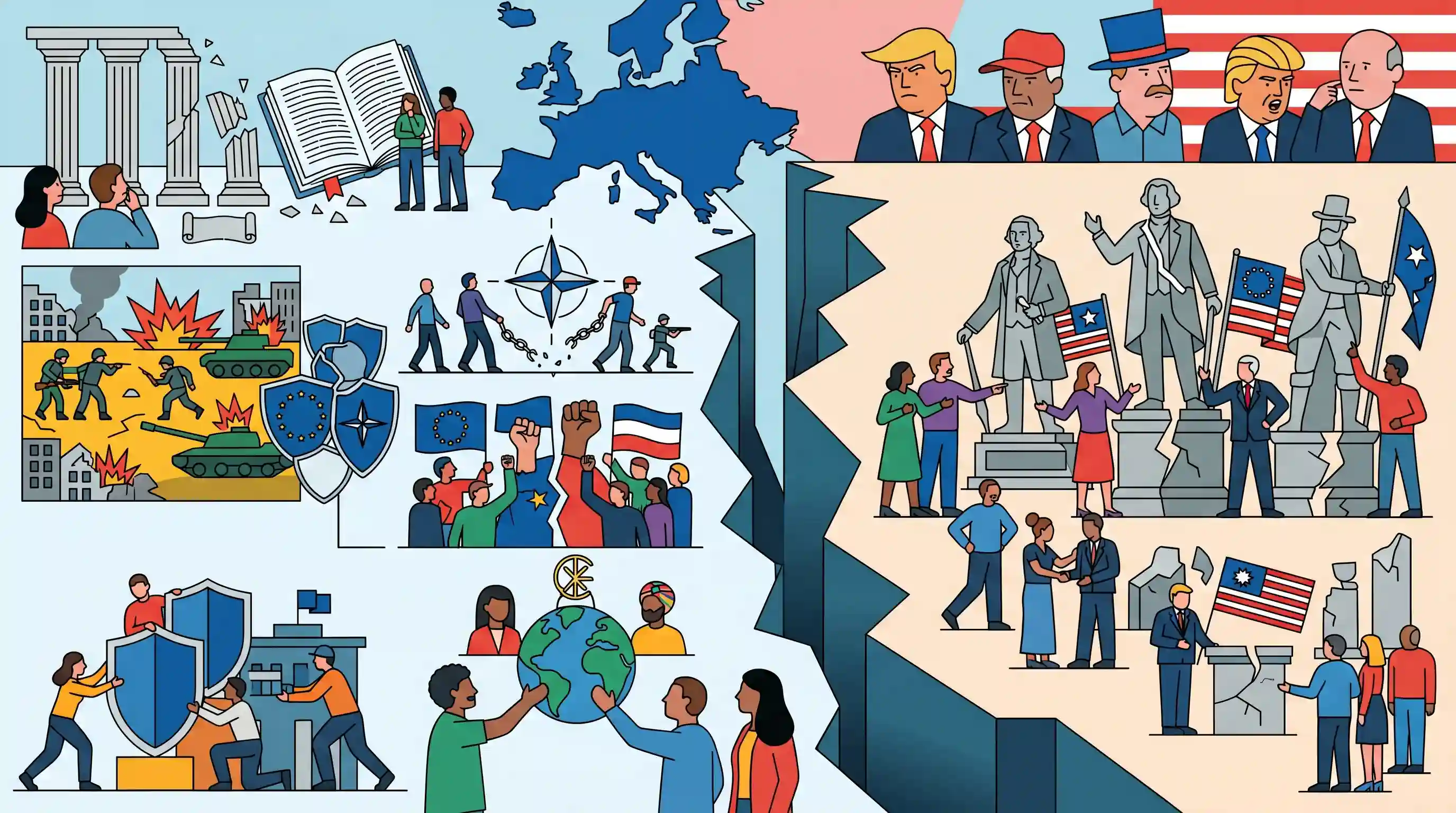
The Munich Security Conference 2026 exposed a widening rift in transatlantic relations between Europe and the US under the Trump administration. While European leaders lament the collapse of the international rules-based order and advocate for greater "military autonomy" and a stronger European pillar within NATO, US leaders are increasingly pushing for alignment based on civilizational history and cultural wars rather than strategic interests. Europe currently faces a "trifecta of challenges": a protracted land war in Ukraine, diminishing US commitment to collective security in NATO, and a surge in far-right political movements threatening the EU's democratic inclusivity. To survive this shifting global order, Europe must forge true strategic autonomy, find a realistic resolution to the Ukraine war, and engage with non-Western actors to reconstruct a stable international framework.
Key Points
- The Munich Security Conference 2026 revealed significant transatlantic rifts, with German Chancellor Friedrich Merz acknowledging the collapse of the international rules-based order.
- French President Emmanuel Macron advocated for European "military autonomy" and a stronger, independent European pillar within NATO.
- US officials, including Secretary of State Marco Rubio, are shifting from strategic cooperation to alignment based on shared Christian history and cultural wars, alienating European allies.
- Europe faces a trifecta of challenges: the protracted Russia-Ukraine land conflict, an unpredictable US ally threatening NATO's collective defence, and resurgent far-right movements internally.
- The editorial suggests Europe must drastically reduce its security reliance on the US, seek a realistic end to the Ukraine war, and engage with the broader non-Western world to rebuild the international order.
Important Terms
NATO (North Atlantic Treaty Organization)

An intergovernmental military alliance of 32 North American and European countries established by the 1949 Washington Treaty. Its core principle is collective defense, where an attack on one member is considered an attack on all.
UPSC context
GS Paper II (International Relations); tests understanding of global security groupings, collective defense, and their impact on India’s strategic environment.
European Union (EU)
A supranational political and economic union of 27 European member states. It operates through common institutions to manage a single market, common currency (Euro), and shared policies on trade and security.
UPSC context
GS Paper II (International Relations); important for regional integration studies, India-EU bilateral ties, and global trade dynamics.
Strategic Autonomy
The ability of a state to pursue its national interests and make sovereign foreign policy decisions without being constrained by external powers or binding alliance obligations. It prioritizes flexibility and independent action.
UPSC context
GS Paper II (International Relations); central to India’s foreign policy evolution and navigating the shifting multipolar global order.
Munich Security Conference (MSC)
The world's leading independent forum on international security policy, held annually in Germany since 1963. It brings together global leaders to discuss security threats and coordinate diplomatic strategies.
UPSC context
GS Paper II (Important International Fora); relevant for tracking global security trends and India’s high-level diplomatic participation.
Rules-based International Order
A global framework of laws, norms, and institutions established post-WWII to ensure international stability, peaceful dispute resolution, and cooperation based on shared rules rather than unilateral force.
UPSC context
GS Paper II (Global Governance); tests knowledge of international law, challenges of unilateralism, and advocacy for reformed multilateralism.
Prelims Trap
"The Munich Security Conference is an intergovernmental organization established under the UN to enforce collective security."
The MSC is an independent, non-official annual forum for international security policy, not a UN body or a treaty-enforcing intergovernmental organization.
Static Concepts Connected
What is NATO's Article 5 and the push for a 'European Pillar'?
- Article 5: The core NATO treaty principle stating that an armed attack against one member state is considered an armed attack against all members.
- Historical Invocation: It has been invoked only once in the alliance's history, following the 9/11 terrorist attacks against the United States.
- European Pillar: A strategic push by European leaders to build an independent, self-reliant military and defense capability within or alongside NATO, reducing structural reliance on the US.
What does 'Strategic Autonomy' mean in the context of the European Union?
- Core Meaning: The capacity of the EU to act independently in key strategic areas like defense, economy, and technology without heavy structural reliance on third countries like the US.
- Catalysts: Accelerated by Brexit, the protracted Russia-Ukraine war, and shifting US geopolitical priorities that increasingly pivot toward domestic populism and the Indo-Pacific.
Cross-Topic Patterns
Strategic Autonomy mirroring Multi-alignment
Europe's push for defense and policy independence structurally mirrors India's long-standing multi-alignment doctrine, opening avenues for deeper Indo-French and EU-India defense collaboration in a multipolar world.
Civilizational shifts in US foreign policy
US rhetoric shifting from universal democratic norms to 'civilizational' linkages complicates the Quad's 'shared democracies' narrative, forcing India to anchor partnerships purely on converging strategic and maritime interests.

Expect a 2026 Mains question contrasting Europe's emerging 'strategic autonomy' with India's 'multi-alignment' in a fragmented global order.
Linked PYQs · 3
Linked PYQs · 3
- 2023MainsGS2
‘The expansion and strengthening of NATO and a stronger US-Europe strategic partnership works well for India.’ What is your opinion about this statement ? Give reasons and examples to support your answer.
- 2025MainsGS2
"With the waning of globalization, post-Cold War world is becoming a site of sovereign nationalism.” Elucidate.
- 2025MainsGS2
"The reform process in the United Nations remains unresolved, because of the delicate imbalance of East and West and entanglement of the USA vs. Russo-Chinese alliance.” Examine and critically evaluate the East-West policy confrontations in this regard.
