AI Training vs Inference Mechanics and Sovereign Capabilities
Source:The Hindu ↗
Why It Matters
Understanding the technical and economic difference between AI model training and inference is crucial for evaluating national AI policies, tech geopolitics, and open-source models.
Summary
The article explains the core technological distinction between AI model training and inference, highlighting its relevance to controversies surrounding Indian and Chinese artificial intelligence initiatives, open-source model adaptation, and indigenous technological self-reliance.
Key Points
- Training and inference are the two fundamental phases of Artificial Intelligence model development and deployment.
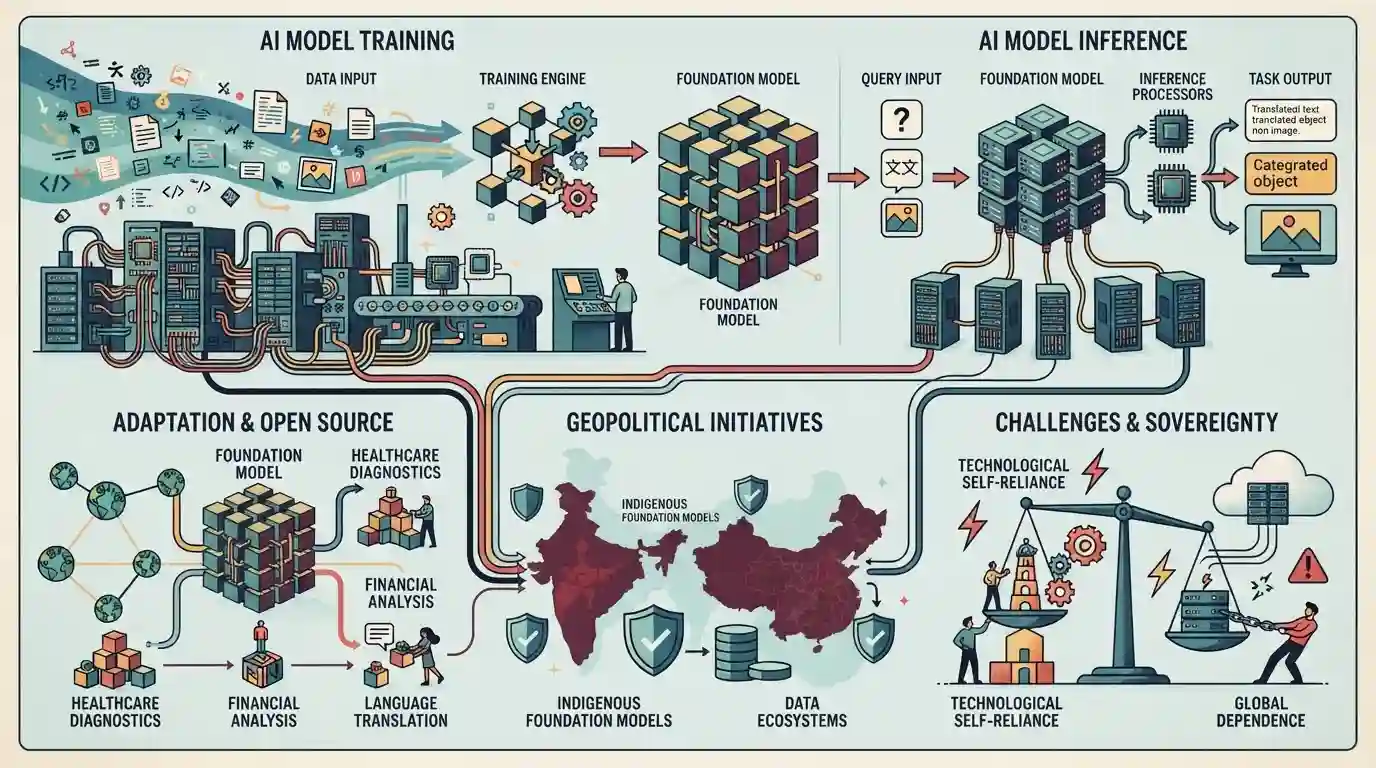
- Training involves teaching the model using massive datasets and vast compute power to recognize patterns, whereas inference is the application phase where the trained model solves new problems and makes predictions.
- The controversy involving Sarvam AI and Chinese AI models highlights debates around the repurposing or fine-tuning of open-source weights versus building foundation models completely from scratch.
- India's indigenous AI strategy faces strategic dilemmas regarding infrastructure dependencies, cost efficiency, and sovereign computing capabilities.
Important Terms
AI Model Training

The foundational phase where an AI model learns patterns from massive datasets by adjusting its parameters, requiring intensive computational resources and high-end GPUs.
UPSC context
GS Paper III (S&T - IT & Computers); tests understanding of computational demands, indigenous R&D, and sovereign technology capacity.
AI Inference
The operational phase where a pre-trained AI model applies its learned knowledge to generate real-time responses, predictions, or outputs for new data.
UPSC context
GS Paper III (S&T - IT & Computers); tests awareness of everyday AI deployment, API infrastructure, and operational efficiency costs.
Sarvam AI
A prominent Indian artificial intelligence startup specializing in foundational language models tailored for Indian languages, supported in part by the national IndiaAI Mission.
UPSC context
GS Paper III (S&T - IT & Computers); tests knowledge of India's indigenous startup ecosystem, sovereign AI initiatives, and technology policy.
Prelims Trap
using open-source or open-weight models developed abroad is equivalent to indigenous foundation model training
Aspirants often assume that hosting open-weight foreign models locally constitutes building a sovereign indigenous foundation model from scratch, which is technically incorrect as training and fine-tuning are distinct.
Static Concepts Connected
What are the key technical differences between AI model training and inference?
- Compute Intensity: Training phase involves processing massive datasets via neural networks, requiring heavy GPU clusters and massive energy consumption to adjust billions of weights.
- Operational Phase: Inference phase is the operational deployment where a pre-trained model applies learned patterns to generate predictions or responses for user inputs.
- Model Adaptation: Open-weight models allow developers to bypass the resource-intensive training phase and directly fine-tune or run inference locally.
Cross-Topic Patterns
AI Sovereignty + Indigenous Software History
The debate over using foreign open-weight AI models mirrors historical software strategies where India relied on imported source code to build domestic IT services.
IndiaAI Mission + Industrial Policy Subsidies
Subsidized GPU allocations under the IndiaAI Mission connect industrial policy with deep-tech state aid, echoing semiconductor and electronics PLI schemes.

Distinction between AI model training (heavy compute) vs. inference (cost-sensitive deployment) will be tested via an application MCQ.
Linked PYQs · 1
Linked PYQs · 1
- 2023MainsGS3
Introduce the concept of Artificial Intelligence (AI). How does Al help clinical diagnosis? Do you perceive any threat to privacy of the individual in the use of Al in healthcare?
