AI Training vs Inference Mechanics and Policy Implications
Source:The Hindu ↗
Why It Matters
Understanding the difference between AI training and inference is crucial for answering questions on core AI technologies, domestic capability building, data security, and geopolitical dependencies in emerging tech.
Summary
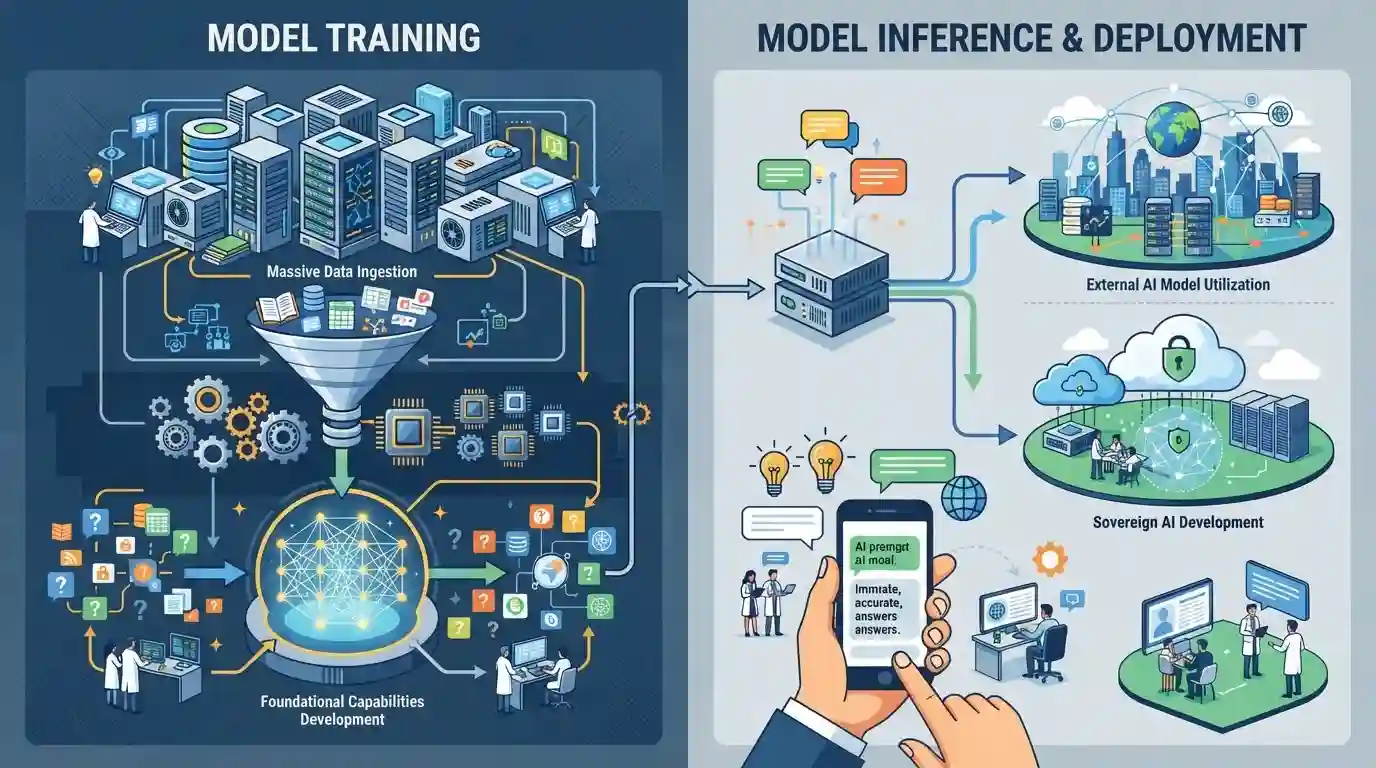
The article explains the core differences between training and inference in artificial intelligence models, contextualized within recent controversies involving Sarvam AI and the utilization of Chinese AI models. Training requires massive data and computing power to build foundational capabilities, whereas inference is the lighter execution phase where the model answers queries. This technical distinction underpins broader policy and geopolitical concerns regarding data security, technological reliance, and sovereign capabilities in AI development.
Key Points
- Training and inference are the two fundamental phases of artificial intelligence (AI) model development and deployment.
- Training involves teaching a model using massive datasets to recognize patterns, which is resource-intensive and computationally expensive.
- Inference is the phase where a trained model applies its learned knowledge to new data to make predictions or generate text and responses.
- Recent controversies involving Indian startups like Sarvam AI and Chinese AI models highlight debates surrounding data sovereignty, intellectual property, and security risks in leveraging foreign foundational architectures.
Important Terms
Training (AI)

The foundational phase in machine learning where an AI model processes massive datasets to learn patterns and adjust its parameters, requiring immense computational power and high-performance hardware like GPUs.
UPSC context
UPSC GS Paper III (Science & Tech): Tests understanding of core artificial intelligence technologies, compute requirements, and foundational model development.
Inference (AI)
The operational phase where an already trained AI model applies its learned knowledge to generate real-time predictions, answers, or outputs for new queries.
UPSC context
UPSC GS Paper III (Science & Tech): Evaluates technical applications of AI and distinctions in infrastructure economics between building models and running them.
Sarvam AI
An Indian artificial intelligence company focused on building sovereign foundational models and multilingual tools, which recently faced public scrutiny over hosting foreign open-weight models.
UPSC context
UPSC GS Paper III (Science & Tech / Economy): Important for tracking indigenous deep-tech startups, sovereign AI initiatives, and data security policies in India.
IndiaAI Mission
A national initiative by the Government of India with a significant financial outlay designed to build scalable AI computing infrastructure, data repositories, and indigenous models.
UPSC context
UPSC GS Paper III (Govt Policies & Interventions): Tests knowledge of state support for high-tech manufacturing, GPU procurement, and strategic self-reliance in emerging technologies.
Prelims Trap
Inference models require massive datasets and computing power equivalent to the original training phase to answer everyday queries.
Aspirants often assume inference requires the same colossal compute and dataset infrastructure as training, whereas inference is the lighter operational phase optimized for deployment.
Static Concepts Connected
What is the difference between AI model training and inference in computing architecture?
- Training Phase:: Teaches the model using massive datasets and high-performance GPUs, requiring vast computational power and energy to establish weights.
- Inference Phase:: Deploys the pre-trained model to generate outputs or answer queries on new data, requiring significantly lower computational overhead.
- Deployment Distinction:: Foundational models are trained centrally, whereas inference often occurs at the edge (on devices) or via cloud APIs.
Cross-Topic Patterns
AI Geopolitics Meets Data Localization DPDP Act
Indian startups balancing cost efficiencies from foreign foundational models against domestic data localization norms under the DPDP Act.
Telecom Infrastructure Debates Analogous to AI Dependency
Concerns over foreign AI dependencies mirror historical debates in telecommunications (like Huawei 5G) regarding strategic infrastructure.

AI training vs. inference distinction + data sovereignty risks under DPDP Act likely to feature in Prelims/Mains.
Linked PYQs · 1
Linked PYQs · 1
- 2023MainsGS3
Introduce the concept of Artificial Intelligence (AI). How does Al help clinical diagnosis? Do you perceive any threat to privacy of the individual in the use of Al in healthcare?
