ISRO Progresses With Rigorous Training for Gaganyaan Mission
Source:The Hindu ↗
Why It Matters
Gaganyaan is India's flagship human spaceflight program. It represents a paradigm shift from ISRO's traditional unmanned satellite and exploration missions, pushing the boundaries of indigenous technology in life support systems, astronaut training, and spacecraft recovery. This topic is highly relevant for GS3 Science and Technology sections, particularly concerning ISRO's achievements and India's growing footprint in the global space sector.
Summary
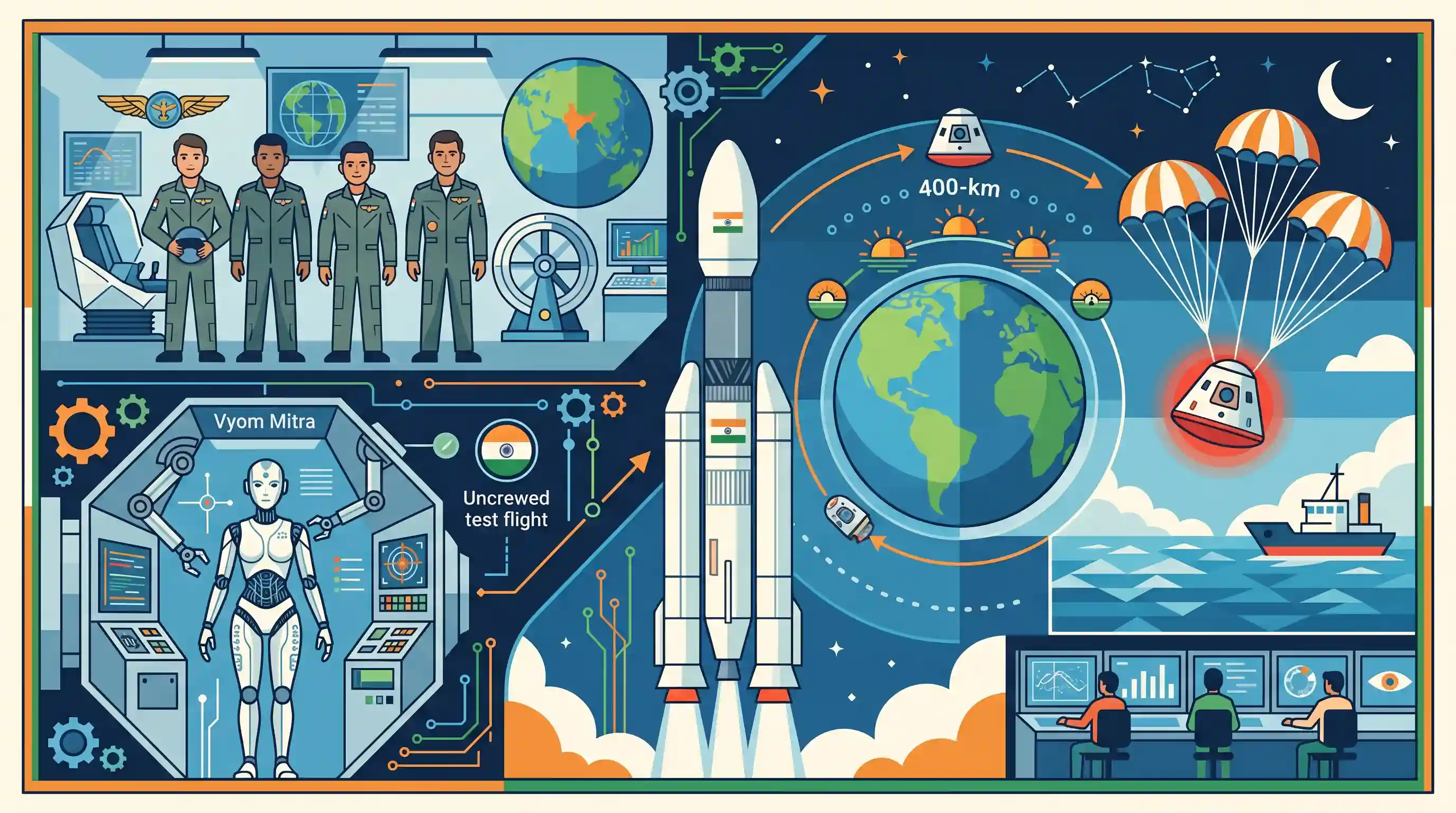
The article provides an update on ISRO's Gaganyaan mission, India's first human spaceflight initiative, targeted for 2027. It highlights the ongoing intensive training of four selected astronaut-designates—Indian Air Force test pilots Prashanth Balakrishnan Nair, Angad Pratap, Ajit Krishnan, and Shubhanshu Shukla. Ahead of the crewed launch, an uncrewed flight featuring the humanoid robot 'Vyom Mitra' will be conducted to validate the spacecraft's systems. The mission aims to demonstrate India's capability to safely launch humans into a 400-km Low Earth Orbit for three days and recover them safely, representing a major leap forward for the Indian space program.
Key Points
- Training for ISRO's Gaganyaan mission, India's first crewed spaceflight, is currently underway.
- The Gaganyaan mission aims to demonstrate indigenous human spaceflight capability by sending astronauts to a 400-km Low Earth Orbit (LEO) for three days and bringing them back safely.
- An uncrewed mission featuring a humanoid robot named ‘Vyom Mitra’ will be launched as a precursor to test critical systems.
- Four Indian Air Force test pilots have been selected as astronaut-designates and have undergone initial training in Russia.
- The crewed mission is targeted for 2027, highlighting India's growing ambitions and capabilities in space technology.
Important Terms
Gaganyaan mission

India's maiden crewed spaceflight program aiming to send a three-member crew to a 400 km orbit for three days and return them safely to Earth.
UPSC context
GS Paper III (Space Technology). Tests understanding of India’s strategic space goals and indigenous technological capabilities.
Vyom Mitra
A "half-humanoid" female robot developed by ISRO to simulate human functions and monitor spacecraft parameters during uncrewed test flights preceding the Gaganyaan mission.
UPSC context
GS Paper III (Robotics/Space). Relevant for prelims questions on mission components and specific robotic applications.
Human Space Flight Centre (HSFC)
An ISRO facility in Bengaluru acting as the lead agency for coordinating the Indian Human Spaceflight Programme, including astronaut training and mission planning.
UPSC context
GS Paper III (Institutions). Tests knowledge of specialized space agencies and their mandates within India.
Low Earth Orbit (LEO)
An Earth-centered orbit at altitudes up to 2,000 km, characterized by high orbital speeds; commonly used for observation satellites and space stations.
UPSC context
GS Paper III (Science & Tech). A fundamental orbital concept frequently tested in UPSC Prelims.
Indigenization of Technology
The process of developing and manufacturing advanced technology within India to achieve self-reliance and reduce dependence on foreign imports in strategic sectors.
UPSC context
GS Paper III (Indigenization of Technology). Key thematic area for Mains questions on Atmanirbhar Bharat.
Human-Rated Launch Vehicle (H-LVM3)
A modified version of ISRO's LVM3 rocket, re-engineered with enhanced safety systems and "human-rating" certification to safely transport astronauts into space.
UPSC context
GS Paper III (Space Technology). Focuses on specific launch systems and safety criteria for crewed missions.
Prelims Trap
The Gaganyaan mission will place Indian astronauts into a Geosynchronous Earth Orbit (GEO).
Gaganyaan targets a 400-km Low Earth Orbit (LEO), not GEO. Additionally, it uses the heavy-lift Human-Rated LVM3 (HLVM3), never the PSLV.
Static Concepts Connected
What distinguishes Low Earth Orbit (LEO) from Geosynchronous Orbit (GEO)?
- LEO (Low Earth): 160 km to 2,000 km altitude. Used for the ISS, Hubble, and human spaceflight (like Gaganyaan) due to lower radiation exposure and launch energy requirements.
- GEO (Geosynchronous): ~35,786 km altitude over the equator. Orbital period matches Earth's rotation (appears stationary). Ideal for communication and weather satellites (e.g., INSAT).
- Payload Capacity: Due to lower altitude, launch vehicles like the LVM3 can carry significantly heavier payloads to LEO (up to 8,000 kg) compared to GTO/GEO (4,000 kg).
What are the key features of the LVM3 (formerly GSLV Mk III) launch vehicle?
- Stage Configuration: It is a three-stage heavy-lift vehicle comprising two solid strap-on motors (S200), a core liquid stage (L110), and a cryogenic upper stage (C25).
- Lift Capability: It is ISRO's heaviest launcher, capable of placing a 4-ton class satellite into Geosynchronous Transfer Orbit (GTO) or an 8-ton payload into LEO.
- Human-Rating: The HLVM3 is the human-rated variant designed for Gaganyaan, featuring enhanced reliability, redundancy, and a Crew Escape System (CES) for emergency aborts.
Cross-Topic Patterns
Space Diplomacy & Human Spaceflight
The astronauts' initial training in Russia highlights how strategic Indo-Russian ties extend into high-end technology transfer and space diplomacy, mirroring early collaborations like Rakesh Sharma's 1984 flight.
AI & Robotics in Extreme Environments
The use of humanoid robot Vyom Mitra for microgravity simulation bridges India's space ambitions with its emerging capabilities in artificial intelligence and autonomous systems.

Expect a multi-statement question contrasting LVM3 vs PSLV capabilities, alongside Gaganyaan's orbit and Vyom Mitra's role.
Linked PYQs · 3
Linked PYQs · 3
- 2025PrelimsGS1
Consider the following space missions : I. Axiom-4 II. SpaDeX III. Gaganyaan How many of the space missions given above encourage and support micro-gravity research?
- 2017MainsGS3
India has achieved remarkable successes in unmanned space missions including the Chandrayaan and Mars Orbitter Mission, but has not ventured into manned space missions. What are the main obstacles to launching a manned space mission, both in terms of technology and logistics? Examine critically.
- 2016MainsGS3
Discuss India's achievements in the field of Space Science and Technology. How the application of this technology has helped India in its socio-economic development?
