Kasganj Trainer Aircraft Crash Landing and DGCA Safety Regulations
Source:thehindu ↗
Why It Matters
This article highlights the regulatory and statutory framework of civil aviation in India (DGCA and Aircraft Amendment Act) and touches upon the regional geography of Western Uttar Pradesh (Aligarh and Kasganj), both of which are high-yield areas for UPPSC PCS Prelims polity and geography questions.
Summary
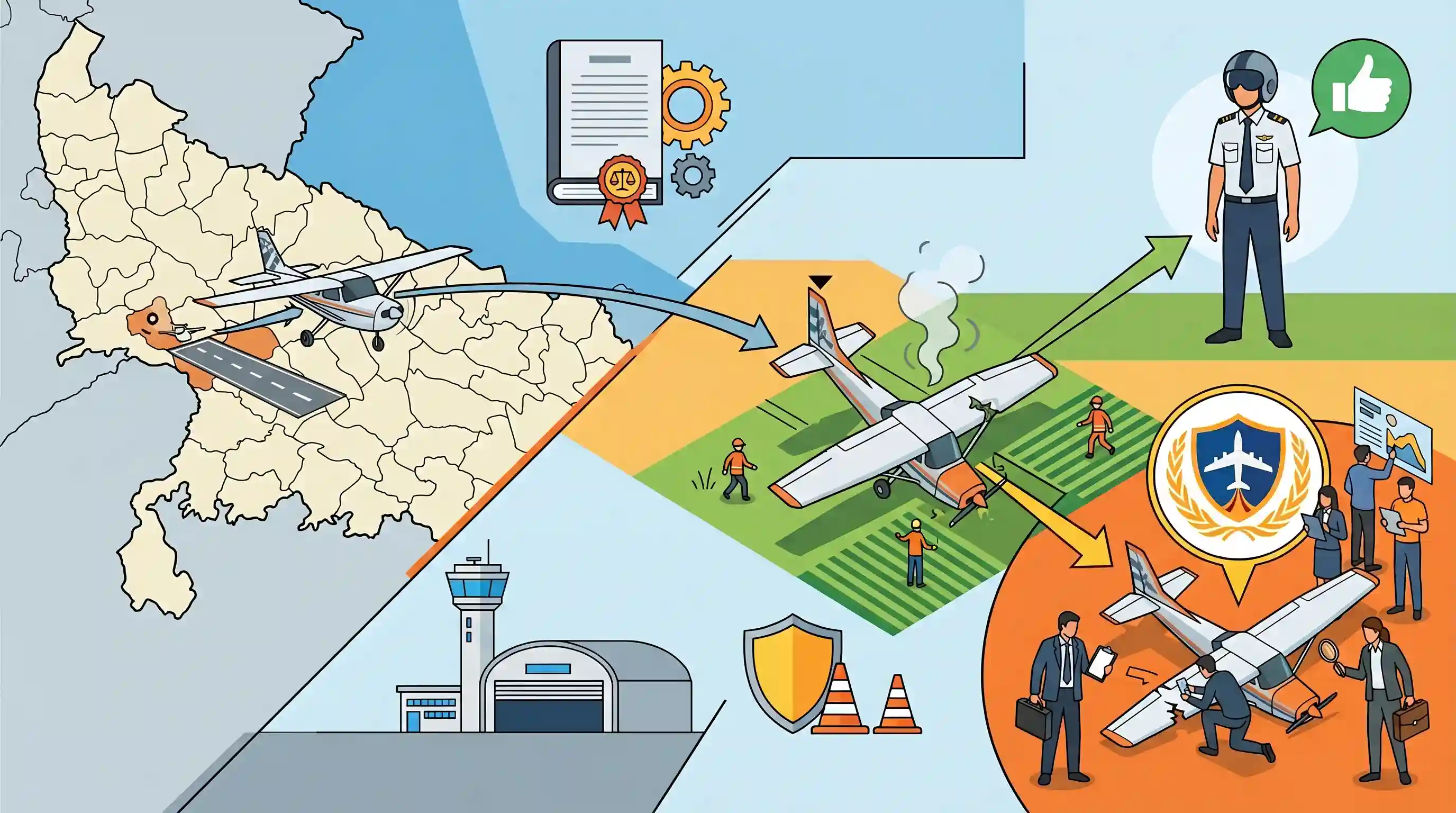
A Cessna 152 trainer aircraft operated by Chetak Aviation crash-landed in Kasganj district, Uttar Pradesh, during a solo training flight from Aligarh. The trainee pilot survived the incident safely, and the statutory aviation regulator, the Directorate General of Civil Aviation (DGCA), has launched an investigation.
Key Points
- On June 29, 2026, a trainer Cessna 152 aircraft (registration VT-AFB) operated by Chetak Aviation crash-landed in a field in Kasganj, Uttar Pradesh.
- The aircraft was performing a solo flight originating from Aligarh; the female trainee pilot safely escaped without injuries.
- The Directorate General of Civil Aviation (DGCA) is investigating the cause of the crash-landing.
- The DGCA was given statutory status under the Aircraft (Amendment) Act, 2020, along with the Bureau of Civil Aviation Security (BCAS) and the Aircraft Accidents Investigation Bureau (AAIB).
- Aligarh and Kasganj districts are located in the Aligarh Division of western Uttar Pradesh. Kasganj was carved out of Etah district in 2008 and renamed from Kanshi Ram Nagar to Kasganj in 2012.
Important Terms
Directorate General of Civil Aviation

India's apex statutory civil aviation regulator responsible for overseeing aviation safety, airworthiness standards, and licensing flight crew, pilots, and air traffic controllers under the Ministry of Civil Aviation.
UPSC context
GS Paper II (Statutory Bodies) & GS Paper III (Infrastructure). Tests understanding of regulatory frameworks and oversight mechanisms in Indian aviation.
Aircraft (Amendment) Act, 2020
An amendment to the Aircraft Act of 1934 that accorded statutory status to the DGCA, BCAS, and AAIB, and increased maximum fines for safety violations up to ₹1 crore.
UPSC context
GS Paper II (Government Policies/Legislations) & GS Paper III (Infrastructure). Tests knowledge of reforms strengthening aviation safety, security, and institutional accountability.
Ministry of Civil Aviation
The nodal ministry of the Government of India responsible for formulating national policies, programs, and regulations for the development, growth, and oversight of civil aviation and airport infrastructure.
UPSC context
GS Paper II (Union Ministry Functions) & GS Paper III (Infrastructure). Tests command over executive structures and policy initiatives in India's aviation sector.
Flying Training Organisation
A flight training academy approved by the DGCA to provide ground instruction, simulator training, and flying hours necessary for licensing commercial and private pilots.
UPSC context
GS Paper III (Infrastructure/Aviation Infrastructure). Tests awareness of pilot training ecosystems, aviation safety, and recent performance-ranking initiatives in India.
Prelims Trap
The Directorate General of Civil Aviation (DGCA) is the statutory body responsible for investigating civil aircraft accidents in India.
The Aircraft Accidents Investigation Bureau (AAIB) is the independent statutory authority for accident investigation, whereas DGCA handles safety, standards, and licensing.
Static Concepts Connected
How is civil aviation regulation structured under Indian law?
- Safety and licensing: The DGCA acts as the safety regulator, issuing licenses, airworthiness certificates, and enforcing safety standards.
- Security oversight: The Bureau of Civil Aviation Security (BCAS) lays down standards and safeguards for civil flights and airports.
- Accident investigation: The Aircraft Accidents Investigation Bureau (AAIB) independently investigates accidents to maintain objective safety standards.
What did the Bharatiya Vayuyan Adhiniyam, 2024 change?
- Modernized scope: It replaced the colonial-era Aircraft Act, 1934, modernizing definitions to explicitly include drones, eVTOLs, and hybrid propulsion.
- Licensing shift: It transferred the authority to issue Radio Telephone Operator (Restricted) Certificates from the Ministry of Communications to the DGCA.
- Dispute resolution: It established a two-tier internal administrative appeal process for licensing and regulatory disputes.
Cross-Topic Patterns
Separation of regulator and investigator
ICAO guidelines mandate separating the safety regulator (DGCA) from the accident investigator (AAIB) to prevent institutional conflicts of interest.
Decolonising technological regulation
Replacing the 1934 Act with the Bharatiya Vayuyan Adhiniyam, 2024 aligns with India's policy of updating colonial laws for drone and eVTOL technologies.

2026 Prelims may target the newly shifted powers of the DGCA and the statutory distinction between DGCA, BCAS, and the AAIB.
Linked PYQs · 3
Linked PYQs · 3
- 2016UPPSC_PRELIMSGS1
The State Finance Commission is a
- 2025UPPSC_PRELIMSGS1
Which of the following districts of Uttar Pradesh shares its boundary with only one other district of Uttar Pradesh ? 1. Lalitpur 2. Saharanpur 3. Sonbhadra Select the correct answer from the code given below :
- 2022UPPSC_PRELIMSGS1
The first airport powered by solar energy in India is
