TRAI Directive on 1601 Series for Service and Transactional Calls
Source:The Hindu ↗
हे का महत्त्वाचे आहे
Demonstrates proactive regulatory interventions by TRAI to mitigate the prevalent issues of unsolicited commercial communication (UCC) and cyber frauds, thereby enhancing digital trust and consumer security.
सारांश
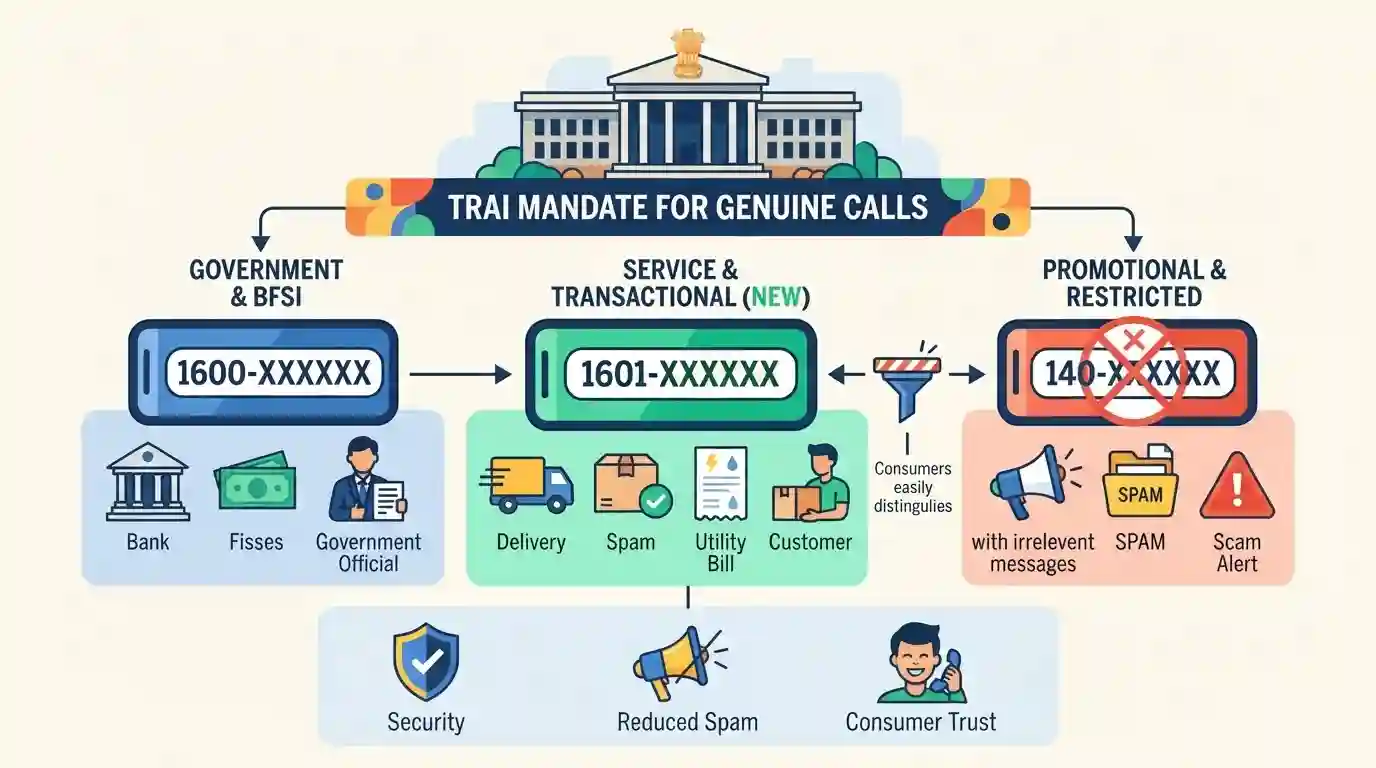
The Telecom Regulatory Authority of India (TRAI) has mandated the use of a new 1601-series for service and transactional calls by utility, courier, and logistics companies. This move, part of broader efforts to curb spam and prevent telecommunication fraud, aims to help consumers distinguish genuine service calls from promotional or fraudulent ones. The 1601-series expands upon the 1600-series already used by the government and BFSI sectors, while promotional calls remain restricted to the 140-series.
मुख्य मुद्दे
- TRAI directed the allocation of a dedicated 1601-series for transactional and service calls by entities outside the BFSI and government sectors.
- Phase 1 of the 1601-series rollout applies to utility services (water, electricity, gas) and the courier/logistics sector.
- The 1600-series is already in use for service calls by Banking, Financial Services, and Insurance (BFSI) entities and government agencies.
- The 140-series is designated exclusively for promotional calls.
- The initiative is designed to prevent fraud by helping consumers easily identify legitimate, non-promotional enterprise calls.
महत्त्वाच्या संज्ञा
Telecom Regulatory Authority of India (TRAI)

The statutory body established under the TRAI Act, 1997, to regulate telecom services, protect consumer interests, and ensure the orderly growth of India’s telecommunication and broadcasting sectors.
UPSC context
GS Paper II: Statutory, regulatory, and quasi-judicial bodies; GS Paper III: Infrastructure and telecommunications.
Truecaller
A third-party smartphone caller-identification application that recently clashed with TRAI over flagging mandatory 140 and 1600-series commercial and transactional numbers as spam on its platform.
UPSC context
GS Paper III: IT, data privacy, cyber security, and challenges in regulating digital platforms.
1601-Series Numbering System
A newly mandated telecommunications number series assigned directly to utility, courier, and logistics companies for service and transactional voice calls to prevent voice fraud and caller impersonation.
UPSC context
GS Paper III: Internal Security/Cyber Security, emphasizing telecom fraud prevention and consumer safety.
Unsolicited Commercial Communications (UCC)
Promotional calls or SMS messages sent to telecom subscribers without their explicit prior consent, heavily regulated under TRAI's anti-spam framework to safeguard consumer rights and privacy.
UPSC context
GS Paper II: Government policies and interventions for consumer protection and privacy.
Distributed Ledger Technology (DLT) in Telecom
A blockchain-based system mandated by TRAI for telecom operators to register telemarketers, headers, and templates, ensuring complete traceability of commercial communications to eliminate phishing and spam.
UPSC context
GS Paper III: Technology and applications of blockchain in digital governance and cyber security.
पूर्वपरीक्षा सापळा
"TRAI resolves disputes and adjudicates penalties for telecom operators violating the new 1601-series mandate."
TRAI is purely regulatory. All adjudicatory and dispute resolution functions were transferred to the Telecom Disputes Settlement and Appellate Tribunal (TDSAT) in 2000.
संबंधित स्थिर संकल्पना
What is the functional division between TRAI and TDSAT?
- TRAI mandate: Regulates telecom services, fixes tariffs, and ensures quality of service under the TRAI Act, 1997.
- TDSAT mandate: Created in 2000 to adjudicate disputes and hear appeals against TRAI directions, separating regulation from adjudication.
How is Distributed Ledger Technology (DLT) applied in Indian telecom regulation?
- Decentralized registry: DLT provides an immutable, shared database across telecom operators to register commercial senders and headers.
- Spam traceability: TRAI mandates DLT to track and verify commercial communications, preventing unauthorized telemarketers from spoofing legitimate businesses.
आंतर-विषय नमुने
Blockchain for Consumer Protection
TRAI's mandate to use Distributed Ledger Technology (DLT) for spam control shows blockchain's utility shifting from cryptocurrencies toward mainstream regulatory compliance and preventing cyber fraud.
Digital India vs. Vishing attacks
Reserving specific number series (1600 for BFSI, 1601 for utilities) helps secure digital financial inclusion by mitigating Jamtara-style voice-phishing (vishing) attacks targeting vulnerable rural and elderly populations.

Expect a 2026 prelims question pairing TRAI's regulatory limits (TDSAT separation) with its mandate of DLT/Blockchain for spam control.
संबंधित PYQ · 2
संबंधित PYQ · 2
- 2019PrelimsGS1
In India, which of the following review the independent regulators in sectors like telecommunications, insurance, electricity, etc.? 1. Ad Hoc Committees set up by the Parliament 2. Parliamentary Department Related Standing Committees 3. Finance Commission 4. Financial Sector Legislative Reforms Commission 5. NITI Aayog Select the correct answer using the code given below.
- 2020MainsGS3
Discuss different types of cyber crimes and measures required to be taken to fight the menace.
