TRAI AI Guidelines for Telecom Accountability and Governance
Source:Indian Express ↗
Why It Matters
It highlights the regulatory response to the integration of Artificial Intelligence in critical infrastructure like telecommunications, ensuring accountability, user data protection, and ethical deployment.
Summary
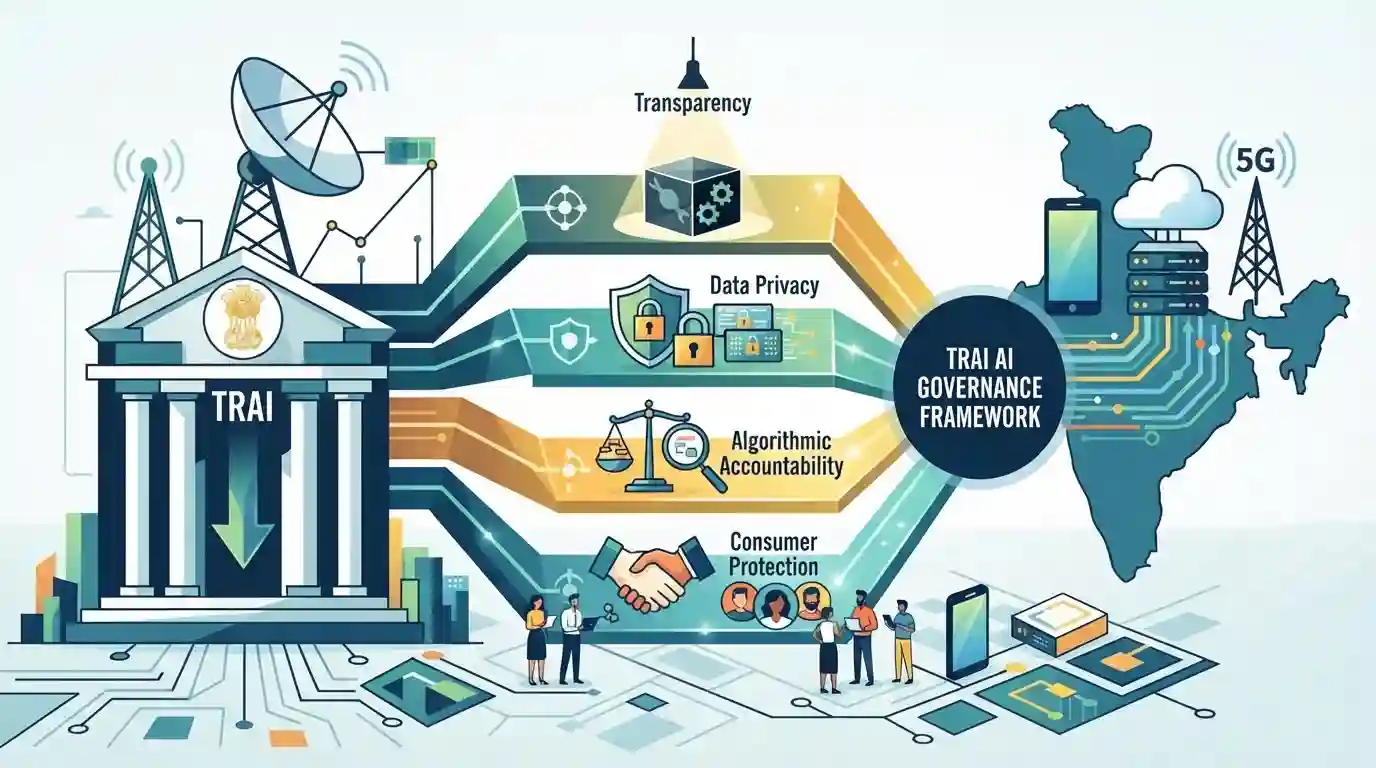
The Telecom Regulatory Authority of India (TRAI) has issued guidelines emphasizing the accountability of telecom companies in deploying Artificial Intelligence (AI) systems. The framework addresses key governance challenges including transparency, data privacy, algorithmic accountability, and consumer protection in the rapidly evolving telecommunications sector.
Key Points
- TRAI has released comprehensive guidelines regarding the deployment and accountability of Artificial Intelligence (AI) systems by telecom companies.
- The guidelines aim to address emerging challenges related to algorithmic bias, data privacy, user protection, and transparency in telecom services.
- Telecom companies are expected to implement responsible AI frameworks to ensure consumer trust and prevent misuse of communication infrastructure.
- The move aligns with broader national efforts to regulate critical digital technologies and secure consumer data under frameworks like the DPDP Act.
Important Terms
Telecom Regulatory Authority of India (TRAI)

An independent statutory body established under the TRAI Act, 1997, to regulate telecommunication services, tariffs, and ensure fair competition in India's telecom sector.
UPSC context
GS Paper II & III: Evaluates statutory regulatory bodies, telecom sector governance, and technology regulations.
Digital Personal Data Protection Act 2023
India's landmark legislation enacted to govern the processing of digital personal data, establishing rights for data principals and obligations for data fiduciaries.
UPSC context
GS Paper II & III: Tests understanding of digital rights, privacy frameworks, and cybersecurity legislation in India.
TRAI AI Guidelines
A governance framework proposed by TRAI to enforce accountability, risk categorization, and ethical deployment of AI systems by telecom operators.
UPSC context
GS Paper III (IT & Computers): Important for questions on AI regulation, ethics, and corporate accountability.
Prelims Trap
TRAI lacks statutory jurisdiction to mandate internal AI governance committees or risk classifications for telecom service providers.
Aspirants often assume TRAI only regulates spectrum and tariffs; however, its mandate covers telecom infrastructure, data security, and consumer rights, extending to AI deployment in networks.
Static Concepts Connected
What are the constitutional and statutory powers of the Telecom Regulatory Authority of India (TRAI)?
- Statutory Origin: Established in 1997 through the TRAI Act, 1997, to regulate telecom services and tariffs in India.
- TDSAT Amendment: Amended in 2000 to establish the Telecom Disputes Settlement and Appellate Tribunal (TDSAT) to adjudicate disputes.
- Core Mandate: Empowered to make recommendations on telecom policy, license terms, spectrum management, and consumer protection.
Cross-Topic Patterns
Telecom Regulation meets DPDP Act Compliance
TRAI's AI frameworks converge with MeitY guidelines and the DPDP Act, illustrating how statutory regulators are embedding data privacy and algorithmic accountability across sectors.
Third-Party AI Liability & Consumer Rights
Holding telecom operators accountable for third-party AI vendor failures mirrors product liability principles in consumer protection laws.

Expect statement-based prelims questions on TRAI's statutory powers over AI governance vs MeitY's overarching tech policies.
Linked PYQs · 3
Linked PYQs · 3
- 2023MainsGS3
Introduce the concept of Artificial Intelligence (AI). How does Al help clinical diagnosis? Do you perceive any threat to privacy of the individual in the use of Al in healthcare?
- 2024MainsGS3
Describe the context and salient features of the Digital Personal Data Protection Act, 2023.
- 2019PrelimsGS1
In India, which of the following review the independent regulators in sectors like telecommunications, insurance, electricity, etc.? 1. Ad Hoc Committees set up by the Parliament 2. Parliamentary Department Related Standing Committees 3. Finance Commission 4. Financial Sector Legislative Reforms Commission 5. NITI Aayog Select the correct answer using the code given below.
