India New Zealand FTA balances export access with domestic protection
Source:The Hindu ↗
Why It Matters
Provides crucial insights into India's evolving trade policy framework, balancing integration into global supply chains with the protection of sensitive domestic sectors like agriculture and dairy against global protectionist trends.
Summary
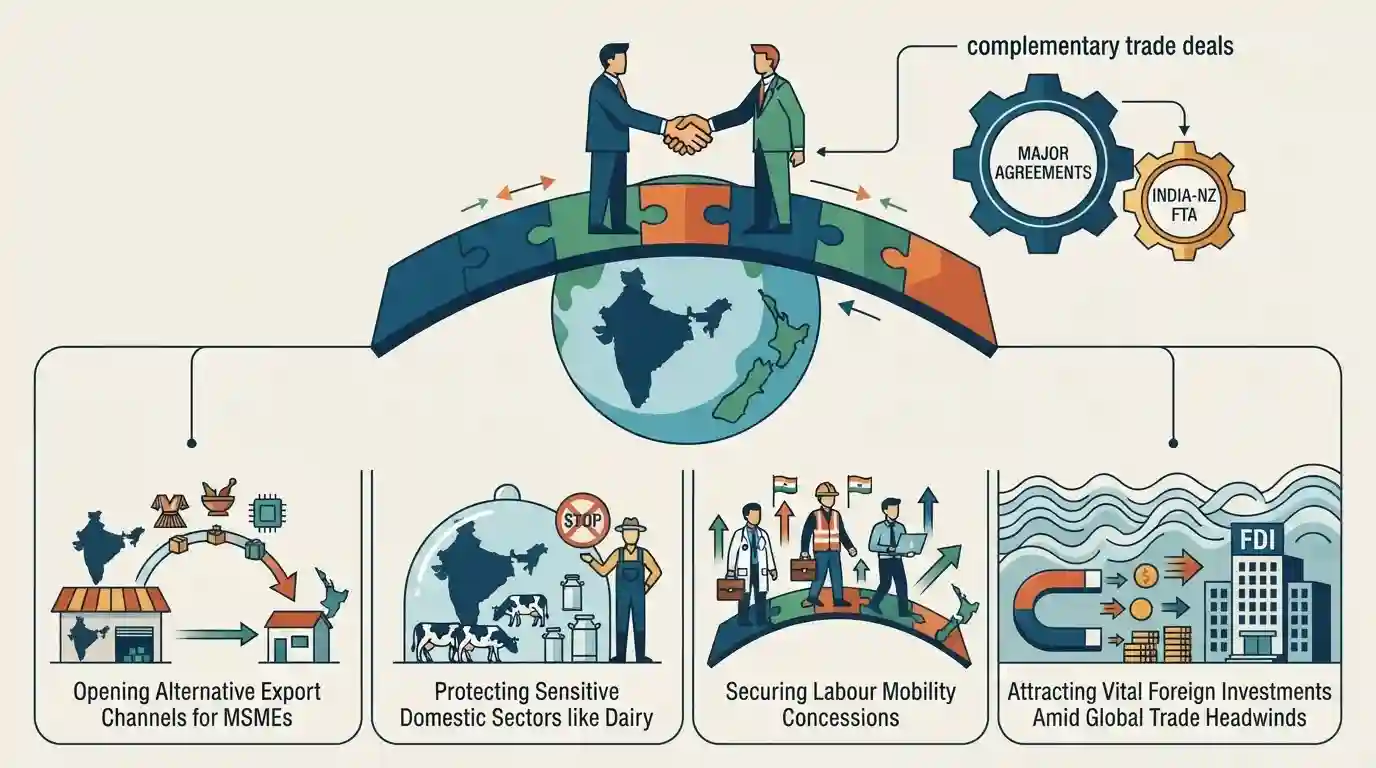
The editorial analyzes the strategic and economic dimensions of the India-New Zealand Free Trade Agreement (FTA). It highlights how smaller trade deals complement major bilateral agreements by opening alternative export channels for MSMEs, protecting sensitive domestic sectors like dairy, securing labour mobility concessions, and attracting vital foreign investments amid global trade headwinds.
Key Points
- India and New Zealand signed a Free Trade Agreement (FTA) set to come into force on October 20, aimed at doubling bilateral goods trade by 2030.
- India successfully secured 100% duty-free access for its exports while fiercely protecting sensitive domestic sectors like dairy by excluding them from tariff concessions.
- The agreement incorporates valuable provisions on labour mobility, student/worker visas, and a commitment of $20 billion in investments from New Zealand over 15 years.
- The deal exemplifies India's strategic push for trade pacts with smaller partners to diversify export destinations amid rising global protectionism and looming tariffs.
Important Terms
India-New Zealand Free Trade Agreement

A bilateral trade pact designed to boost economic ties, enhance market access for MSMEs, secure labor mobility, and safeguard domestic sensitive sectors like dairy from import competition.
UPSC context
UPSC GS Paper III (Economy - International Trade & Bilateral Agreements). Tests understanding of regional/bilateral economic partnerships and strategic export diversification.
EFTA
The European Free Trade Association (comprising Iceland, Liechtenstein, Norway, and Switzerland), which concluded a landmark Trade and Economic Partnership Agreement (TEPA) with India featuring significant investment commitments.
UPSC context
UPSC GS Paper III (Economy - Growth & Development). Relevant for evaluating non-EU European trade corridors, investment pledges, and modern comprehensive economic partnerships.
Prelims Trap
signed a Free Trade Agreement... aimed at doubling bilateral goods trade by granting reciprocal zero-duty access across all agricultural and industrial sectors.
Aspirants often assume FTAs require symmetrical zero-duty access across all sectors. In practice, negative lists and sensitive sector exclusions (like dairy) are standard exemptions.
Static Concepts Connected
What are the key generations and modalities of Free Trade Agreements (FTAs) in international trade?
- PTAs: Preferential Trade Agreements (PTAs) involve reduced tariffs on a limited positive list of goods between partner nations.
- CECAs: Comprehensive Economic Cooperation Agreements (CECAs) cover deeper integration including services, investment, and regulatory cooperation alongside goods.
- CEPAs: Comprehensive Economic Partnership Agreements (CEPAs) represent the deepest level of bilateral trade pacts, including extensive economic partnership and institutional mechanisms.
Cross-Topic Patterns
FTAs vs WTO Agreement on Agriculture
While major FTAs protect sensitive sectors like dairy, domestic farm lobbies frequently clash with WTO subsidy rules on agricultural support, creating complex legal hurdles for export competitiveness.
Services Mobility in Bilateral vs Plurilateral Pacts
Bilateral service mobility chapters complement broader plurilateral pacts like RCEP or IPEF, offering targeted visa pathways without full multilateral tariff exposure.

Expect a statement-based question pairing India's FTA exclusions (dairy) with service mobility and investment targets under recent trade pacts.
Linked PYQs · 1
Linked PYQs · 1
- 2025MainsGS3
What are the challenges before the Indian economy when the world is moving away from free trade and multilateralism to protectionism and bilateralism? How can these challenges be met?
