Tariff Policies and Global Supply Chain Realignment Pressures
Source:Indian Express ↗
Why It Matters
Understanding the dynamics of the US-China trade war is critical for analyzing global economic shifts, the rise of protectionism, and their direct impact on India's macroeconomic stability and strategic interests.
Summary
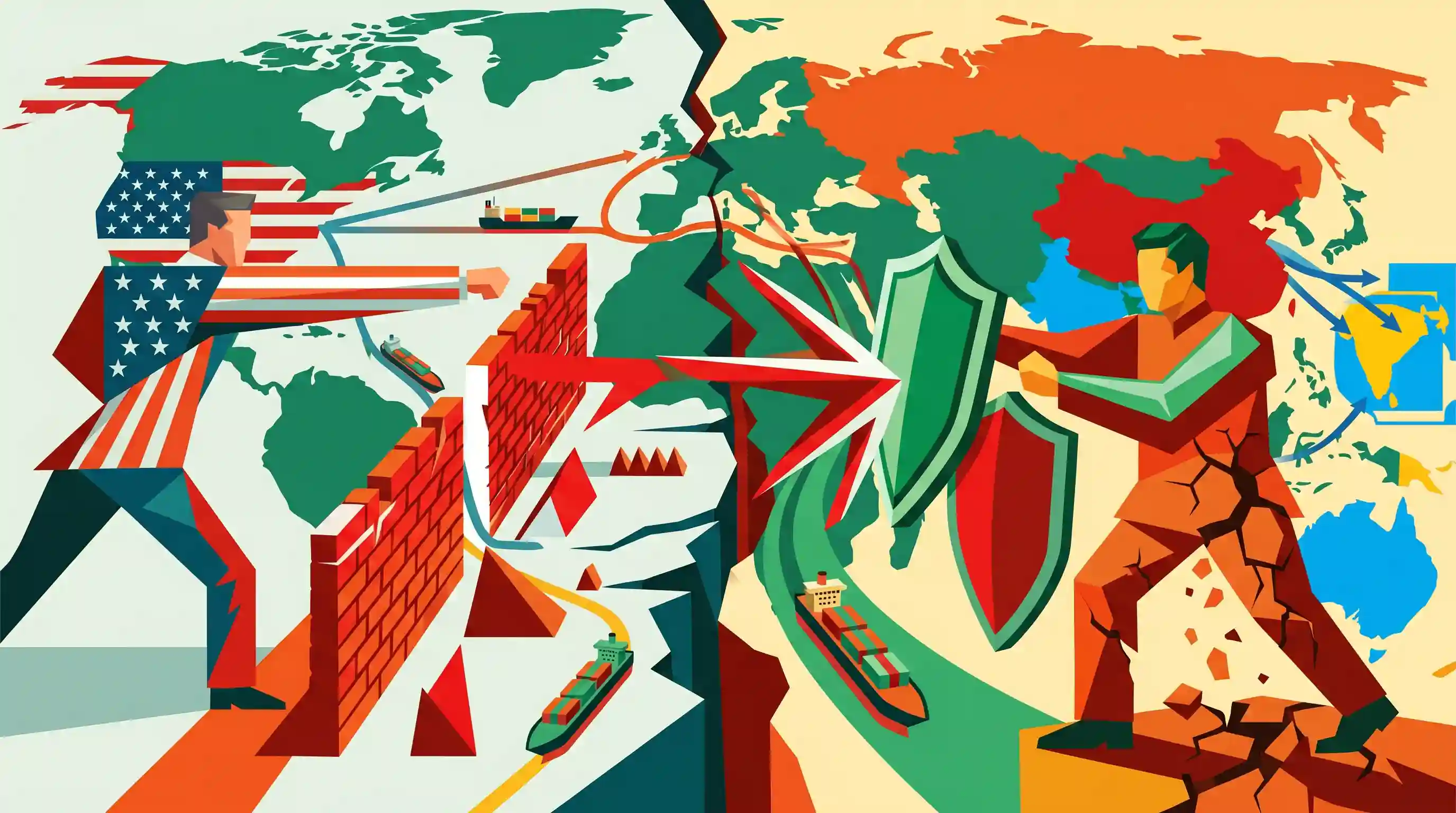
The article discusses the escalating US-China trade war, emphasizing Donald Trump's aggressive tariff proposals. It argues that while China responds with strong diplomatic and economic rhetoric, this posturing conceals deep structural frailties within the Chinese economy, such as slowing growth and heavy reliance on export-driven manufacturing. Persistent US protectionism highlights a global shift away from multilateral free trade toward bilateralism and sovereign nationalism. This geopolitical friction forces a realignment of global supply chains, presenting both macroeconomic challenges and strategic opportunities for emerging economies like India.
Key Points
- Donald Trump's aggressive tariff proposals signal an intensification of the US-China trade war and a broader American push toward economic protectionism.
- Despite Beijing's assertive diplomatic rhetoric, China's economy faces deep-seated structural frailties, increasing its vulnerability to severe US trade disruptions.
- The persistent US-China economic friction accelerates the unwinding of globalization, replacing multilateral free trade with bilateralism and sovereign nationalism.
- A protracted trade war forces a realignment of global supply chains, presenting India with both macroeconomic challenges from a global slowdown and strategic opportunities via the 'China Plus One' strategy.
Prelims Trap
Unilateral tariff hikes for geopolitical containment are explicitly permitted under WTO's standard Most-Favoured-Nation (MFN) framework.
Unilateral tariffs violate core WTO MFN rules. The US bypasses this by invoking the GATT Article XXI 'National Security Exception,' a highly contested loophole, not standard MFN policy.
Static Concepts Connected
What are the primary WTO-compliant trade remedy measures?
- Anti-dumping duty: Applied when a country exports a product at a price lower than its normal domestic market price, injuring the importing country's industry.
- Countervailing duty: Imposed to neutralize the negative effects of specific subsidies provided by the exporting country's government to its producers.
- Safeguard measures: Temporary restrictions (like quotas or tariffs) on imports of a product to protect a specific domestic industry from a sudden, unforeseen surge in imports.
What is the 'China Plus One' strategy and its macroeconomic rationale?
- Definition: A business strategy where multinational corporations diversify their manufacturing operations and supply chains outside of China to alternative destinations.
- Objective: To mitigate supply chain risks arising from geopolitical friction (US-China trade war), rising Chinese labor costs, and over-reliance on a single geography.
- India's opportunity: India uses tools like the Production-Linked Incentive (PLI) scheme to capitalize on this realignment, aiming to attract global manufacturing and boost domestic job creation.
Cross-Topic Patterns
Tariffs and Competitive Devaluation
Heavy US tariffs often provoke China to artificially devalue the Yuan to maintain export competitiveness, potentially triggering global currency friction and impacting India's import bill and forex reserves.
Supply chain shifts & Critical Minerals
As the US pushes for supply chain decoupling, China frequently retaliates by weaponizing its dominance in critical minerals (e.g., restricting gallium exports), directly impacting India's EV and solar manufacturing ambitions.

Expect a 2026 prelims question linking the 'China Plus One' strategy with the WTO's National Security exception under GATT Article XXI.
Linked PYQs · 4
Linked PYQs · 4
- 2018MainsGS3
How would the recent phenomena of protectionism and currency manipulations in world trade affect macroeconomic stability of India?
- 2025MainsGS3
What are the challenges before the Indian economy when the world is moving away from free trade and multilateralism to protectionism and bilateralism? How can these challenges be met?
- 2025MainsGS2
"With the waning of globalization, post-Cold War world is becoming a site of sovereign nationalism.” Elucidate.
- 2021MainsGS2
“The USA is facing an existential threat in the form of a China, that is much more challenging than the erstwhile Soviet Union.” Explain.
