Critical Minerals Partnership and Global South Solidarity
Source:Indian Express ↗
Why It Matters
The increasing focus on critical minerals highlights the shifting geopolitical priorities from fossil fuels to clean energy resources. For UPSC aspirants, understanding India's bilateral efforts to secure these resources is vital for GS2 (International Relations) and GS3 (Economy & Energy Security), as it reflects India's strategy to lead the Global South and mitigate supply chain vulnerabilities.
Summary
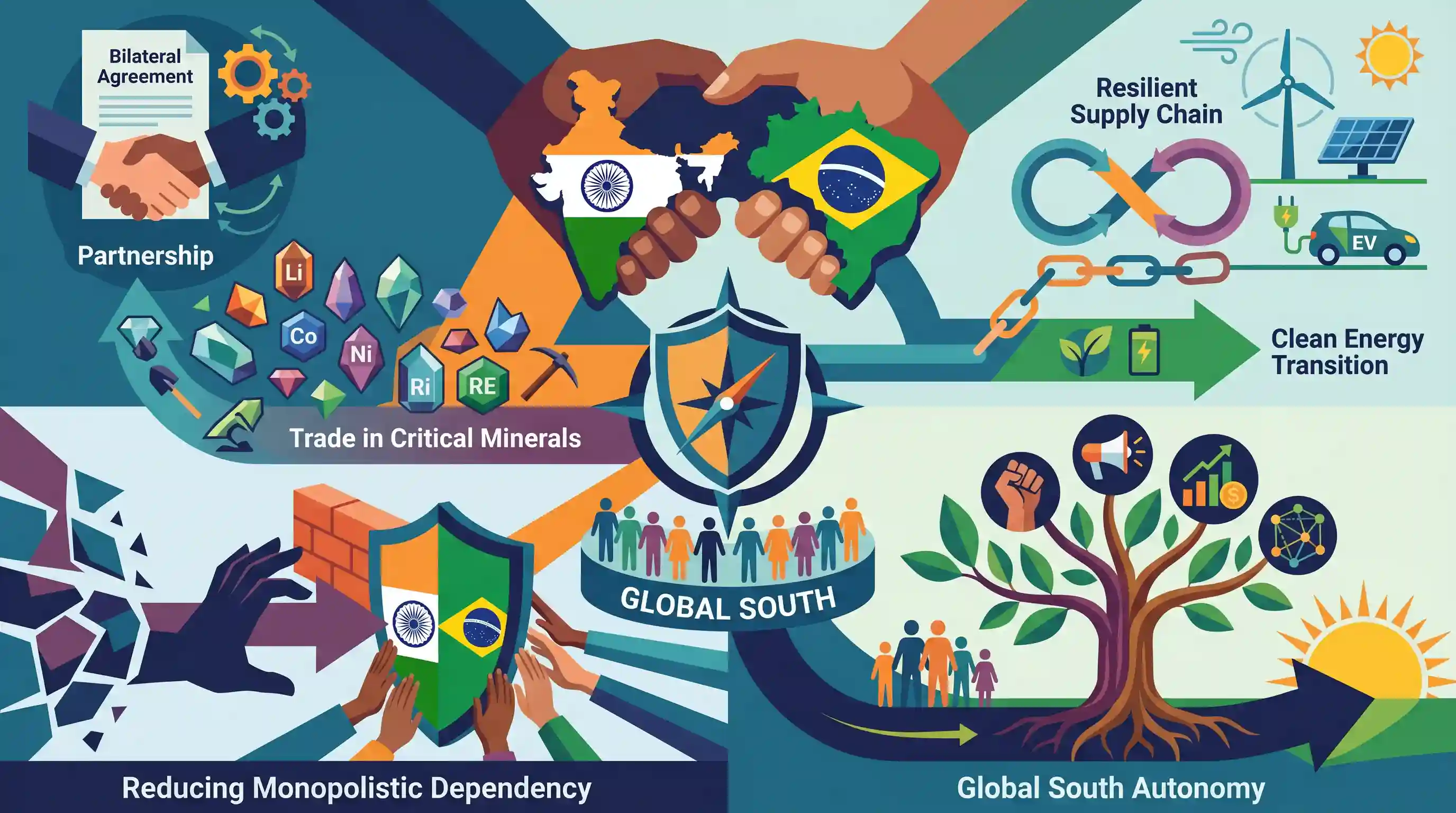
India and Brazil are strengthening their bilateral partnership by focusing on enhancing trade, particularly in the strategic domain of critical minerals. This cooperation aims to secure resilient supply chains for both nations, crucial for the clean energy transition, while reducing dependencies on current monopolistic suppliers. By collaborating on these fronts, India and Brazil seek to amplify the voice, economic resilience, and strategic autonomy of the Global South in the evolving geopolitical landscape.
Key Points
- India and Brazil are expanding their bilateral cooperation to focus on trade and the strategic sector of critical minerals.
- Securing a resilient supply chain for critical minerals is essential for the clean energy transition, digital economy, and reducing dependence on existing market monopolies.
- The partnership emphasizes South-South cooperation, aiming to amplify the voice and strategic autonomy of developing nations in the global economic order.
- Strengthening India-Brazil ties is positioned as a broader strategy to champion the interests of the Global South and foster equitable global trade practices.
Prelims Trap
"India recently signed a comprehensive Free Trade Agreement with the MERCOSUR bloc to secure critical minerals."
India is not a member of MERCOSUR, nor does it have an FTA. It only holds a limited Preferential Trade Agreement (PTA) with the bloc.
Static Concepts Connected
How does the IBSA Dialogue Forum differ strategically from BRICS?
- Democracy focus: IBSA exclusively comprises democratic nations (India, Brazil, South Africa), whereas BRICS includes non-democracies like China and Russia.
- Geopolitical scope: IBSA is purely focused on South-South developmental cooperation, whereas BRICS has evolved to encompass broader multipolar, often anti-Western, geopolitical posturing.
What defines a mineral as "critical" for a country?
- Economic necessity: They are indispensable for modern technology, defense, and the green transition, with no viable commercial substitutes available.
- Supply vulnerability: Their extraction or processing is highly concentrated geographically (e.g., China for rare earths), posing severe supply chain disruption risks.
Cross-Topic Patterns
Energy transition shifts geopolitics
The pivot from fossil fuels to renewables turns mineral-rich Latin America into a strategic pivot, echoing the historical geopolitical weight of Middle Eastern petro-states.
Global South vs China mineral monopoly
India's bilateral deals with Brazil and Argentina run parallel to multilateral moves like the US-led Mineral Security Partnership, showing multi-alignment to counter China's processing dominance.

Expect a 2026 multi-statement question linking India’s critical mineral strategy (KABIL, MSP) with Latin American reserves and MERCOSUR.
Linked PYQs · 3
Linked PYQs · 3
- 2012PrelimsGS1
Recently, there has been a concern over the short supply of a group of elements called 'rare earth metals'. Why? 1. China, which is the largest producer of these elements, has imposed some restrictions on their export. 2. Other than China, Australia, Canada and Chile, these elements are not found in any country. 3. Rare earth metals are essential for the manufacture of various kinds of electronic items and there is a growing demand for these elements. Which of the statements given above is/are correct?
- 2021PrelimsGS1
Consider the following statements : 1. The Global Ocean Commission grants licences for seabed exploration and mining in international waters. 2. India has received licences for seabed mineral exploration in international waters. 3. 'Rare earth minerals' are present on seafloor in international waters. Which of the statements given above are correct?
- 2016MainsGS2
The broader aims and objectives of WTO are to manage and promote international trade in the era of globalization. But the Doha round of negotiations seem doomed due to differences between the developed and the developing countries." Discuss in the Indian perspective.
