Commerce Ministry Expands North America Desk Amid US Tariff Pressures
Source:Indian Express ↗
Why It Matters
The article is relevant for understanding how India manages its economic diplomacy in the face of growing global protectionism. Changes in US trade policy have a direct impact on Indian exports, and the restructuring of the Commerce Ministry illustrates institutional responses to evolving international relations.
Summary
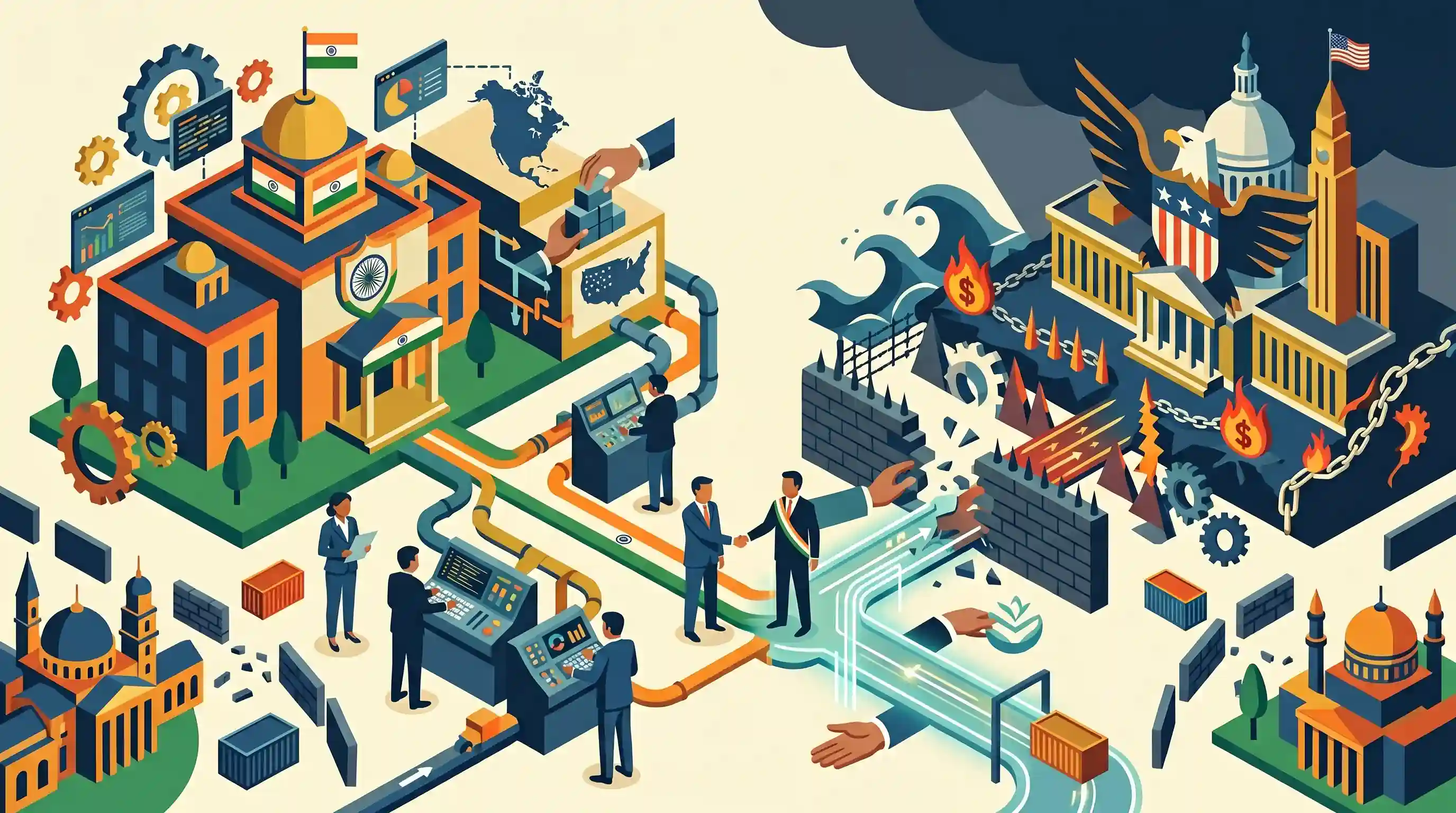
India's Ministry of Commerce and Industry is expanding its NAFTA (North America) desk to proactively manage trade relations with the United States and its regional partners. Anticipating potential shifts in US trade policy—particularly a return to higher tariffs or protectionist measures under a new administration—India aims to negotiate a 'tariff truce' to safeguard its export interests. This institutional restructuring reflects a strategic emphasis on robust economic diplomacy to navigate a global trading environment increasingly characterized by bilateralism and protectionist barriers.
Key Points
- India's Ministry of Commerce and Industry is expanding its North America (NAFTA/USMCA) division to strengthen institutional capacity for trade negotiations.
- The restructuring is a proactive measure to anticipate and manage potential shifts toward protectionist trade policies in the US.
- India seeks to negotiate a 'tariff truce' to prevent trade frictions and protect its export interests from arbitrary tariff hikes.
- This move highlights India's evolving economic diplomacy, adapting to a global landscape increasingly defined by bilateralism rather than multilateral free trade.
Important Terms
Ministry of Commerce and Industry

India's central authority for trade and industrial policy. Its Department of Commerce manages foreign trade negotiations, export promotion, and regional trade desks, including the North America (NAFTA) division.
UPSC context
GS Paper 2/3: Tests understanding of India's institutional framework for trade negotiations and economic governance.
North American Free Trade Agreement (NAFTA)
A 1994-2020 trade pact between the US, Canada, and Mexico. Though replaced by USMCA, India's commerce ministry still uses this name for its North American trade desk.
UPSC context
GS Paper 2: International Relations; tests knowledge of regional trade blocs and their historical impact on global trade.
United States-Mexico-Canada Agreement (USMCA)
The successor to NAFTA, effective July 2020. It modernized trade rules for North America, specifically targeting digital trade, labor standards, and increased local content requirements for automobiles.
UPSC context
GS Paper 2: IR; highlights the evolution of global trade regimes and their implications for India's bilateral interests.
Tariff Truce
A temporary agreement to suspend or reduce tariffs and trade barriers. It acts as a "cooling-off" period to prevent trade wars and facilitate negotiations for long-term agreements.
UPSC context
GS Paper 3: Economy; tests understanding of trade conflict resolution and India's strategic responses to protectionism.
Economic Diplomacy
The use of economic instruments—such as trade agreements, investment, and aid—to achieve a country's strategic foreign policy objectives and national interests.
UPSC context
GS Paper 2: IR; assesses ability to link economic interests with geopolitical strategy and global positioning.
Protectionism
Economic policies designed to restrict imports and protect domestic industries, often through high tariffs, quotas, or subsidies, typically to counter perceived unfair trade practices.
UPSC context
GS Paper 3: Economy; crucial for analyzing global trade shifts and their impact on India’s export-led growth.
Prelims Trap
"NAFTA is the current active free trade agreement governing US-Canada-Mexico trade relations."
NAFTA was officially replaced by the USMCA in 2020. The 'NAFTA desk' is merely a legacy bureaucratic division within India's Commerce Ministry, not an active treaty.
Static Concepts Connected
What is the Generalized System of Preferences (GSP)?
- Core Concept: A non-reciprocal preferential tariff system where developed countries grant zero or low tariffs to imports from developing nations.
- WTO Exception: It operates as a legal exception to the WTO's Most-Favored-Nation (MFN) principle, sanctioned under the 1979 Enabling Clause.
- India Context: The US revoked India's GSP beneficiary status in 2019, citing a lack of equitable and reasonable market access for US dairy and medical devices.
How do standard WTO trade remedies differ from bilateral tariff actions?
- WTO Remedies: Standard remedies (Anti-dumping, Countervailing, Safeguards) require objective, proven material injury to domestic industries before implementation.
- Bilateral Tariffs: Punitive tariffs and truces often rely on domestic executive actions (like US Section 232 on national security) that operate outside standard WTO dispute resolution mechanisms.
Cross-Topic Patterns
Weaponization of Trade (GS2/GS3)
Tying US tariff relief to India's reduction of Russian crude imports shows the merging of economic diplomacy with hard geopolitical alignments, moving beyond traditional trade economics.
Paralysis of the WTO
India's push for bilateral 'tariff truces' reflects the structural decline of the WTO’s multilateral dispute settlement body, forcing nations to negotiate custom bilateral settlements rather than relying on institutional rulings.

USMCA (replacing NAFTA) + India's GSP status + the shift toward bilateral tariff truces likely to form a multi-statement Prelims question.
Linked PYQs · 4
Linked PYQs · 4
- 2025MainsGS3
What are the challenges before the Indian economy when the world is moving away from free trade and multilateralism to protectionism and bilateralism? How can these challenges be met?
- 2019MainsGS2
‘What introduces friction into the ties between India and the United States is that Washington is still unable to find for India a position in its global strategy, which would satisfy India's national self-esteem and ambitions.’ Explain with suitable examples.
- 2018PrelimsGS1
Consider the following countries: 1. Australia 2. Canada 3. China 4. India 5. Japan 6. USA Which of the above are among the 'free-trade partners' of ASEAN?
- 2016PrelimsGS1
The term 'Regional Comprehensive Economic Partnership' often appears in the news in the context of the affairs of a group of countries known as
