US China summit agenda focuses on trade Iran and Taiwan
Source:Indian Express ↗
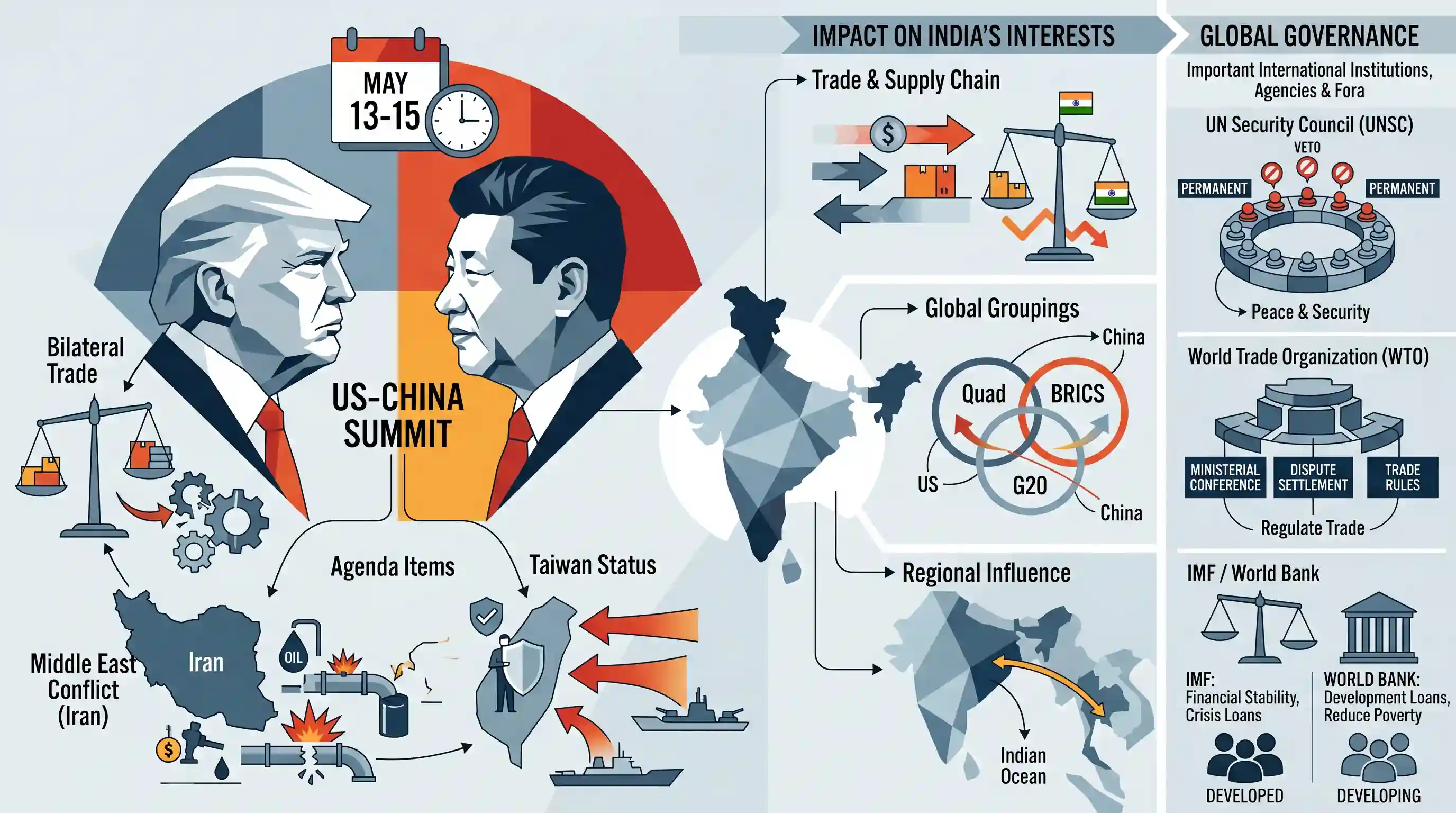
Why It Matters
Understanding the shifting dynamics between the US and China is crucial for UPSC aspirants, as this superpower rivalry impacts global trade, geopolitical stability in the Indo-Pacific (including Taiwan), and conflicts in the Middle East. These developments dictate India's strategic calculus, foreign policy adjustments, and energy security considerations in a multipolar world order.
Summary
US President Donald Trump is scheduled to visit China to meet President Xi Jinping from May 13 to 15, marking his first trip to the country in his current term. The agenda is heavily focused on managing geopolitical tensions, with discussions expected to revolve around bilateral trade, the ongoing Middle East conflict involving Iran, and Taiwan. Amid continuing Chinese military patrols, Taiwan remains confident in its stable relationship with the US despite Washington's concerns over Taipei's defense budget decisions.
Key Points
- US President Donald Trump will meet Chinese President Xi Jinping in China from May 13 to 15, his first visit to the country since 2017.
- The diplomatic talks aim to manage escalating tensions surrounding bilateral trade tariffs, the Middle East conflict (particularly Iran), and Taiwan.
- Washington seeks progress on trade deals and plans to raise the issue of Iran's role in the Middle East conflict during the visit.
- Taiwan expressed confidence in stable US-Taiwan relations, though the US remains concerned about Taipei's domestic decisions on defense spending.
- China continues to conduct military patrols near Taiwan, asserting its territorial claims over the island.
Important Terms
One China Policy

A diplomatic position recognizing only one sovereign state under the name China, with the People's Republic of China (PRC) as the sole legal government.
UPSC context
GS Paper II: International Relations. India formally adheres to this policy but maintains growing unofficial economic ties with Taiwan.
Taiwan Relations Act (TRA)
A 1979 U.S. federal law governing unofficial relations with Taiwan, mandating that the U.S. provide the island with defensive weapons for self-defense.
UPSC context
GS Paper II: Bilateral agreements. It is the legal cornerstone for U.S. military support to Taiwan, a major point of friction with Beijing.
Strategic Ambiguity
A U.S. policy of being intentionally non-committal about whether it would militarily intervene if China were to attack Taiwan.
UPSC context
GS Paper II: Geopolitics. Tests understanding of diplomatic balancing acts intended to deter unilateral changes to the status quo.
Legislative Yuan (Taiwan Parliament)
The unicameral legislature of Taiwan, responsible for passing laws and approving the national budget, including contentious defense spending packages.
UPSC context
GS Paper II: Comparative Politics/IR. Critical for understanding Taiwan's internal political divides affecting its defense posture and U.S. relations.
Strait of Hormuz
A vital maritime choke point between the Persian Gulf and the Gulf of Oman, critical for global oil and gas transport.
UPSC context
GS Paper I/II: Geography and International Relations. Its blockade has direct implications for global energy security and India's energy imports.
White House
The official residence and workplace of the President of the United States, representing the U.S. executive branch and administration.
UPSC context
GS Paper II: International Relations. Often used metonymically for the U.S. government's executive decisions and foreign policy stance.
Prelims Trap
The US officially recognizes Taiwan as a sovereign nation and maintains a formal mutual defense treaty with it.
The US follows a 'One China Policy' acknowledging Beijing, and uses 'strategic ambiguity'—supplying arms via the Taiwan Relations Act without a formal mutual defense treaty.
Static Concepts Connected
What is the US policy of 'Strategic Ambiguity' regarding Taiwan?
- One China Policy: The US acknowledges Beijing as the sole legal government of China, but only acknowledges (not endorses) Beijing's claim over Taiwan.
- Taiwan Relations Act: It mandates the US to provide Taiwan with arms of a defensive character to maintain its self-defense capabilities.
- No Intervention Guarantee: The US deliberately avoids stating whether it would militarily intervene if China invaded, deterring both Taiwanese independence declarations and Chinese aggression.
How is China altering the geopolitical landscape of the Middle East?
- Diplomatic Mediation: Beijing successfully brokered the historic 2023 diplomatic reconciliation between regional rivals Iran and Saudi Arabia.
- Strategic Partnerships: China signed a 25-year comprehensive strategic partnership with Iran to secure stable oil supplies and expand Belt and Road infrastructure investments.
- Challenging US Hegemony: By presenting itself as a non-interventionist economic alternative to the US, China complicates India's traditional balancing act in West Asia.
Cross-Topic Patterns
Supply Chain Resilience vs Product Dumping
US tariffs on China push supply chains to India (China Plus One), but also increase the risk of Chinese manufacturing overcapacity being dumped into Indian markets, necessitating active WTO trade remedies.
The "G-2" Threat to Strategic Autonomy
Any mutual accommodation or 'G-2' detente between Washington and Beijing shrinks the geopolitical space for emerging powers, directly reducing India's leverage as a strategic swing state in the Indo-Pacific.

Expect a 2026 Prelims multi-statement question contrasting the US 'One China Policy' with Beijing's 'One China Principle'.
Linked PYQs · 3
Linked PYQs · 3
- 2021MainsGS2
“The USA is facing an existential threat in the form of a China, that is much more challenging than the erstwhile Soviet Union.” Explain.
- 2014MainsGS2
With respect to the South China sea, maritime territorial disputes and rising tension affirm the need for safeguarding maritime security to ensure freedom of navigation and over flight throughout the region. In this context, discuss the bilateral issues between India and China.
- 2018MainsGS2
In what ways would the ongoing US-Iran Nuclear Pact Controversy affect the national interest of India? How should India respond to this situation?
