Carbon Border Taxes and Trade Restrictive Environmental Measures
Source:The Hindu ↗
Why It Matters
The intersection of international trade and climate action—particularly the use of carbon border taxes like CBAM—is an emerging flashpoint in global diplomacy. It is crucial for UPSC aspirants to understand how unilateral environmental regulations act as non-tariff barriers, impacting India's export economy and shaping its stance at forums like the UNFCCC and WTO.
Summary
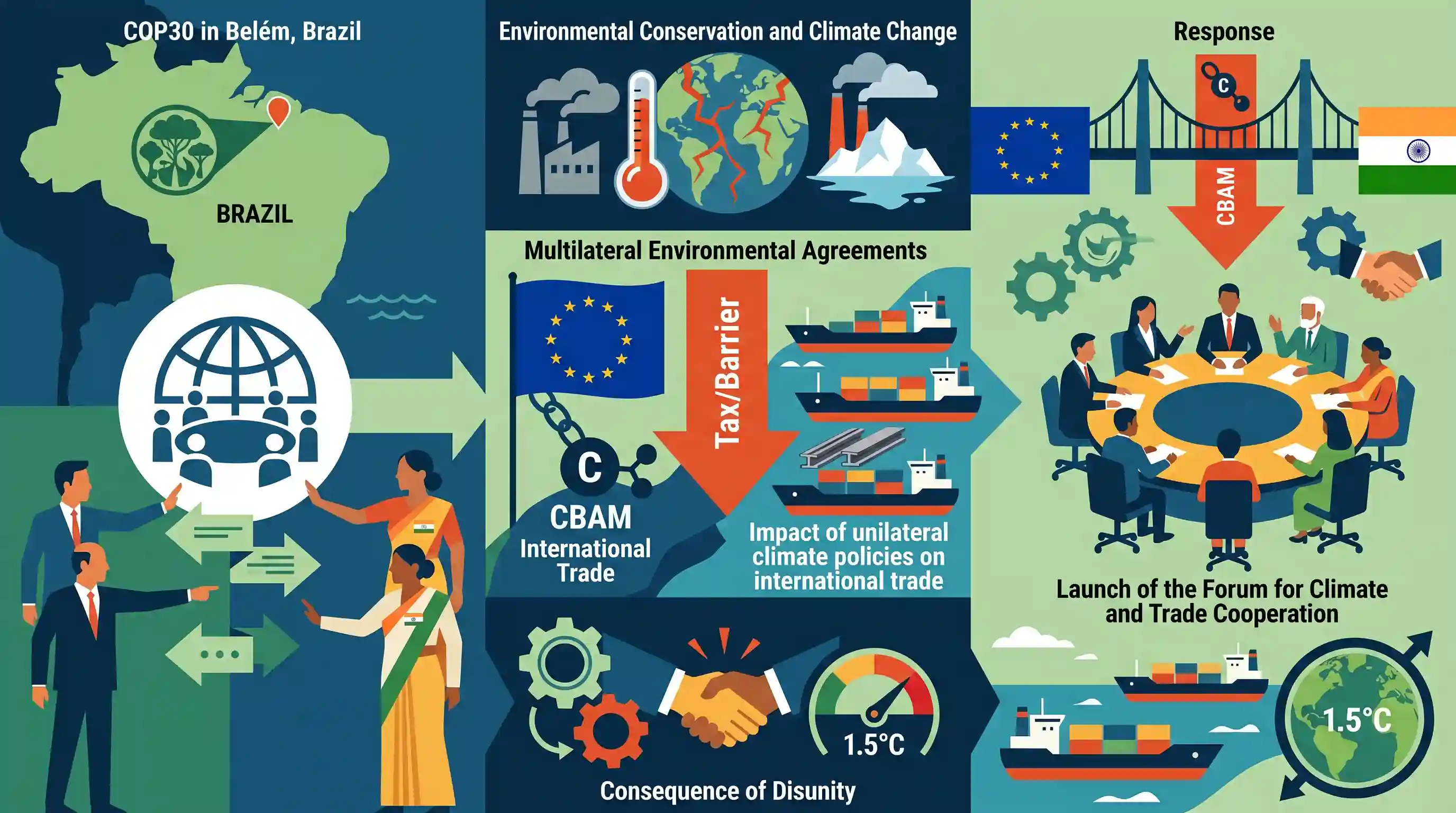
At COP30 in Belem, Brazil, developing countries like India strongly advocated for addressing the impacts of unilateral climate policies on international trade. A central point of contention is the European Union's Carbon Border Adjustment Mechanism (CBAM), set to take full effect in 2026, which threatens to impose substantial carbon taxes on Indian iron and steel exports. In response to growing concerns that such trade-restrictive climate measures could undermine global cooperation and the 1.5°C climate target, a new 'Forum for Climate and Trade Cooperation' was launched to foster dialogue and bridge differences between developed and developing nations.
Key Points
- Developing nations, including India, demanded that the trade impacts of climate policies be given prominence at COP30 in Belem, Brazil.
- The COP30 Presidency proposed annual dialogues on climate-related trade-restrictive measures and their cross-border impacts.
- The European Union's impending Carbon Border Adjustment Mechanism (CBAM), effective January 2026, is a major concern and could cost Indian iron and steel exporters an estimated €301 million in fees.
- A 'Forum for Climate and Trade Cooperation' was launched at COP30 to facilitate dialogue at the intersection of trade and climate change.
- Unilateral climate-trade measures are increasing friction between developed and developing nations, threatening collective action on the 1.5°C climate target.
Important Terms
Carbon Border Adjustment Mechanism (CBAM)

An EU policy effective from 2026 placing a carbon price on carbon-intensive imports (like steel and cement) to prevent 'carbon leakage' from countries with lower environmental standards.
UPSC context
GS-III: Environment and Economy; tests knowledge of green protectionism and impacts on Indian manufacturing competitiveness.
Global Stocktake
A periodic review process under the Paris Agreement to assess collective global progress in climate mitigation, adaptation, and finance to inform future national commitments (NDCs).
UPSC context
GS-III: Environmental Conservation; critical for monitoring international climate governance and the implementation of Paris Agreement goals.
UNFCCC
The primary international treaty framework for stabilizing greenhouse gas concentrations; it serves as the legal basis for annual COP summits and global climate diplomacy.
UPSC context
GS-III: Environment; the foundational framework for international environmental negotiations and India’s primary platform for climate diplomacy.
World Trade Organization (WTO)
A global body regulating international trade that adjudicates disputes where environmental measures (like carbon taxes) conflict with free-trade principles and non-discrimination rules.
UPSC context
GS-II: International Organizations; essential for understanding the 'Green Trade' debate and challenges to multilateral trade rules.
European Union
A 27-member political and economic union that sets global environmental and trade standards, significantly impacting international climate policy through measures like CBAM.
UPSC context
GS-II: International Relations; important for analyzing India-EU bilateral trade and the role of regional blocs in governance.
Integrated Forum on Climate Change and Trade (IFCCT)
An independent platform launched at COP30 (2025) to foster non-binding dialogue between climate and trade officials, addressing friction caused by unilateral climate-trade policies.
UPSC context
GS-III: Environmental Governance; represents emerging institutional responses to the intersection of global trade and climate mitigation strategies.
Prelims Trap
The Forum for Climate and Trade Cooperation is an official negotiating body established under the WTO.
The newly launched Integrated Forum on Climate Change and Trade is a non-negotiating global platform explicitly independent of both the WTO and UNFCCC.
Static Concepts Connected
What is 'Carbon Leakage' and how does CBAM aim to address it?
- Carbon Leakage: When industries shift carbon-intensive production to countries with lax environmental regulations to avoid strict domestic climate policies.
- CBAM mechanism: The EU's mechanism levies a tax on high-carbon imports to equalize carbon costs between domestic and foreign producers, preventing this leakage.
- CBDR-RC conflict: Developing nations argue this violates UNFCCC principles by ignoring the historical emissions of developed countries and unfairly penalizing the Global South.
What are 'Disguised Trade Barriers' under WTO norms?
- Definition: Measures that appear to serve a legitimate goal (like environmental protection) but are actually designed to restrict imports and protect domestic industries.
- GATT Article XX: While allowing environmental exceptions, it strictly prohibits measures that act as a means of arbitrary or unjustifiable discrimination in international trade.
Cross-Topic Patterns
Environmental norms as Non-Tariff Barriers
Similar to the EU Deforestation Regulation (EUDR), CBAM highlights a rising trend where developed world environmental standards act as non-tariff barriers against Global South exports.
Green Hydrogen and Steel Transition
The threat of substantial CBAM fees forces India's carbon-intensive sectors to decarbonize faster, directly linking this trade friction to the success of India's National Green Hydrogen Mission.

Expect a 2026 multi-statement Prelims question intertwining the EU's CBAM, UNFCCC's CBDR principle, and WTO's environmental exceptions.
Linked PYQs · 3
Linked PYQs · 3
- 2021MainsGS3
Describe the major outcomes of the 26th session of the Conference of the Parties (COP) to the United Nations Framework Convention on Climate Change (UNFCCC). What are the commitments made by India in this conference?
- 2022PrelimsGS1
"Climate Action Tracker" which monitors the emission reduction pledges of different countries is a :
- 2025PrelimsGS1
Consider the following statements : Statement I: Article 6 of the Paris Agreement on climate change is frequently discussed in global discussions on sustainable development and climate change. Statement II: Article 6 of the Paris Agreement on climate change sets out the principles of carbon markets. Statement III : Article 6 of the Paris Agreement on climate change intends to promote inter-country non-market strategies to reach their climate targets. Which one of the following is correct in respect of the above statements?
