India Merchandise Trade Deficit Widens Amid High Commodity Imports
Source:The Hindu ↗
Why It Matters
This article highlights the structural vulnerabilities of India's external sector. It illustrates how geopolitical tensions drive up commodity prices (oil and gold) and expand the trade deficit, illustrating the pressure points for India's Current Account Deficit (CAD) and Balance of Payments (BoP). It also shows the critical offsetting role of services exports and the importance of RBI's forex management.
Summary
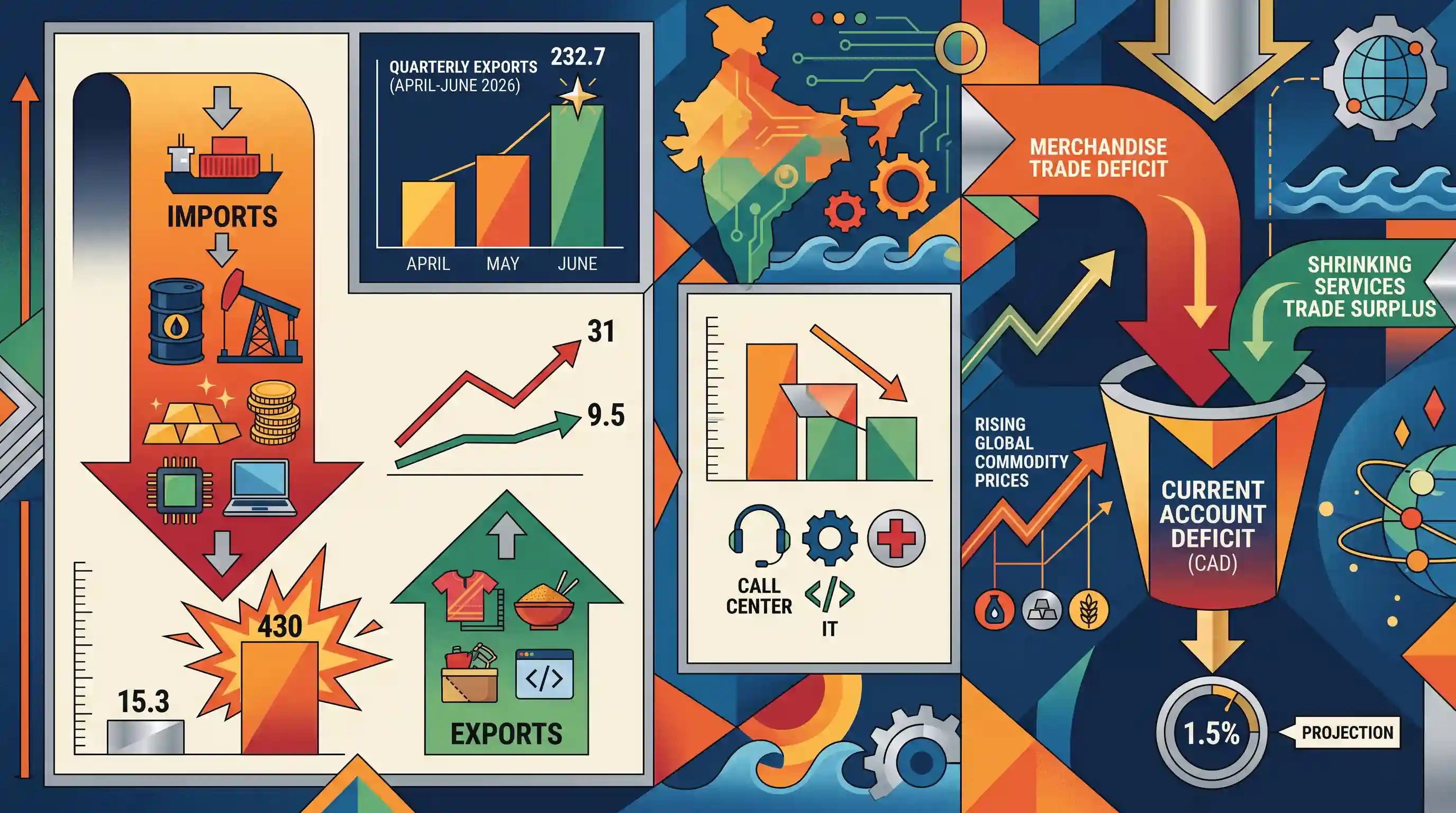
In June 2026, India's overall trade deficit surged by 430% to $15.3 billion, driven by a 31% jump in merchandise imports (principally crude oil, gold, and electronics) that overshadowed a 9.5% rise in overall exports. While India's overall quarterly exports (April-June 2026) reached a record high of $232.7 billion, a shrinking services trade surplus and rising global commodity prices present risks to the Current Account Deficit (CAD) to GDP ratio, currently projected at 1.5%.
Key Points
- India's overall trade deficit (goods and services combined) widened by 430% to $15.3 billion in June 2026 compared to $2.9 billion in June 2025.
- Total imports grew nearly 27% to $88.8 billion, while overall exports rose at a slower pace of 9.5% to $73.4 billion.
- Merchandise imports surged 31% to $70.8 billion, heavily skewed by higher global prices of crude oil and gold (caused by geopolitical tensions) and a rise in electronics imports used for consumption and domestic manufacturing inputs.
- Merchandise exports grew 15.5% to $40.4 billion, resulting in a merchandise trade deficit of $30.4 billion (a 59% year-on-year increase).
- The services surplus shrank by 6.8% to $15.1 billion as services imports (grew 12.7% to $17.9 billion) outpaced services exports (grew 2.9% to $33 billion).
- On a quarterly basis (April-June 2026), India's cumulative exports reached an all-time quarterly high of $232.7 billion, with 68 out of 104 export lines growing in both volume and value.
- Economists monitor crude oil price movements for potential risks to India's Current Account Deficit (CAD) to GDP ratio (currently projected at 1.5%), noting that RBI's foreign exchange measures will likely cushion Balance of Payments (BoP) risks.
Important Terms
Balance of Payments (BoP)

A systematic ledger of all economic and financial transactions between a country's residents and the rest of the world over a specific period, typically a quarter or year.
UPSC context
GS Paper III (Indian Economy). Tests understanding of external sector stability, trade imbalances, and currency exchange rate dynamics.
Current Account Deficit (CAD)
A shortfall arising when a nation's total payments for imports of goods, services, and transfers exceed its total receipts from exports and transfers.
UPSC context
GS Paper III (Indian Economy). Essential for analyzing macroeconomic vulnerability, currency stability, and the overall balance of payments health.
Merchandise Trade Deficit
The gap occurring when the monetary value of a country's physical goods imports (like oil and gold) exceeds the value of its physical exports.
UPSC context
GS Paper III (Indian Economy). Tests key knowledge on import dependence, domestic manufacturing competitiveness, and trade balance dynamics.
Services Surplus
A positive balance when a country's exports of intangible services (such as IT, consulting, and software) exceed its imports of those services.
UPSC context
GS Paper III (Indian Economy). Tests understanding of India's export strengths and how service earnings finance the goods trade deficit.
Reserve Bank of India (RBI)
India's statutory central bank responsible for formulating monetary policy, regulating the banking system, issuing currency, and managing foreign exchange reserves to maintain price stability.
UPSC context
GS Paper III (Indian Economy). Tests institutional knowledge of monetary regulation, inflation targeting, and external sector management.
Ministry of Commerce and Industry
The Union ministry responsible for formulating and implementing foreign trade policies, promoting industrial development, attracting investment, and facilitating domestic and international commerce.
UPSC context
GS Paper II (Government Policies) and GS Paper III (Economic Development). Tests knowledge of trade policies, export schemes, and SEZ regulations.
Prelims Trap
An all-time record high in quarterly export earnings guarantees a contraction in India's trade deficit for that period.
Record-high exports do not guarantee a narrowed deficit if inelastic import values (crude, gold) grow at a much faster absolute rate, widening the net deficit.
Static Concepts Connected
What components constitute the Current Account of the Balance of Payments (BoP)?
- Visible Trade: Includes trade in physical goods (exports and imports), often referred to as the trade balance.
- Invisible Trade: Comprises services trade (IT, travel), income (profits, dividends), and unilateral transfers (remittances, gifts).
- Net Balance: A persistent negative balance on these combined accounts indicates a Current Account Deficit, requiring capital account inflows.
How do the merchandise trade deficit and services surplus interact in India's economy?
- Merchandise Deficit: India runs a structural goods deficit due to inelastic demand for crude oil, gold, and advanced electronic components.
- Services Cushion: A consistent surplus driven by software exports and business services acts as a major shock absorber.
- Net CAD Impact: The goods deficit typically dwarfs the services surplus and remittances, resulting in a persistent net CAD.
Cross-Topic Patterns
Energy Security + CAD Vulnerability
India's heavy crude dependence (~85%) links West Asian geopolitical disruptions directly to domestic CAD expansion and rupee volatility, complicating monetary policy.
Electronics Imports + PLI Efficacy
Surging electronic component imports, despite active PLI schemes, highlight India's deep integration into global value chains as an assembler rather than a self-reliant component producer.

2026 Prelims will likely test the structural composition of BoP, contrasting merchandise deficits with services surpluses under external shocks.
Linked PYQs · 1
Linked PYQs · 1
- 2020PrelimsGS1
With reference to the international trade of India at present, which of the following statements is/are correct? 1. India's merchandise exports are less than its merchandise imports. 2. India's imports of iron and steel, chemicals, fertilisers and machinery have decreased in recent years. 3. India's exports of services are more than its imports of services. 4. India suffers from an overall trade/current account deficit. Select the correct answer using the code given below:
