Surging Imports Widens India Merchandise Trade Deficit
Source:The Hindu ↗
Why It Matters
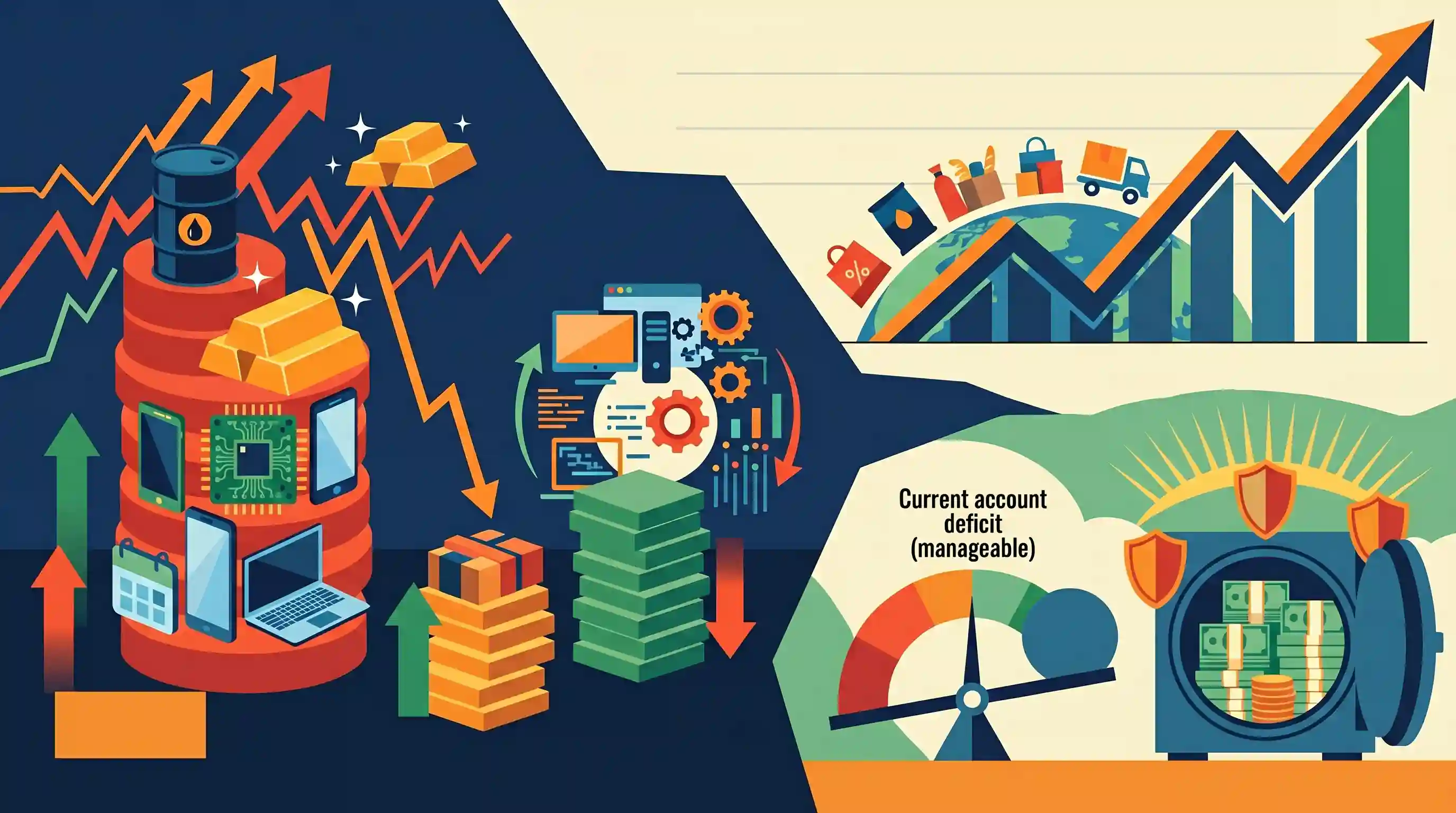
This article highlights critical trends in India's external sector, including the structural divergence between merchandise and services trade, the impact of global geopolitical tensions on essential commodity prices (oil and gold), and how these factors influence macroeconomic indicators like the Current Account Deficit (CAD) and Balance of Payments (BoP).
Summary
In June 2026, India's overall trade deficit expanded by 430% year-on-year to $15.3 billion. This was caused by a widening merchandise trade deficit of $30.4 billion and a 6.8% decline in the services trade surplus to $15.1 billion. The merchandise import bill rose due to geopolitically driven higher prices of crude oil and gold, along with rising consumption and manufacturing inputs for electronics. Despite the monthly trade deficit rise, the quarterly overall exports for April-June 2026 reached a historic high of $232.7 billion. Economists project the current account deficit to remain manageable at 1.5% of GDP, cushioned by the RBI's foreign exchange reserves.
Key Points
- India's overall trade deficit (goods and services combined) jumped 430% in June 2026 to $15.3 billion, compared to $2.9 billion in June 2025.
- Overall exports grew 9.5% to $73.4 billion, while overall imports surged nearly 27% to $88.8 billion, driven primarily by a widening merchandise trade deficit.
- Merchandise imports grew 31% to $70.8 billion, while merchandise exports grew 15.5% to $40.4 billion, resulting in a merchandise deficit of $30.4 billion (a 59% increase year-on-year).
- The surge in merchandise imports was primarily driven by oil and gold (inflated by global geopolitical tensions) and electronic goods (driven by rising domestic demand and inputs for manufacturing).
- Services trade surplus fell by 6.8% to $15.1 billion in June 2026, as services imports (up 12.7% to $17.9 billion) grew faster than services exports (up 2.9% to $33 billion).
- On a quarterly basis, overall exports for the April-June 2026 quarter hit a record high of $232.7 billion.
- Analysts predict that the Current Account Deficit (CAD) will remain around 1.5% of GDP, and RBI's foreign exchange reserves will act as a cushion against Balance of Payments (BoP) risks.
Important Terms
Trade Deficit

An economic condition occurring when a country's total value of imports exceeds its total value of exports over a specific period.
UPSC context
GS Paper III (Economy). Tested in questions about India’s trade balance, export competitiveness, and import-dependency.
Current Account Deficit (CAD)
The shortfall between a country's foreign exchange earnings (exports, remittances, transfers) and its payments (imports) on the current account over a given period.
UPSC context
GS Paper III (Indian Economy). Tested in discussions on the balance of payments, external stability, and rupee volatility.
Balance of Payments (BoP)
A systematic record of all economic transactions between the residents of a country and the rest of the world, comprising current and capital accounts.
UPSC context
GS Paper III (Indian Economy). Essential for understanding currency valuation, foreign reserves, and external macroeconomic stability.
Ministry of Commerce and Industry
The Union ministry responsible for formulating and implementing India's foreign trade policy, promoting exports, and fostering industrial development and internal trade.
UPSC context
GS Paper II (Government Policies) and GS Paper III (Economy). Tested in international trade negotiations and manufacturing initiatives.
Reserve Bank of India
India's central bank and regulatory body for the banking system, responsible for monetary policy, managing forex reserves, and maintaining price and financial stability.
UPSC context
GS Paper III (Indian Economy). Highly tested regarding monetary policy tools, inflation targeting, and external sector reserves management.
Prelims Trap
A historic high in overall quarterly exports guarantees a concurrent narrowing of the overall trade deficit.
A surplus/deficit depends on the relative growth rates of imports and exports. If imports grow much faster (e.g., 27%) than exports (9.5%), the deficit widens despite record exports.
Static Concepts Connected
What are the key components of India's Balance of Payments Current Account?
- Merchandise Trade (Visible): Comprises import and export of goods; structurally remains in a deficit for India due to oil, gold, and electronics.
- Invisibles Trade: Includes services (software, business, tourism), financial transfers (remittances from diaspora), and income (interests, dividends). Structurally in surplus.
- Current Account Deficit (CAD): Reflects the net flow of goods, services, and transfers. A CAD of 1.5% to 2% of GDP is generally deemed sustainable.
How does a widening trade deficit exert depreciating pressure on the domestic currency?
- Dollar Demand: An expanding trade deficit means India is importing more than it is exporting, generating higher market demand for US Dollars to settle trades.
- Rupee Supply Excess: To purchase dollars, importers must sell Rupees, which increases the supply of Rupees in the foreign exchange market relative to foreign currencies.
- Depreciation Mechanism: The imbalance of high dollar demand and excess rupee supply naturally depreciates the Rupee, unless buffered by RBI's forex interventions.
Cross-Topic Patterns
Electronics imports vs PLI manufacturing goals
Rising imports of electronic inputs highlight a key structural issue: domestic electronics manufacturing under PLI schemes still depends heavily on foreign component imports, inflating the trade deficit.
Safe-haven gold buying and CAD volatility
Geopolitical instability drives global gold prices upward, forcing up India’s non-essential import bill and worsening the CAD, regardless of domestic export-boosting initiatives.

Expect a multi-statement question analyzing why record overall export growth can coexist with a historic widening of the trade deficit.
Linked PYQs · 1
Linked PYQs · 1
- 2020PrelimsGS1
With reference to the international trade of India at present, which of the following statements is/are correct? 1. India's merchandise exports are less than its merchandise imports. 2. India's imports of iron and steel, chemicals, fertilisers and machinery have decreased in recent years. 3. India's exports of services are more than its imports of services. 4. India suffers from an overall trade/current account deficit. Select the correct answer using the code given below:
