India merchandise trade deficit narrows on rising exports
Source:The Hindu ↗
Why It Matters
Understanding the components of India's balance of payments, such as the merchandise trade deficit and current account deficit, is foundational for GS3 Economy. The resilience of Indian exports in the face of targeted US tariffs also provides a vital real-world case study for GS2 IR and GS3 Economy questions concerning global protectionism, bilateral trade disputes, and economic resilience.
Summary
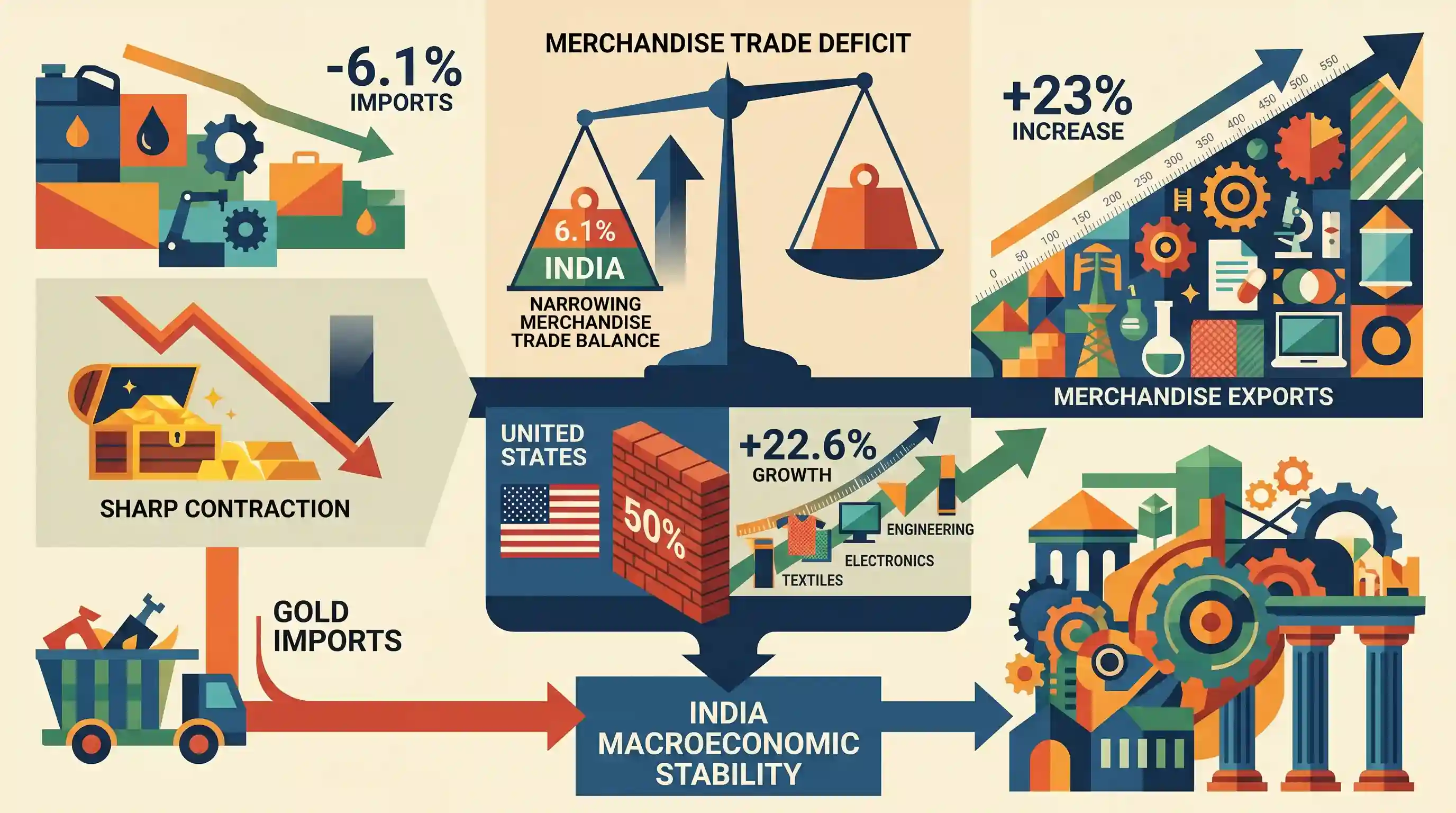
India's merchandise trade deficit narrowed significantly by 6.1% in November 2025, landing at $6.6 billion. This improvement was largely fueled by a robust 23% increase in merchandise exports, contrasting with a slight dip in overall imports—particularly a sharp contraction in gold imports. Notably, Indian exports to the United States proved resilient, growing by 22.6% despite steep 50% protectionist tariffs implemented by the US earlier in the year. The data reflects underlying strength in India's export sector and highlights how shifting global trade dynamics and protectionism interact with India's macroeconomic stability.
Key Points
- India's merchandise trade deficit fell 6.1% to a multi-month low of $6.6 billion in November 2025.
- The narrowing deficit was driven by a 23% surge in merchandise exports, which reached $38.74 billion.
- Imports saw a slight contraction, particularly influenced by a significant decline in gold imports.
- Despite the US imposing 50% tariffs since August 2025, Indian exports to the US grew impressively by 22.6% in November.
- Services exports continued their growth trajectory, further aiding India's overall balance of trade profile.
Important Terms
Merchandise Trade Deficit

The negative difference between the value of a country's physical goods imports and exports, often referred to as 'visible' trade.
UPSC context
GS-III (Economy): Understanding trade balance, its impact on forex reserves, and the stability of the Indian Rupee.
Protectionism
Economic policies such as tariffs and quotas designed to restrict imports and shield domestic industries from foreign competition.
UPSC context
GS-II (IR) & GS-III: Evaluates global trade shifts, WTO challenges, and bilateral relations with partners like the USA.
Reciprocal Tariffs
A trade policy where a country imposes duties on a partner's imports that match the levels imposed by that partner on its own exports.
UPSC context
GS-III (Economy): Key for understanding modern trade wars and their effect on India's export-oriented sectors.
Current Account Deficit (CAD)
A measurement where the total value of a country’s imported goods, services, and transfers exceeds the value of its exports.
UPSC context
GS-III (Economy): Critical for assessing external sector vulnerability and macroeconomic stability.
Ministry of Commerce and Industry
The nodal Union ministry responsible for formulating trade policy, promoting exports, and regulating international trade and investment.
UPSC context
GS-II (Governance): Institutional framework governing India’s international trade, industrial policy, and Ease of Doing Business.
Gold Imports
Physical gold purchased from international markets, which in India acts as a major non-essential import significantly impacting the trade deficit.
UPSC context
GS-III (Economy): Managing non-essential imports, forex outflows, and the impact of schemes like Sovereign Gold Bonds.
Prelims Trap
India achieved a merchandise trade surplus in 2025 owing to a 23% surge in exports to the US.
Despite a 23% export surge, India only *narrowed* its deficit to $6.6 billion. India structurally runs a merchandise trade deficit, historically offset by its services surplus.
Static Concepts Connected
What are the components of the Current Account in India's Balance of Payments?
- Visible Trade: Trade in physical goods (merchandise imports and exports). India historically and structurally maintains a deficit in this specific component.
- Invisible Trade: Comprises services, income (profits, interest, dividends), and transfers (like foreign remittances). India consistently enjoys a surplus in services and transfers.
Why do gold imports disproportionately threaten India's macroeconomic stability?
- Widening CAD: High volumes of gold imports drastically increase the merchandise import bill, which directly expands the Current Account Deficit (CAD) and stresses forex reserves.
- Unproductive Asset: Unlike imported machinery or technology, gold largely enters domestic household hoarding, draining foreign exchange without contributing to gross fixed capital formation or industrial output.
Cross-Topic Patterns
US Protectionism + China Plus One
Export growth despite steep 50% US tariffs signals structural supply chain shifts. Western buyers are increasingly absorbing higher tariff costs to de-risk their supply chains away from China, benefiting Indian merchandise.
Gold Imports + Rupee Exchange Rate
Falling gold imports ease the merchandise import bill, which directly lowers the domestic demand for dollars. This dynamic fundamentally alleviates downward pressure on the Indian Rupee in forex markets.

Expect a multi-statement question contrasting India's structural merchandise deficit with its services surplus amid rising US protectionism.
Linked PYQs · 4
Linked PYQs · 4
- 2020PrelimsGS1
With reference to the international trade of India at present, which of the following statements is/are correct? 1. India's merchandise exports are less than its merchandise imports. 2. India's imports of iron and steel, chemicals, fertilisers and machinery have decreased in recent years. 3. India's exports of services are more than its imports of services. 4. India suffers from an overall trade/current account deficit. Select the correct answer using the code given below:
- 2025MainsGS3
What are the challenges before the Indian economy when the world is moving away from free trade and multilateralism to protectionism and bilateralism? How can these challenges be met?
- 2012MainsGS2
Discuss the likely negative impact of the protectionist measures proposed by the US on India's software industry.
- 2019MainsGS2
‘What introduces friction into the ties between India and the United States is that Washington is still unable to find for India a position in its global strategy, which would satisfy India's national self-esteem and ambitions.’ Explain with suitable examples.
