Evolution of India Free Trade Agreements with EU and US
Source:Indian Express ↗
Why It Matters
Provides a critical perspective on India's evolving FTA strategy with Western nations, directly relevant to Mains questions analyzing the shift from multilateralism to bilateralism and the challenges of integrating into global value chains.
Summary
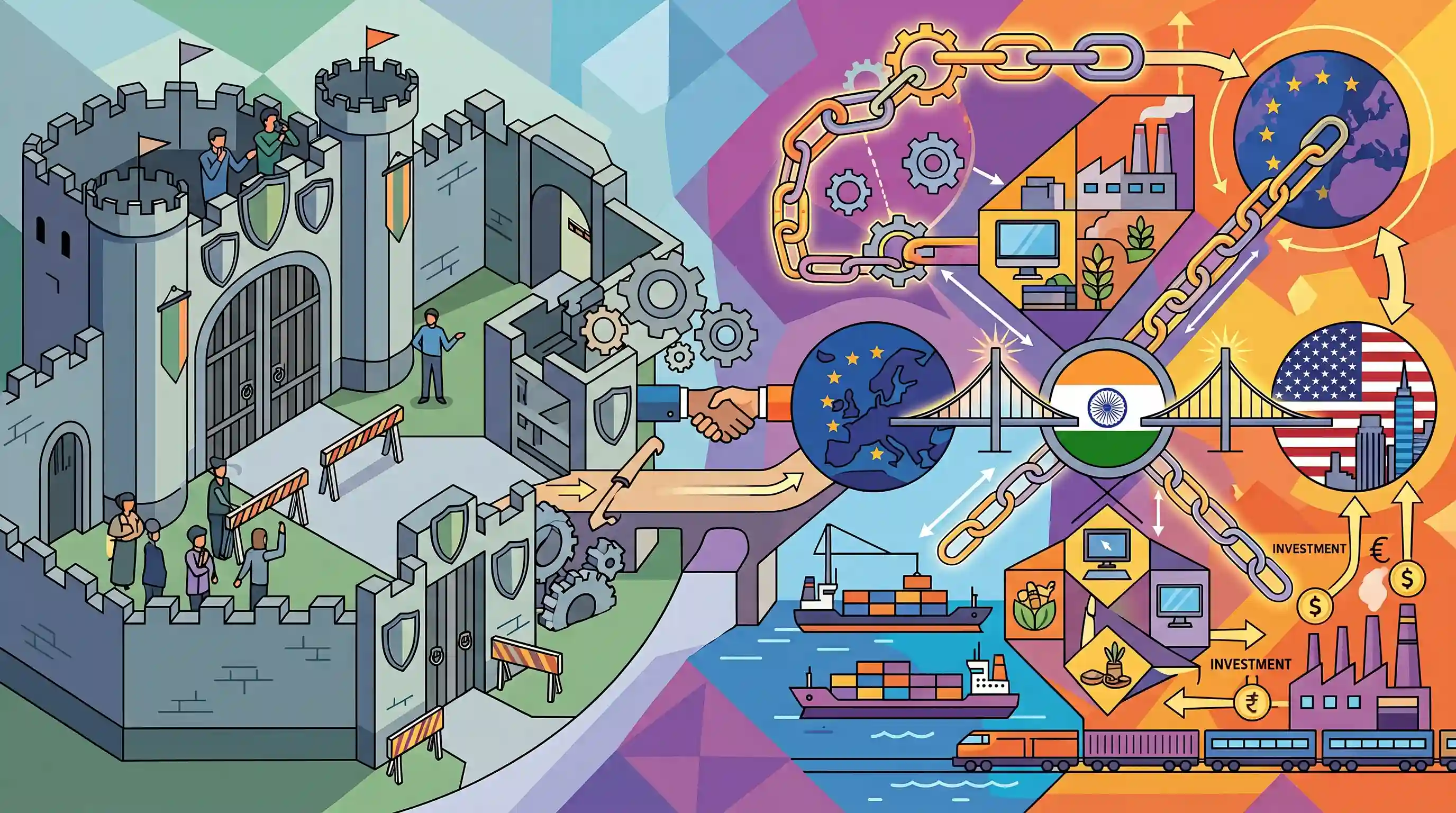
The article analyzes the evolution of India's approach to Free Trade Agreements (FTAs) with developed economies like the European Union and the United States. It argues that modern trade negotiations should be viewed pragmatically, neither as complete triumphs nor as a surrender of domestic interests. Instead, these agreements represent an evolutionary step in India's trade policy, focusing on strategic integration into Global Value Chains (GVCs), attracting investment, and aligning geopolitically with 'friend-shoring' initiatives to build resilient global supply chains. The shift highlights a move from defensive protectionism toward reciprocal, mature economic engagements.
Key Points
- India's trade negotiations with major developed economies like the EU and the US mark a pragmatic shift from historical defensive postures to balanced economic engagement.
- Modern trade deals require mutual concessions; they are neither outright 'triumphs' nor complete 'surrenders' but evolutionary steps necessary to secure broader market access and foreign direct investment.
- Concluding high-standard FTAs is crucial for India's integration into Global Value Chains (GVCs), requiring alignment on new-age trade issues like labor, environment, and intellectual property.
- Geopolitically, these trade agreements facilitate 'friend-shoring' and help build resilient supply chains, reducing overarching dependency on single manufacturing hubs like China.
Important Terms
Free Trade Agreements (FTAs)

Legal treaties between two or more nations to reduce or eliminate trade barriers like tariffs and quotas. India uses them to enhance market access for its exports and integrate with global economies.
UPSC context
GS Papers 2 & 3; tests understanding of India's foreign trade policy, bilateral relations, and economic integration strategies.
Broad-based Trade and Investment Agreement (BTIA)
The official title for the India-EU free trade negotiations initiated in 2007. It encompasses trade in goods, services, and investment, aiming to resolve long-standing hurdles like data security and market access.
UPSC context
GS Paper 2; critical for questions on India-EU bilateral relations and the evolution of 'next-generation' trade deals.
Indo-Pacific Economic Framework (IPEF)
A US-led economic initiative among 14 nations to strengthen supply chain resilience and clean energy. India participates in three of its four pillars, opting out only of the trade pillar.
UPSC context
GS Paper 2; relevant for India's strategic role in the Indo-Pacific and its shift towards plurilateral economic frameworks.
Global Value Chains (GVCs)
International production networks where different stages of manufacturing or service delivery occur in various countries. India aims to increase its participation through schemes like PLI and 'Make in India.'
UPSC context
GS Paper 3; fundamental for topics on industrial growth, export competitiveness, and supply chain resilience.
Friend-shoring
A trade practice of sourcing goods and relocating supply chains to countries that are geopolitical allies. It aims to reduce reliance on potentially hostile nations for critical materials.
UPSC context
GS Papers 2 & 3; tests knowledge of 'deglobalisation' trends, the 'China Plus One' strategy, and supply chain security.
Protectionism
Policy of restricting imports through tariffs and regulations to protect domestic industries from foreign competition. The article describes India's shift from 'defensive protectionism' toward pragmatic, reciprocal trade engagements.
UPSC context
GS Paper 3; key for discussing economic liberalization, trade wars, and the balance between domestic industry and global trade.
Prelims Trap
"India has finalized comprehensive Free Trade Agreements encompassing tariff reductions with the US and the European Union."
India currently has no FTA with the US; the IPEF is not a traditional tariff-reducing FTA. The comprehensive EU trade pact (BTIA) is still actively under negotiation.
Static Concepts Connected
What distinguishes FTAs from comprehensive agreements like CEPA and CECA?
- FTA: Primarily focuses on a negative list to reduce or eliminate customs duties on a specified list of goods.
- CECA: Covers a broader spectrum including goods, services, and investment, but acts as a stepping stone.
- CEPA: The deepest form of integration, encompassing robust regulatory harmonization, trade facilitation, and strict IPR rules.
What are the "new-age" non-tariff issues in modern FTAs?
- Environment: Carbon border taxes (e.g., EU's CBAM) and strict domestic sustainability standards.
- Labour Standards: Mandating fair labor practices, gender equality, and union rights in manufacturing.
- Digital Trade & IPR: Prohibiting data localization mandates and enforcing stricter Intellectual Property Rights.
Cross-Topic Patterns
FTAs & EU's Carbon Border Tax
Modern EU trade negotiations force India to confront the Carbon Border Adjustment Mechanism (CBAM), linking global market access directly to domestic climate policies and green energy transitions.
Geopolitics of Supply Chains
Integrating into Western Global Value Chains through 'friend-shoring' closely parallels India's strategic initiatives like the Quad and iCET, merging GS3 Economic Trade with GS2 International Relations.

Expect a 2026 multi-statement question contrasting traditional tariff-focused FTAs with modern frameworks (IPEF) covering labor/climate.
Linked PYQs · 3
Linked PYQs · 3
- 2025MainsGS3
What are the challenges before the Indian economy when the world is moving away from free trade and multilateralism to protectionism and bilateralism? How can these challenges be met?
- 2018MainsGS3
How would the recent phenomena of protectionism and currency manipulations in world trade affect macroeconomic stability of India?
- 2018PrelimsGS1
Consider the following countries: 1. Australia 2. Canada 3. China 4. India 5. Japan 6. USA Which of the above are among the 'free-trade partners' of ASEAN?
