World Bank chief stresses mutual benefits in trade deals
Source:The Hindu ↗
Why It Matters
Provides an important institutional perspective (World Bank) on India's macroeconomic strategy. It underscores the balance India must strike between opening up through FTAs and protecting domestic manufacturing. It also highlights the criticality of capital formation, domestic consumption, and youth skilling as the primary engines for India's long-term economic growth.
Summary
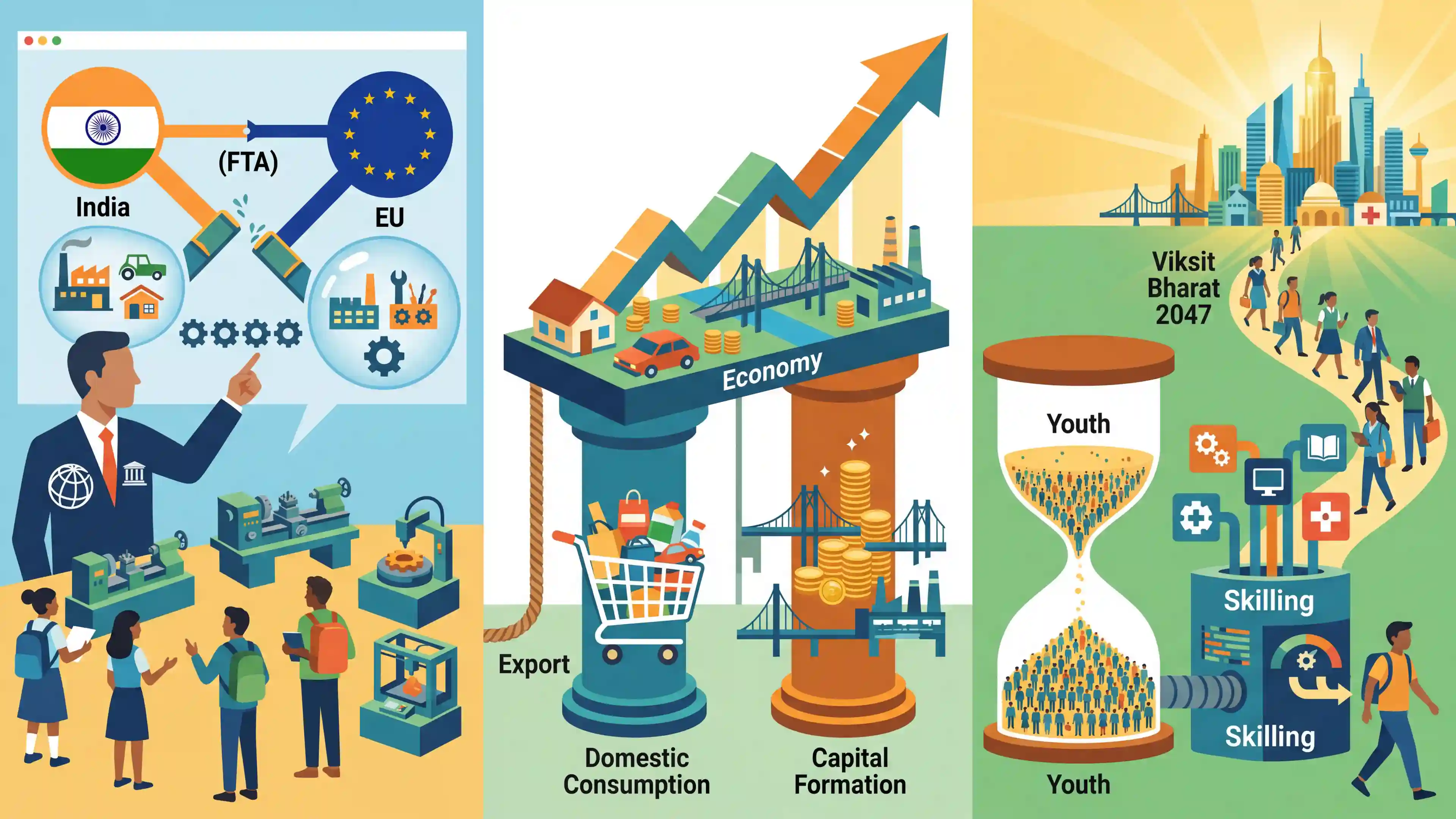
World Bank President Ajay Banga, during a visit to the Central Tool Room and Training Centre in Bhubaneswar, emphasized that Free Trade Agreements (FTAs) like the proposed India-EU deal must safeguard and benefit domestic industries on both sides. He noted that India’s economic strength is uniquely anchored in strong domestic consumption and capital formation, allowing it to sustain high growth without being overly reliant on exports. Endorsing India's projected 6.8%-7.2% growth rate, Banga highlighted that lowering tariff and non-tariff barriers can mutually boost manufacturing employment. He further stressed that upskilling India's youth demographic is essential to meet the changing demands of the global job market and achieve the goal of a 'Viksit Bharat' by 2047.
Key Points
- World Bank President Ajay Banga stated that trade deals, including the proposed India-EU FTA, should be structured to benefit and protect domestic industries of both participating nations.
- Lowering tariff and non-tariff barriers can be mutually beneficial by boosting employment, particularly in the manufacturing sector.
- India's economic resilience is driven heavily by robust domestic consumption and strong capital formation, making the country less dependent on export-led growth compared to other economies.
- Banga expressed optimism about India's economic trajectory, aligning with the Economic Survey's growth projection of 6.8% to 7.2% for the upcoming fiscal year.
- Upskilling the youth demographic to prepare for emerging sectors—such as green energy and semiconductor manufacturing—is critical for achieving 'Viksit Bharat' (Developed India) by 2047.
Important Terms
India-EU Free Trade Agreement (FTA)

A proposed comprehensive trade pact to eliminate tariffs on over 90% of goods and enhance cooperation in services and investment between India and the European Union.
UPSC context
GS Paper 2: International Relations; critical for bilateral trade strategy, market access, and managing the Carbon Border Adjustment Mechanism (CBAM).
Viksit Bharat 2047
The government's roadmap to transform India into a developed nation by its 100th independence anniversary, targeting a $30–35 trillion economy with high per-capita income.
UPSC context
GS Paper 3: Indian Economy; represents the core long-term vision for economic growth, infrastructure, and inclusive development.
Demographic Dividend
The economic growth potential resulting from a shift in population age structure where the working-age population (15-64) is larger than the dependent population.
UPSC context
GS Paper 1 (Society) and GS Paper 3 (Economy); vital for assessing India's labor force advantages and skilling requirements.
Capital Formation
The process of increasing a country's stock of physical assets (like machinery and infrastructure) by investing savings into productive capacity rather than current consumption.
UPSC context
GS Paper 3: Indian Economy; a primary driver of GDP growth and a key indicator of investment health.
Non-tariff Barriers (NTBs)
Regulatory trade restrictions other than customs duties, such as quotas, technical standards, licensing, or sanitary requirements, used to protect domestic industries.
UPSC context
GS Paper 3: Indian Economy/External Sector; central to trade negotiations and challenges faced by Indian exporters in developed markets.
Central Tool Room and Training Centre (CTTC)
An autonomous society under the Ministry of MSME that provides precision tool design, manufacturing services, and industry-oriented technical training to youth.
UPSC context
GS Paper 3: MSME and Industrial Growth; highlights the role of institutional support in skilling and technological upgrading.
Prelims Trap
"India's recent economic resilience and high GDP growth is primarily driven by export-led growth."
India’s growth is structurally anchored in Private Final Consumption Expenditure (PFCE) and domestic capital formation, unlike East Asian export-driven economic models.
Static Concepts Connected
What are the components of GDP calculated via the expenditure method?
- PFCE (Consumption): Private Final Consumption Expenditure measures household spending. It forms the largest chunk of India's GDP (roughly 55-60%), acting as a primary growth driver.
- GFCF (Investment): Gross Fixed Capital Formation reflects investments in physical assets (infrastructure, machinery). It is a crucial indicator of future productive capacity and job creation.
- Net Exports: This is calculated as total exports minus total imports. For India, this figure is traditionally negative due to a persistent trade deficit.
What are Non-Tariff Barriers (NTBs) in international trade?
- Regulatory Restrictions: Unlike direct import taxes (tariffs), NTBs are regulatory or administrative measures that restrict imports, such as quotas, licensing requirements, or embargoes.
- SPS & Labor Standards: Countries often use Sanitary and Phytosanitary (SPS) measures or strict labor standards to block imports, ostensibly for health/safety but practically to protect domestic industries.
- Environmental Levies: Environmental regulations like the EU's Carbon Border Adjustment Mechanism (CBAM) act as modern NTBs, challenging the competitiveness of developing nations in Free Trade Agreements.
Cross-Topic Patterns
FTAs + Carbon Border Taxes
The India-EU FTA negotiations are significantly complicated by the EU's Carbon Border Adjustment Mechanism (CBAM), which acts as a protective non-tariff barrier against Indian manufacturing exports.
Demographic Dividend + Green Tech
Reaping India's demographic dividend by 2055 relies on rapidly upskilling the workforce for emerging sectors like semiconductors and green energy, shifting labor from low-productivity informal jobs.

Expect a 2026 Prelims question testing the expenditure components of GDP (PFCE, GFCF) alongside the impact of Non-Tariff Barriers.
Linked PYQs · 4
Linked PYQs · 4
- 2014MainsGS3
While we flaunt India's demographic dividend, we ignore the dropping rates of employability. What are we missing while doing so? Where will the jobs that India desperately needs come from? Explain.
- 2017MainsGS3
Account for the failure of manufacturing sector in achieving the goal of labour-intensive exports. Suggest measures for more labour-intensive rather than capital-intensive exports.
- 2020MainsGS3
Explain the meaning of investment in an economy in terms of capital formation. Discuss the factors to be considered while designing a concession agreement between a public entity and a private entity.
- 2011MainsGS2
Compared to the South Asian Free Trade Area (SAFTA), the Bay of Bengal Initiative for Multisectoral Technical and Economic Cooperation Free Trade Area (BIMSTEC FTA) seems to be more promising." Critically evaluate.
