Opposition Raises Concerns Over US Trade Deal and Agriculture Sector
Source:The Hindu ↗
Why It Matters
This article touches upon multiple core UPSC syllabus areas: the impact of bilateral Free Trade Agreements (FTAs) on the domestic agriculture sector, parliamentary mechanisms like the Motion of Thanks, and the integrity of democratic processes through the Election Commission's maintenance of electoral rolls.
Summary
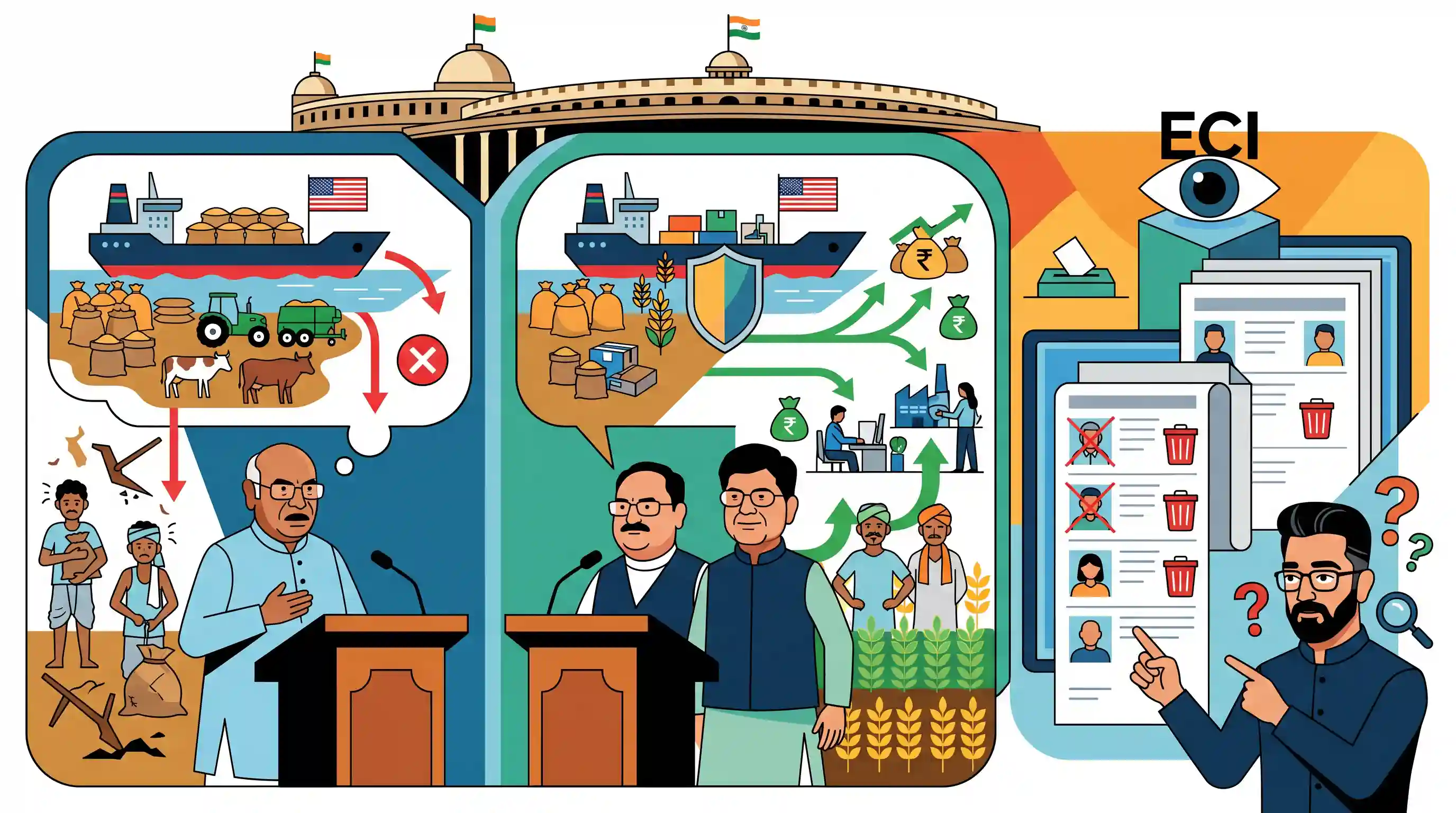
During the parliamentary debate on the Motion of Thanks to the President's address, Congress president Mallikarjun Kharge opposed a proposed India-U.S. bilateral trade deal, warning that zero-tariff imports of American agricultural products could devastate Indian farmers. In response, Union Ministers J.P. Nadda and Piyush Goyal clarified that sensitive sectors like agriculture and dairy would be excluded from any such pact, asserting the deal would broadly benefit the economy and create jobs. Additionally, MP Kamal Haasan flagged concerns regarding the Election Commission’s Special Intensive Revision of electoral rolls, citing instances where genuine voters were allegedly deleted arbitrarily.
Key Points
- The Opposition warned that a prospective India-U.S. trade deal featuring zero-tariff agricultural imports would severely hurt domestic farmers.
- The government clarified that sensitive sectors such as agriculture and dairy are explicitly excluded from trade negotiations to protect local interests.
- The discussion took place during the parliamentary debate on the Motion of Thanks to the President’s address.
- Concerns were also raised regarding the Election Commission of India's Special Intensive Revision (SIR) of electoral rolls, specifically highlighting the unwarranted deletion of legitimate voters.
Important Terms
India-U.S. Bilateral Trade Agreement (BTA)

A 2026 trade framework reducing tariffs on industrial and select agricultural goods while safeguarding sensitive sectors like dairy and poultry through specific exclusions.
UPSC context
GS Paper II/III: International Relations and Economy; tests knowledge of trade diplomacy and agricultural safeguards.
Motion of Thanks
A formal parliamentary debate and vote on the President’s special address; its defeat serves as a de facto no-confidence motion against the government.
UPSC context
GS Paper II: Indian Polity; tests understanding of parliamentary devices and executive accountability.
Special Intensive Revision (SIR)
A comprehensive, door-to-door voter verification exercise conducted by the ECI to purge duplicates and update electoral rolls under Section 21 of RPA, 1950.
UPSC context
GS Paper II: Governance and Elections; tests knowledge of electoral integrity and ECI’s statutory powers.
Article 87
Constitutional mandate requiring the President to address both Houses of Parliament at the commencement of the first session each year and after every general election.
UPSC context
GS Paper II: Polity; tests constitutional provisions regarding the President's role in the legislative process.
Election Commission of India (ECI)
An autonomous constitutional authority (Article 324) responsible for the superintendence, direction, and control of the entire electoral process in India.
UPSC context
GS Paper II: Constitutional Bodies; tests the functions and independence of key democratic institutions.
Prelims Trap
The defeat of the Motion of Thanks in either House of Parliament forces the Council of Ministers to resign.
Defeat or amendment of the Motion of Thanks only amounts to a no-confidence vote in the Lok Sabha. Defeat in the Rajya Sabha causes embarrassment but not government resignation.
Static Concepts Connected
What governs the President's Address and the Motion of Thanks?
- Article 87: Mandates the President to address both Houses assembled together at the first session of each year and after general elections to the Lok Sabha.
- Parliamentary Convention: Defeat of the Motion of Thanks in the Lok Sabha acts as a de facto vote of no-confidence, requiring the Council of Ministers to resign.
- Amendments: Members in both Houses can move amendments to the Motion of Thanks to highlight specific issues, policy omissions, or grievances.
How does India shield sensitive sectors like agriculture in FTAs?
- Negative List: Sensitive sectors like dairy and agriculture are routinely placed on an exclusion list, exempting them from mandatory bilateral tariff reductions.
- TRQs: Tariff Rate Quotas allow limited quantities of specific imports at lower tariffs, protecting domestic producers from a sudden flood of cheap imports.
- Domestic Policy Clash: Opening borders to zero-tariff agricultural imports structurally conflicts with India's domestic Minimum Support Price (MSP) and food procurement mechanisms.
Cross-Topic Patterns
FTAs vs WTO Subsidy Debates
US demands for zero-tariff agriculture access clash directly with India's MSP framework, mirroring India's ongoing defensive stance at the WTO regarding the Peace Clause and Amber Box subsidies.
ECI Autonomy & RPA 1950 Implementation
The ECI's discretionary power under Section 21(3) of RPA 1950 for Special Intensive Revisions connects to ongoing syllabus debates over voter disenfranchisement, ECI autonomy, and Aadhaar-Voter ID deduplication.

Expect a multi-statement Prelims question linking India's FTA 'Negative List' strategy for agriculture with WTO's AoA and domestic MSP regimes.
Linked PYQs · 3
Linked PYQs · 3
- 2023MainsGS3
What are the direct and indirect subsidies provided to farm sector in India? Discuss the issues raised by the World Trade Organization (WTO) in relation to agricultural subsidies.
- 2017MainsGS2
To enhance the quality of democracy in India the Election Commission of India has proposed electoral reforms in 2016. What are the suggested reforms and how far are they significant to make democracy successful?
- 2020PrelimsGS1
Consider the following statements: 1. The President of India can summon a session of the Parliament at such place as he/she thinks fit. 2. The Constitution of India provides for three sessions of the Parliament in a year, but it is not mandatory to conduct all three sessions. 3. There is no minimum number of days that the Parliament is required to meet in a year. Which of the statements given above is/are correct?
