Trade agreements with US impacting domestic agriculture
Source:The Hindu ↗
Why It Matters
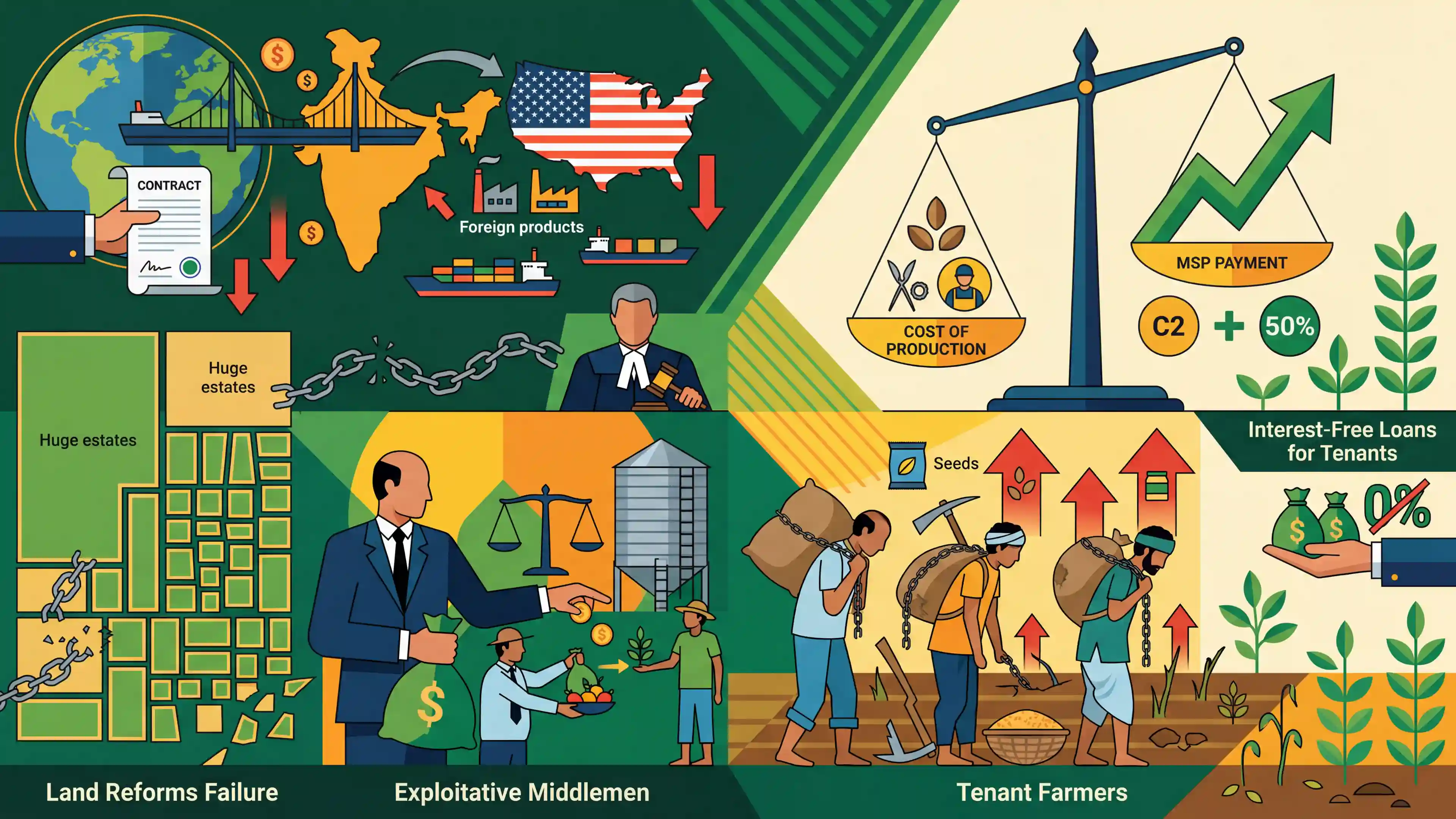
The article links local agricultural distress to macro-level issues like international trade agreements, the structural problem of lacking land reforms for tenant farmers, and the critical ongoing debate surrounding the Swaminathan Commission's MSP recommendations. This is highly relevant for GS Paper 3 topics concerning the economics of agriculture, farm subsidies, and land reforms.
Summary
All India Kisan Sabha (AIKS) president Ashok Dhawale highlighted an ongoing crisis in the agriculture sector, attributing it to flawed policies and India's trade agreements with the United States. Speaking at the Andhra Pradesh Tenant Farmers' Association conference, he argued that these trade deals weaken domestic farming amid rising costs for inputs like fertilizers and seeds. Dhawale also criticized the historical failure of land reforms and the exploitative role of middlemen, which plunge cultivators into debt. Key demands from the conference included interest-free loans for tenant farmers and the implementation of the Swaminathan Commission's recommendation to fix Minimum Support Price (MSP) at 50% above production costs.
Key Points
- AIKS president Ashok Dhawale asserted that trade agreements with the U.S. have weakened domestic agriculture and negatively impacted Indian farmers.
- Farmers and tenant cultivators face a severe crisis due to rising input costs for fertilizers, pesticides, diesel, and seeds, exacerbated by flawed policies.
- The lack of effective land reforms and the unchecked role of middlemen deprive farmers of fair prices, frequently leading to extreme debt traps.
- Demands include providing interest-free bank loans for tenant farmers and implementing the Swaminathan Commission's recommendation to set Minimum Support Price (MSP) at 50% above production costs.
Important Terms
All India Kisan Sabha (AIKS)

A prominent peasant organization founded in 1936 by Swami Sahajanand Saraswati and N.G. Ranga to abolish the Zamindari system and secure farmers' rights.
UPSC context
GS Paper I (Modern History) and GS III (Agriculture); tests knowledge of peasant movements and agrarian pressure groups.
M.S. Swaminathan Commission
The National Commission on Farmers (2004-2006) which recommended making agriculture sustainable and fixing MSP at 50% over the comprehensive cost of production (C2 formula).
UPSC context
GS Paper III (Agriculture); crucial for questions on farm distress, MSP policies, and agricultural sustainability.
Minimum Support Price (MSP)
A form of market intervention by the Government of India to insure agricultural producers against any sharp fall in farm prices, recommended by the CACP.
UPSC context
GS Paper III (Agriculture/Economy); frequently tested regarding food security, farm subsidies, and procurement challenges.
Land Reforms
Institutional measures to redistribute land, secure tenancy rights, and consolidate holdings to improve agricultural productivity and ensure social justice.
UPSC context
GS Paper III (Agriculture); tests understanding of post-independence institutional changes and their socio-economic impact.
Tenant Farmers
Farmers who cultivate land owned by others under lease; they often lack formal records, barring them from institutional credit and government welfare benefits.
UPSC context
GS Paper III (Agriculture/Land Reforms); focuses on informal economy challenges and financial inclusion for actual cultivators.
Prelims Trap
"Schemes like PM-KISAN provide direct income support to all cultivators, including tenant farmers."
PM-KISAN provides income support exclusively to landholding farmer families. Tenant farmers and sharecroppers are currently excluded because the scheme relies on land ownership records.
Static Concepts Connected
What are the three formulas used for calculating crop production costs?
- A2: Covers all direct, out-of-pocket expenses incurred by farmers on seeds, fertilizers, pesticides, hired labor, etc.
- A2+FL: Includes A2 plus the imputed value of unpaid family labor. The government currently bases its MSP announcements on this formula.
- C2: A comprehensive cost that adds the imputed rent on owned land and interest on fixed capital to A2+FL. This is what the Swaminathan Commission recommended.
How does the WTO Agreement on Agriculture categorize domestic subsidies?
- Green Box: Non-trade distorting subsidies (e.g., agricultural research, direct income support decoupled from production). Not subject to reduction commitments.
- Amber Box: Trade-distorting measures like MSP and input subsidies (fertilizers, power). Subject to capping and reduction commitments (de minimis limits).
- Blue Box: Amber Box subsidies with specific conditions designed to limit overall production levels.
Cross-Topic Patterns
Land Titles & Institutional Credit
The exclusion of tenant farmers from formal credit and schemes like PM-KISAN highlights a gap between financial inclusion drives and agrarian reality (unrecorded oral tenancies).
WTO Obligations vs Domestic Food Security
Demands for higher, legally guaranteed MSPs (C2+50%) directly clash with India's WTO limits on Amber Box subsidies, necessitating reliance on the 'Peace Clause'.

Expect a multi-statement question linking MSP calculation (A2+FL vs C2) with WTO Amber Box subsidy limits and the Peace Clause in 2026.
Linked PYQs · 4
Linked PYQs · 4
- 2023MainsGS3
What are the direct and indirect subsidies provided to farm sector in India? Discuss the issues raised by the World Trade Organization (WTO) in relation to agricultural subsidies.
- 2021MainsGS3
How did land reforms in some parts of the country help to improve the socio-economic conditions of marginal and small farmers?
- 2016MainsGS3
Discuss the role of land reforms in agricultural development. Identify the factors that were responsible for the success of land reforms in India.
- 2018MainsGS3
What do you mean by Minimum Support Price (MSP)? How will MSP rescue the farmers from the low income trap?
